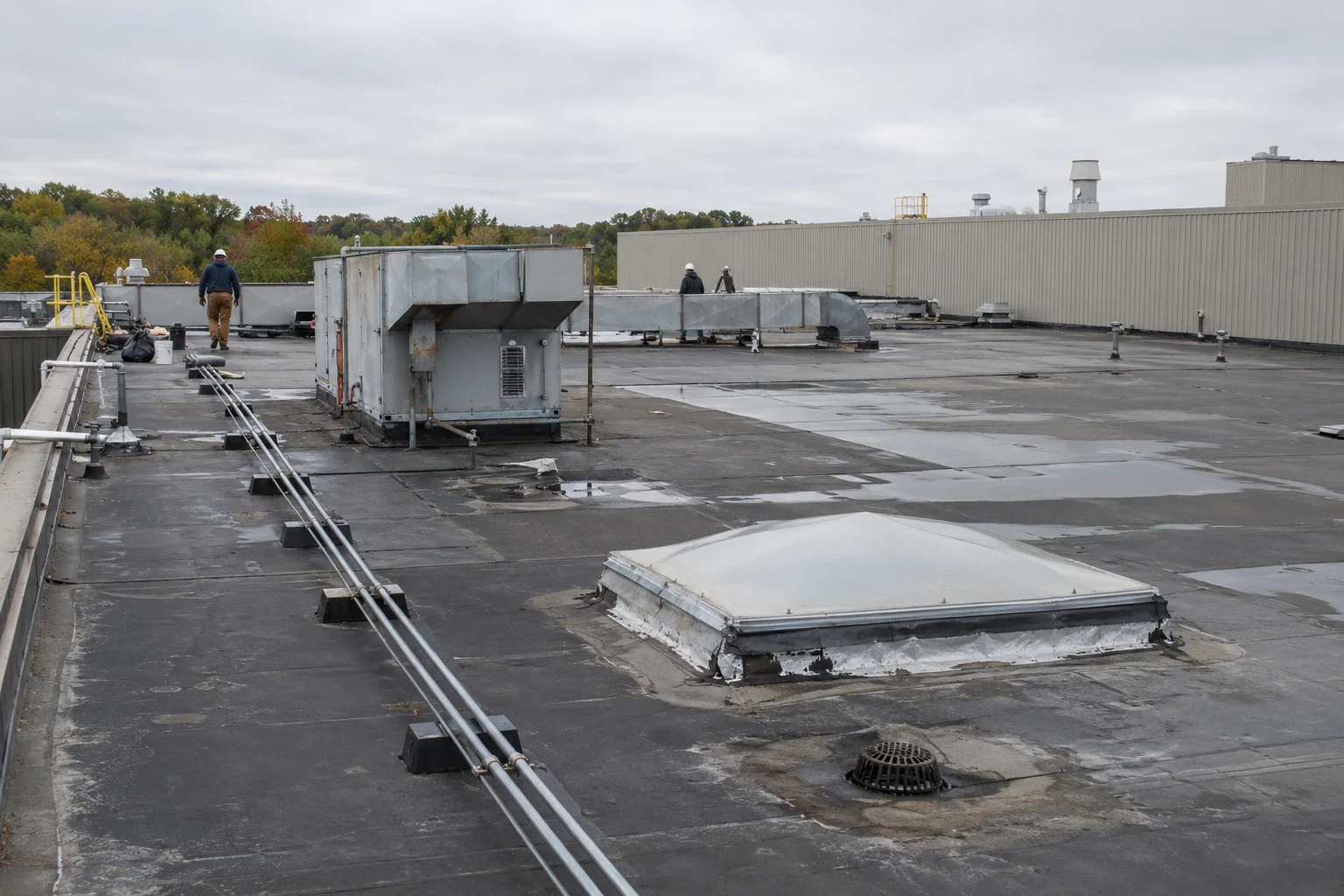
The maintenance planner opens next month's shutdown schedule and finds a roof leak competing with a die change for the same Saturday. The die change has a crew, a crane and a customer waiting. The leak has a bucket, a pan of oily water on the floor and a plant manager asking what it will cost to put a patch on it before the weekend. In South Bend, IN a plant roof is a second production schedule that nobody wrote down, and the work is to get it onto the page before water makes the next decision.
We take a manufacturer's call in the same order every time. Someone asks what is under the leak and what is running, the crew arrives and stops the water where it enters, and the plant manager gets a written plan that fits around the shifts, the shutdowns and the process air. Temporary repairs are made to hold through the next production run, not to look finished. When a plant has more than one building, those plans roll up into a multi-site roof program that matches the company's own maintenance calendar.
Lockout before ladders
Before anyone climbs, the plant tells us what the drip touches. A leak over a welding cell, a paint line, a press or an electrical gallery is handled differently from one over a storage aisle, and the maintenance lead decides what is locked out and what can keep running. Our crew checks in at the gate, takes the plant's own safety briefing, and works from the roof side so production inside can continue where the supervisor allows it. The first task is to clear the drains and scuppers, the second is to trace the opening, and the third is a temporary dry-in that will hold until the shutdown. We send photographs that show where the water entered and which roof area it came from.
Where the process meets the membrane
Roofs over manufacturing take what the plant sends up. A plant that lays up fiberglass, sprays paint on vans or makes roller bearings, the kind of work found in Bremen, runs exhaust stacks, spray booth fans and dust collectors that discharge fumes, oil mist and fine particles close to the membrane. Over years that film softens some sheets, stains others and clogs the drains that carry it away. We sample the residue where we can, check the membrane for swelling or blistering near the exhaust, and compare the roof to the chemistry above it. Where oils or fats land on the roof, a KEE membrane is built to resist them, and the same walk catches the weld and flashing details that a spray of solvent has worked loose.
Shutdown weekends and roof time
Roof work wants dry days and production wants a shutdown, and those seldom line up. A section replacement needs a dry deck, a few days of workable weather and a place to stage materials, so the plant's planned downtime may not be enough by itself. We split large roofs into sections that can be opened and closed in a day, use the shutdown window for the portions that disturb the process most, such as work near exhausts and rooftop units, and run the rest during normal shifts with noise and fume controls. Work at each rooftop unit, from resealing an equipment curb to replacing its flashing, is timed so the roof is watertight again before the line restarts.
Plants that sit far from the shop
Manufacturing in this part of Indiana is spread out. Elkhart has Forest River, Keystone, Thor Motor Coach, NIBCO and Elkhart Brass, Middlebury has four RV makers, Plymouth has Hoosier Racing Tire, Zentis and Pregis, and Warsaw, about 40 miles south, is the Orthopedic Capital of the World with DePuy, Zimmer and Biomet. AM General's Mishawaka manufacturing area has a factory built for Humvee production in 1984 that still assembles them. A company with plants in more than one of those towns needs a contractor that schedules crews by the route, carries materials for the likely repairs on the truck, and does not make the Warsaw plant wait because the crew is committed to Mishawaka.
Equipment weight, wind and snow
Plants add equipment over time, and every addition puts weight and penetrations on a roof that was designed for something else. A new rooftop unit, a conduit run or a platform for a fan may be fastened through the membrane or set on supports that nobody flashed. We check that curbs are properly secured and sealed, supports have pads that protect the sheet, and nothing is draining onto the membrane from above. South Bend's wind record of 92 mph and the 64.5 inches of annual snow also set the load that edge metal, drifts at the taller walls and rooftop supports must bear. The weeks after a plant adds a unit are a good time to look at the whole roof, since the crew is already there.
Roof records that match the maintenance system
A plant that tracks every motor and bearing should track its roof the same way. For each building we produce a roof plan with numbered areas, a log of every leak call and repair, and photographs tied to dates, so a maintenance team can add the roof to its own work-order system. The condition report ranks the roofs by remaining life and by what sits below them, and it feeds a capital request that finance can follow. Manufacturers that lease from a landlord get the same records, and those who share a building with warehouse operations can pass the findings to logistics tenants and to the owners who hold the lease.
Commercial Roofing Questions
A line is running under a leak. Can the repair happen without stopping it?
Often it can, if the crew works from the roof side only and the leak is a seam, a flashing or a drain rather than a failed membrane over the equipment itself. The maintenance lead makes the call after we describe the opening. Where the work would drop debris or fumes into the process, we wait for a break or a shutdown and keep the temporary dry-in on until then.
How should a roof covered in process residue be treated?
We identify the residue before touching the surface, because oil, solvent and fine dust each behave differently with different sheets. Some residue can be cleaned and the roof repaired. Some has softened the membrane, and then a repair over it will not stay bonded. The sampling and cleaning plan goes to the plant's environmental contact before the crew starts.
What kind of shutdown window does a section replacement need?
A section needs a stretch of dry weather, a dry deck and enough hours to tear off, insulate and close it in. We build sections small enough that a day's work ends watertight, so a plant with a single long weekend can still replace the parts near the process while the rest is planned for shifts. Cold weather narrows the window further, as sheets and adhesives have temperature limits.
Should a company with several plants replace all its roofs on one schedule?
No single schedule fits plants of different ages and different process loads. Rank the buildings by the evidence: wet insulation, repeated leak calls, residue damage and the cost of an unplanned shutdown. The worst roof goes first, and sound roofs get maintenance. A written plan lets the company spread the cost over several budget years.
Which membrane suits a roof under cooking or oil mist exhaust?
Look at what lands on the roof before looking at the sheet. Fats and oils attack some membranes, so a plant that exhausts them often chooses KEE or a PVC formulated for grease, with the welds and flashing detailed to match. Installers should hold the manufacturer's data on that chemistry before the order is placed, and a test patch near the exhaust is cheap insurance.
Related Roof Work
Talk to Our Team
Tell us where the water is landing, what the roof is made of and when the building is easiest to reach.
Phone: 555-555-5555
Email: [email protected]