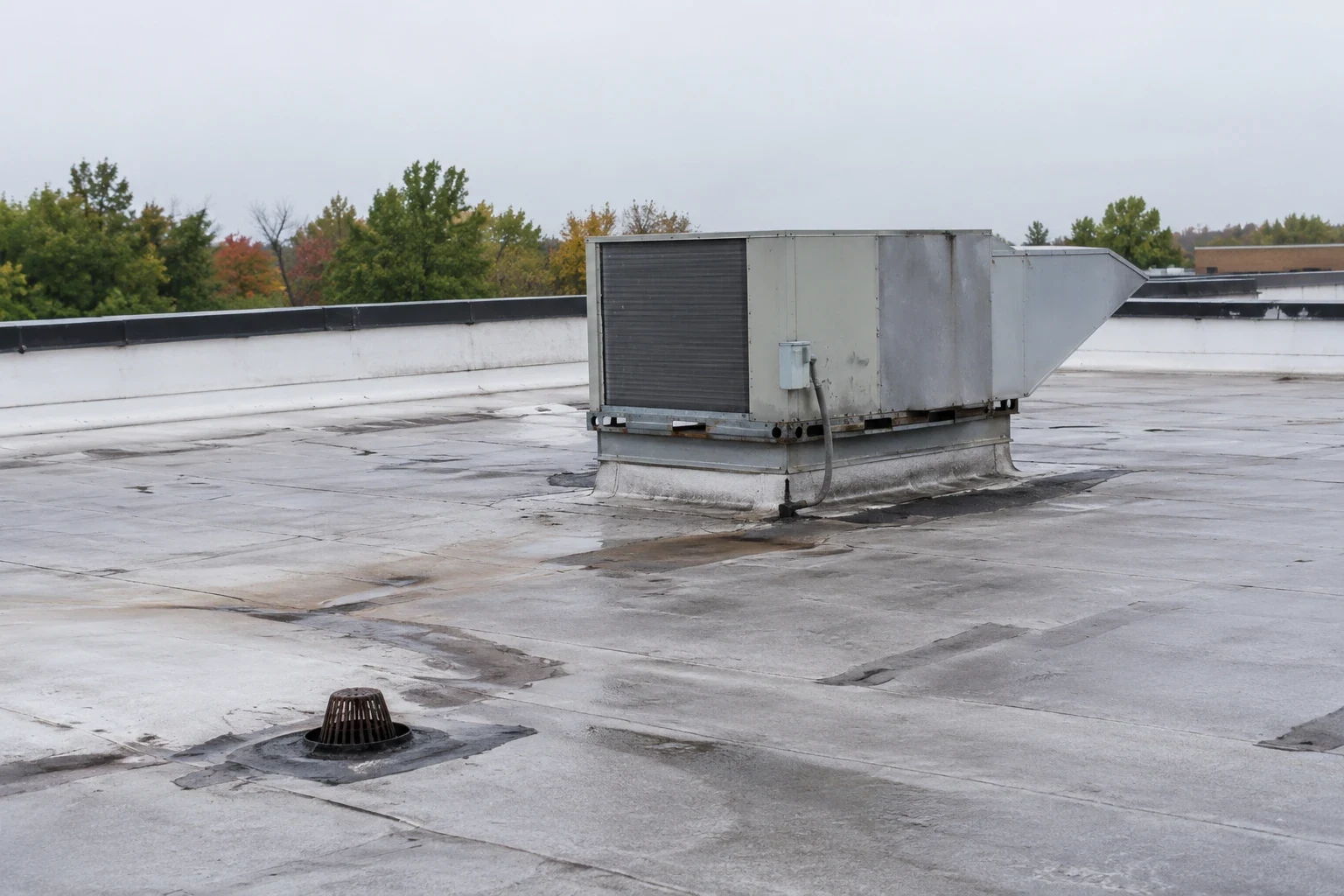
The renewal notice for the maintenance contract lands on a property manager's desk in the same week the first hard freeze appears in the forecast, and the question sitting on that desk is whether the program earned its fee. For a flat roof in South Bend, IN the right answer shows up in what did not happen: the drain that never iced over, the open lap that was resealed in April instead of discovered in January, the tenant who never sent a message about a stain. A preventive program is a calendar of small visits that keeps a roof from needing the large ones. Our visits run season by season, and each one ends with a report in the manager's inbox.
Two visits a year and a standby for storms
The core of any program here is a fall visit and a spring visit, because the weather writes the schedule. Freezing nights usually begin in the third week of October and keep returning until the first days of May, so a membrane spends about half the year cycling through freeze and thaw. We put a crew on the roof before the first freeze and again once the last of the ice is gone. Between those two visits we stay on standby for weather. A storm like the October 2016 microburst that cut a swath from Northside Boulevard to Longfellow Road, or the hail of June 2019, is when an owner wants someone on the roof within days, not at the next scheduled stop. Enrolled buildings go to the front of that line, and the work follows the same steps as storm damage repair after any storm.
What a visit covers on the roof
Every visit starts at the drains. We clear the strainers, the scuppers and any overflow openings, then check that water actually leaves the roof once the debris is gone. From there we walk the field of the membrane looking at seams, fastener lines, patches from earlier repairs and the traffic paths that lead to rooftop equipment, where foot traffic wears a membrane faster than weather does. We look at every wall flashing and termination bar, the sealant around pipes and conduit, the edge metal at the perimeter, and the skylight and penetration flashing, a common place for leaks to begin. Every finding gets a photograph tied to a location on the roof plan, so the next visit can compare the same spot against the last.
The fall visit, before the freeze
The fall visit is about leaving the roof ready to carry water and snow. We clean the drains, resecure loose edge metal, close up any seam that has lifted over the summer, and replace sealant that has cracked after a season of heat and UV. Then we talk about snow. Snow drifts pile heavy against parapets and rooftop units, and a snow contractor with a plow blade or a metal shovel can do more harm to a membrane than January did. We give the manager a short set of instructions for whoever clears the roof: which areas to leave alone, where the drains are so they can be kept open, and who to call if the shovel hits something. A tenant who knows that plan in November is far less surprised in February.
After the thaw
Spring is when we find out what the winter did. Ice that built up at the drains can lift a flashing, a seam that flexed through a run of subzero nights can open along its edge, and a fastener that backed out of the deck leaves a bulge in the membrane. The record low here is -22 F and the record high is 104 F, and while most years stay well inside that range, a membrane still moves every day through spring. We walk the whole roof, mark each opening and repair small defects when conditions and access allow. If the winter forced a temporary dry-in at any point, spring is when the snow and ice damage repair gets finished properly.
What the manager receives afterward
After each visit the property manager gets a photo log, a plain written summary of what was found, and a priority list. The list separates what we fixed during the visit from what should be scheduled soon and what can wait for a larger project. That sorting is why an owner with several buildings, whether a retail center in Mishawaka or a set of plants out toward Elkhart, can keep the reports from year to year and compare them. Over time the logs become a roof condition record that shows which buildings are slipping and which are stable, and that record feeds directly into roof capital planning when the budget meeting comes around.
When a visit finds more than a patch
Small findings get fixed on the spot. Sometimes a pattern shows up instead: a soft spot underfoot, repeated patches in one corner, or a drain that backs up even when it is clear. Those signs point to wet insulation or a slope problem, and a cosmetic repair will not hold. In that case we stop patching and recommend an infrared moisture survey so the owner sees how far the damage goes before choosing between a larger repair, a coating or a replacement. The recommendation comes with photographs and a clear reason, and the decision stays with the owner. A program that hides the real condition of a roof does the owner no good.
Commercial Roofing Questions
Is a maintenance program worth it on a roof that is only a few years old?
A young roof usually benefits more than an old one, because the problems that appear in the first few seasons are cheap to fix and expensive to ignore. A drain that sits half clogged, a flashing that was not fully terminated, or a seam that opened at a rooftop unit will all show up early. Catching them while the membrane is still in good shape also keeps a clean record for any manufacturer warranty claim later, since most warranties expect the owner to look after the roof.
Does a manufacturer warranty replace a maintenance program?
No, and in practice they work together. A warranty covers defects in the material and installation under its own terms, and it usually excludes damage from neglected drains, foot traffic or unrepaired punctures. Our visits keep those exclusions from coming into play. We recommend the owner keep every photo log in the same folder as the warranty paperwork, so that a claim years later has dated proof that the roof was inspected and kept clear.
Who clears the snow, you or our snow contractor?
Your snow contractor handles the parking lot, and we handle the roof only when there is a real reason to, such as a drift loading a section near a parapet or a blocked drain that is already causing a leak. For routine clearing we write instructions for the contractor and mark the drains and equipment curbs on a roof plan. If a contractor cuts the membrane, keep people away from the opening and call us promptly. We can assess the damage, protect the area as conditions allow and plan a permanent repair before routine roof work resumes.
How do we budget for the repairs that each visit turns up?
Treat the priority list as a rolling forecast. Items marked for immediate action are small, and we fix most of them during the visit. Items marked for the next season go into the operating budget, and anything that points toward a coating or a replacement goes into the capital plan with a rough time window. After two or three visits the pattern is usually predictable enough that the manager can tell ownership what to expect a year ahead, without waiting for a leak to force the conversation.
What happens if a storm hits between scheduled visits?
Call and describe the building and visible conditions. A post-storm inspection documents the membrane, edge metal, rooftop equipment and any opening. We assess temporary protection based on roof access and weather, then add the findings and work performed to the same log as scheduled visits. That record helps the insurer, owner and crew work from one account when a claim follows.
Related Roof Work
Talk to Our Team
Tell us where the water is landing, what the roof is made of and when the building is easiest to reach.
Phone: 555-555-5555
Email: [email protected]