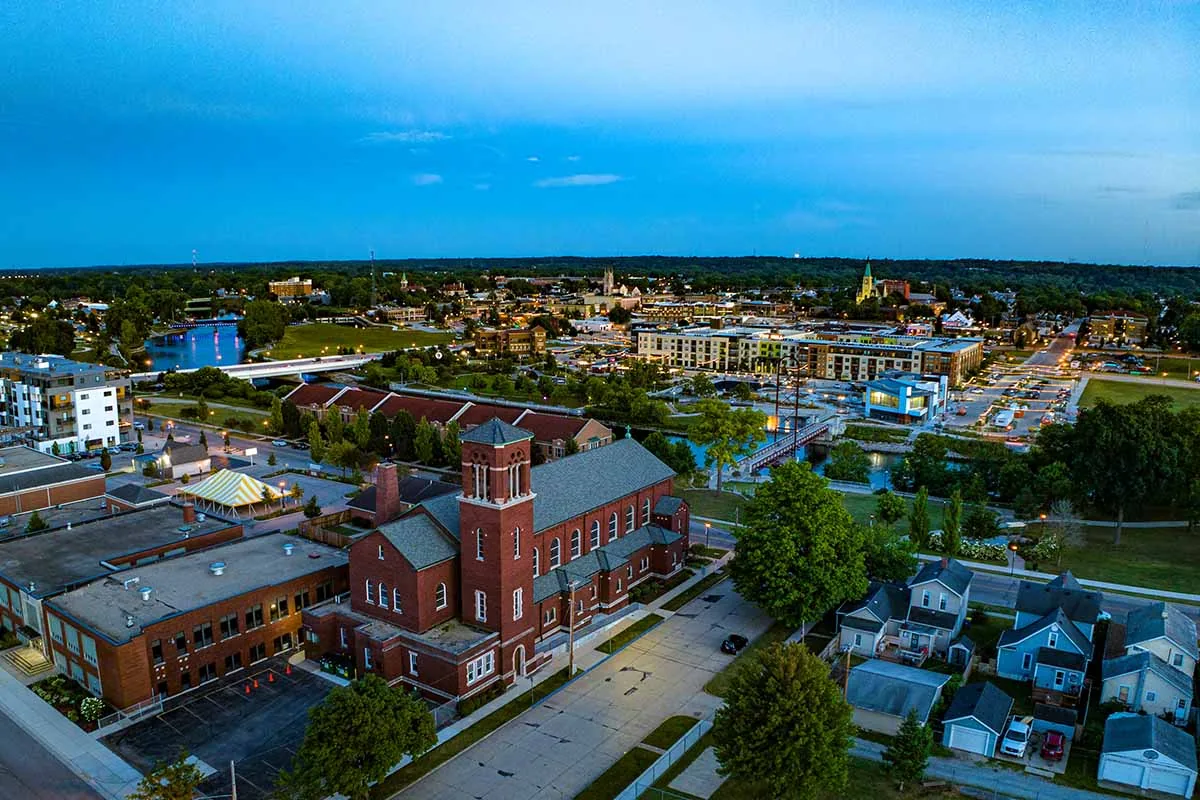
The on-call phone rings a little after dark. Wind and rain have been working on a building in Mishawaka, IN since mid-afternoon, and the person calling has just found water on a floor that was dry at lunch. They are rarely asking for a roofing lecture. They want to know whether someone can get on the roof tonight, what will be done first, and what they should tell the people who work or shop inside. We answer in that order: we find where the water is entering, stop it from reaching the interior, and write down what we saw. The buildings here run from a mall and retail centers to plants, clinics and county offices, and each wants the same calm sequence applied to a different roof.
Retail, small industry and a manufacturing past
Mishawaka had 51,063 residents in 2020 across 18.25 square miles, and the local economy has shifted from heavy manufacturing to retail, services and small industry. For a roof, that shift matters in a specific way: a building that was designed for one use is often asked to carry another, with different rooftop equipment, different hours and a different tolerance for water. When a new tenant moves in, we like to know what was added to the roof for the last one, what was removed and what was left behind. Abandoned curbs, capped pipes and old patches turn up on older buildings, and each is a place where a membrane has been cut and later closed by someone who may not have recorded how.
Routes where the buildings cluster
US 20 and State Roads 23, 331 and 933 form the commercial spine of town, Interstate 80/90 runs along its north side, and Toll Road exit 83 ties SR 331 and SR 23 to Mishawaka and nearby Granger. Those corridors are where the businesses are, so access matters on the day: a storefront roof sits above a customer entrance, a plant roof sits above loading doors and truck traffic, and a clinic roof sits above a patient drop-off. Before anyone climbs, we walk the ground under the work and decide where the barricade, the ladder and the debris chute can go without blocking a door.
The mall and the strip around it
University Park Mall, an enclosed 918,559 square foot center opened in 1979, is a major retail destination in the Grape Road corridor. The opening date says when the building began, not what is on top of it today, so the roof is read from the roof itself. A mall roof shares the pattern of shopping centers generally: leaks that track along a wall between suites, flashing around dozens of rooftop units, drains that serve more than one tenant. On shopping center roofs the first tool is a leak map drawn across the suites, and the Grape Road corridor is the kind of multi-suite setting where that map earns its keep.
What a collapse on April 1, 2016 means for owners
On April 1, 2016 part of the roof came down at the St. Joseph County Services Building, after a stretch of high winds and rain, and the top floor flooded. What failed is a question for engineers. The useful part for any owner is the sequence we check on a first walk: how the roof drains, whether water can pond when a drain is blocked, how the deck and framing look from below, and whether a heavy rain has anywhere to go if the primary drains are overwhelmed. A flat roof carries water as a load, and an overflow path is the difference between a wet day and a bad one. Public buildings in particular benefit from a written record, because a government building roof answers to a board as well as to occupants.
Snow, hail and a tornado track
The November 2022 lake-effect storm left 20.7 inches of snow in Mishawaka, part of a month that set a South Bend record for its opening twenty days. Snow like that settles into drifts against walls and rooftop units and turns to ice at the drains after the first thaw. Hail reached Mishawaka on June 1, 2019, at 0.7 inch, small enough that damage may not show from the lot, yet worth a walk and a photo log on a worn membrane. An F2 tornado on October 24, 2001 tracked through the stretch between Mishawaka and Osceola, and South Shore Avenue took the worst of it. After any of these, storm damage roof repair comes first, and in the worst cases the job becomes tornado damage roof repair, with tarps, debris removal and a look at the structure before any membrane goes back.
A plant floor and a clinic corridor
AM General runs a large plant in Mishawaka that has built the Hummer since 1990 and, from 2015, vehicles for Mercedes. A working plant adds exhaust, heat and vibration to the questions a roof normally faces, and a roof at the South Bend-Mishawaka industrial area is planned around who can be on it and when. Also in Mishawaka, the VA clinic at Mishawaka is an 88,109 square foot single-story building, and a clinic roof leaves little margin for dust or fumes drifting into patient areas; the Mishawaka puts patients under every schedule. On a flat roof at either site, the first question is where water stands after a rain, and ponding water roof repair starts from the answer.
Commercial Roofing Questions
A tenant moved out and left rooftop equipment behind. Who deals with it?
Start with the lease, because it usually names who owns abandoned equipment, but the roof does not wait for that answer. We walk the roof, photograph the unit, its curb and every line that runs through the membrane, and tell the owner whether the penetrations are sealed or open. If the equipment is coming out, we cap and flash the openings properly so a hole does not become the next tenant's leak. The photo log goes to whoever holds the lease so the question of cost can be settled on evidence.
What do you look at on a roof over a building that opened in 1979?
Age tells you when the building started, so we look at what is actually overhead: how many layers there are, whether insulation under them is wet, and where past repairs cluster. A short moisture survey and a few core samples usually separate a roof that can be repaired for several more seasons from one where patching is spending money twice. We give the owner that judgment in writing with photographs, then lay out repair, recovery and replacement side by side so the choice rests on the roof in front of us.
Hail was small last time. Do we still need someone on the roof?
Small stones leave quiet damage, so a walk is worth the morning. Hail of 0.7 inch, like the June 2019 stones reported in Mishawaka, can bruise brittle membrane and knock granules off a mineral surface without leaving a visible hole. We photograph any marks, check seams and flashings, and tell you plainly if nothing is found, which is useful to have on file if an insurer later asks whether damage was reported promptly.
What should we tell tenants when the roof is being worked on after a storm?
Tell them which suites sit under the work, which entrance is closed, and when you expect the next update. We can supply a short written notice with those details and a phone number for questions during the day. Tenants are usually less upset by the repair than by silence, and a clear notice also gives the property manager a record that each suite was informed.
Related Roof Work
- Shopping Center Roofing
- Grape Road in Mishawaka
- Government Building Roofing
- Storm Damage Roof Repair
- Tornado Damage Roof Repair
- South Bend and Mishawaka Industrial Area
- Mishawaka
- Ponding Water Roof Repair
Talk to Our Team
Tell us where the water is landing, what the roof is made of and when the building is easiest to reach.
Phone: 555-555-5555
Email: [email protected]