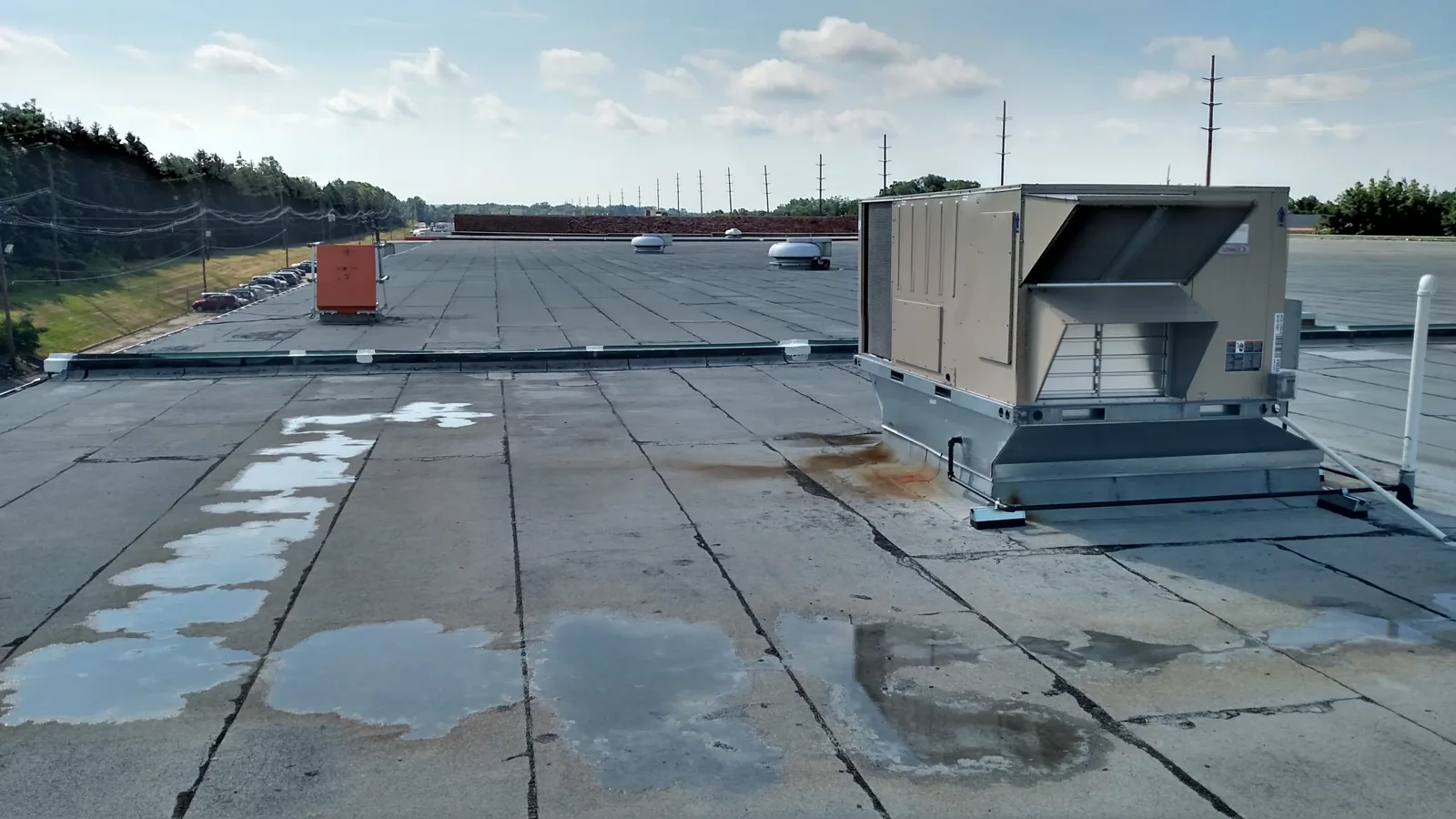
The maintenance tech sends a photo on a dry Tuesday. There is no water in it, only a pale ring of dirt on the membrane around a low spot the size of a delivery van, in the same place the ring appeared last spring. That ring is how ponding shows itself once the sun has done its work, and it is the reason we ask for pictures taken after the rain rather than during it. Ponding water roof repair in South Bend, IN has less to do with the puddle than with what put it there and what it has been doing to the sheet, the seams and the insulation beneath while nobody was looking.
Reading the ring after the rain
On site we walk the roof the day after a rain and again when it is dry, because the two visits tell different stories. The wet visit shows where water is still standing and how deep. The dry visit shows tide lines, algae, grit and debris that mark the true edge of every pool, including the ones that evaporate before anyone is there to see them. We measure depth at the center of each, photograph it with a straightedge laid across the top, and sketch the roof with the pools drawn in place. Then we look at what surrounds them: drain locations, deck lines, the position of rooftop equipment, and any sag along the joists or purlins that is visible from below. A pool beside a drain points to a different cause than a pool in the middle of a bay, and the repair follows the cause.
Drains first, then the deck
The least costly cause to correct is a drain that is not draining. Leaf litter, windblown plastic, gravel from an old ballast layer and ice left from the last freeze all slow a bowl or close a scupper, so we clear and flush each outlet and time how fast the water leaves. If the drain runs freely and the pool stays, the surface is lower than the outlet, and that points to the structure. Steel deck deflects between supports under snow load and under equipment added over the years, and the sag can be shallow enough that nobody sees it until water collects. Where a drain sump sits higher than the membrane around it, we reset the drain with the same methods used in our drain and scupper work, and we check the flashing at the bowl while it is open.
What a pool does between October and May
Standing water becomes more than a drainage problem once the first freeze arrives, which averages October 18 in South Bend and does not finish until about May 1. A pool that freezes at night and thaws by afternoon works every seam and flashing beneath it, lifting the sheet slightly as ice forms and letting it settle as the ice melts. Over a winter that movement opens laps that held all summer. Rain or snow is measured on roughly 148 days of every year here, so a low spot refills again and again, and a roof that never fully dries collects algae and grit that make the surface slick for anyone who walks it. Ice also closes the bowl at the lowest point, which turns a pool into a larger pool. When the laps do open, the repair turns to seam failure work as well.
Adding slope without a tear-off
Once the cause is known, the options sort themselves. A clogged or undersized drain is corrected at the drain, sometimes by adding a second outlet at the low spot. A shallow sag can be built out with a cricket or tapered board cut to push water toward the outlet, and tapered insulation and cover board are how slope is added when the deck itself cannot be changed. Where the sheet is sound and the only trouble is water that will not leave, a coating formulated to sit under it may be the answer, and silicone coatings are the usual choice for that reason. Where the membrane and insulation are both failing beneath the pool, replacing that section with corrected slope is cleaner than coating over wet material.
The wet insulation under the pool
The pool is the visible half of the problem. The hidden half is whatever has soaked into the insulation below it, where water adds weight, cuts the thermal value of the board and keeps the underside of the sheet damp long after the surface is dry. We confirm it with an infrared moisture survey, then take small core cuts at the edges of the warm and cool patterns to see what the board actually holds. Wet board is cut out rather than sealed in, because a repair over damp insulation fails from the inside. If the ceiling below has stained, we document the affected bay, the visit and the planned work sequence, so people below understand why the crew is on the roof and what comes next.
Rain and melt this market has already handled
The heaviest 24-hour rain on the South Bend record came to 4.88 inches over August 2 and 3, 1995, and a roof that holds water on an ordinary day has little margin on a day like that. The lake-effect storm of November 2022 buried the airport under 22.7 inches and Mishawaka under 20.7, and the month's first twenty days added up to 30.2 inches, leaving flat roofs a great deal of weight to melt through whatever drains were open. After a prolonged event, we compare drift pockets around rooftop equipment with the drain map, then record whether meltwater has an open path off the roof. On industrial roofs near the airport business park, the practical check is whether snowmelt can reach an open drain from each low area. The same post-storm walk applies to warehouse roofs anywhere in the county. Where ponding meets a wall termination, a flashing failure repair closes the entry point as well as correcting the drainage path.
Commercial Roofing Questions
How long can water stand on a flat roof before it counts as a problem?
A pool that is gone within a day or two of the rain is ordinary on many flat roofs. One that is still there after two or three dry days, or that returns to the same spot after every storm, is telling you the roof is holding it. At that point the surface, the slope and the drains deserve a measured look.
Our roof is only a few years old and already ponding. Is that the roofer or the building?
It can be either, and measuring is the way to find out. We compare the pool locations against the drawings, the drain heights and the deck below, because a pool at a drain suggests installation while a pool mid-bay suggests deflection in the structure. The written findings state what we saw and where, which gives the owner a factual record to take to whoever carries the responsibility.
Would one more drain cost less than re-sloping the roof?
Where a single bay holds the water, a new outlet with a short run of tapered board is often the quicker route. Where several bays hold water, or the deck sags across a wide area, added drains tend to multiply while the problem remains, and a tapered system laid across the whole zone becomes the better value. A moisture scan and a roof sketch let us price both fairly.
Is a coating enough, or does ponding mean the roof has to come off?
Coating works when the membrane is sound and the insulation under it is dry. A scan and a few cores will tell us which condition applies. If both are good, a ponding-tolerant coating over cleaned and repaired seams can extend the roof. If the board is wet, the coating only hides a failure that keeps growing underneath.
What should we tell tenants below a bay that keeps holding water?
We can supply wording for a tenant notice and a photo log. If a ceiling has stained, the record identifies the affected bay and the planned work sequence, so people below understand what is happening overhead.
Related Roof Work
- Roof Drains, Scuppers and Ponding Correction
- Seam Failure Repair
- Roof Insulation, Tapered Systems and Cover Board
- Silicone Roof Coatings
- Infrared Roof Moisture Surveys
- South Bend Airport Industrial Park
- Warehouse Roofing
- Flashing Failure Repair
Talk to Our Team
Tell us where the water is landing, what the roof is made of and when the building is easiest to reach.
Phone: 555-555-5555
Email: [email protected]