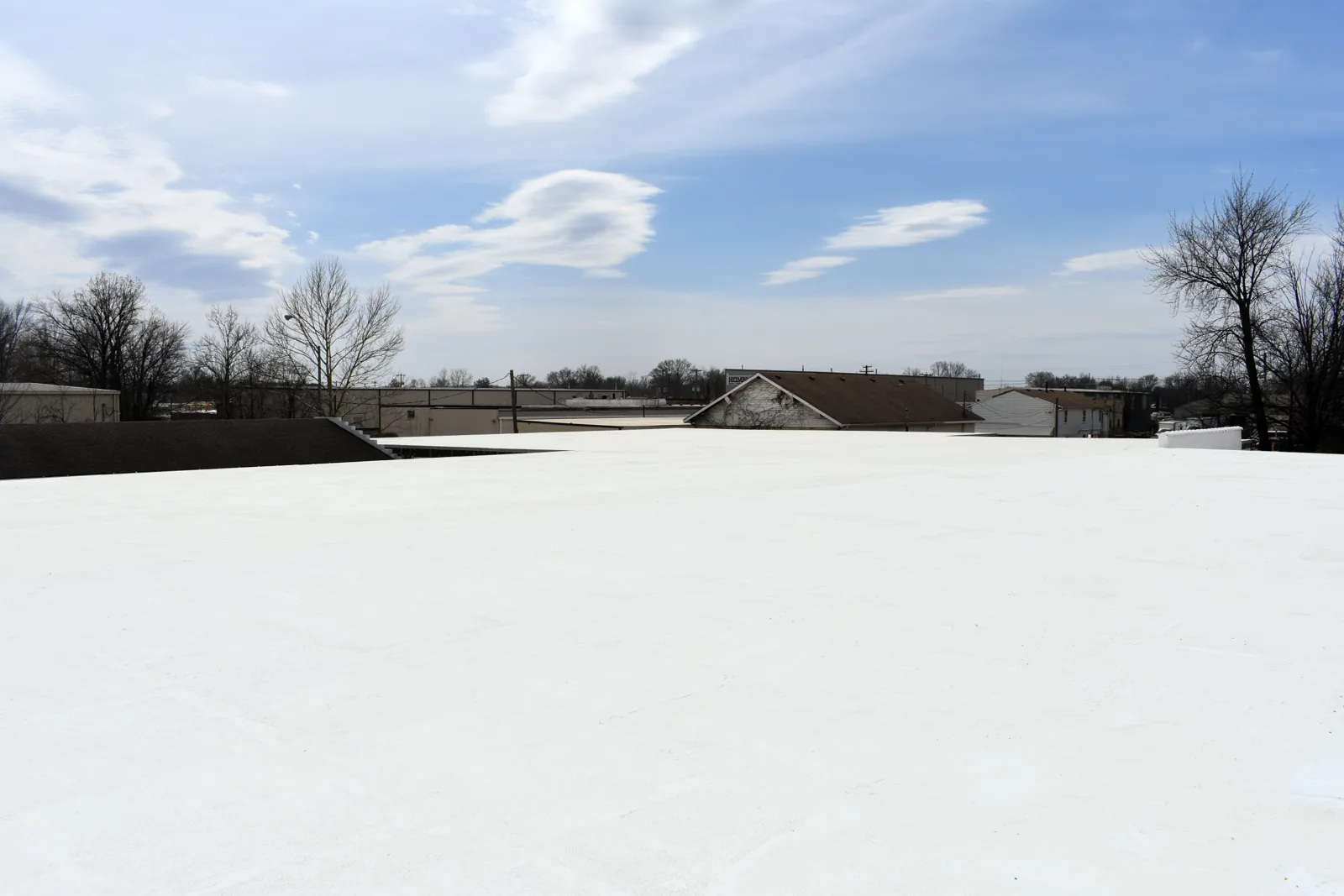
Two days after the last storm, a property manager climbs the stair to the roof hatch and finds a shallow pool still sitting beside the drain. It has not leaked yet. The membrane around it is weathered and thin, though, and the pool has been returning after every heavy rain since the previous summer. That is the roof silicone was made for. A silicone coating cures into a flexible, waterproof skin that shrugs off standing water, and it can give a sound South Bend, IN roof several more seasons without a tear-off. The coating only works on a roof that is dry underneath, so our walk-through begins with questions about what the old membrane is actually holding.
Standing water is the reason to choose it
Most coatings soften or break down when a roof stays wet for days. Silicone does not, which is why it is the usual answer for a flat roof with low spots near the drains or between curbs. South Bend sees measurable precipitation on roughly 148 days a year, and a roof that drains slowly spends a lot of those days wearing a puddle. The 4.88 inches that fell in 24 hours in August 1995 set the record, and a roof that already holds water has the least margin on a day like that. Silicone covers the shallow pool without blistering, but it does not fix the reason the pool formed. If a sagging deck or a clogged drain line is behind the water, we sort that out first, because the coating can only protect a roof, not rebuild its slope.
What it will and will not stick to
Silicone bonds well to many surfaces, but each one calls for its own preparation. Over an aging built-up roof or an EPDM sheet, a cleaned surface and the right primer usually give a good bond. Over modified bitumen, asphalt can bleed up through the coating and leave brown staining unless a barrier coat goes down first. Over metal, we treat rust, seal fasteners and seams, and let the manufacturer's instructions set the primer. Silicone over PVC or a heat-welded TPO sheet needs a compatibility check before anyone orders material. We run adhesion test patches on the real roof, wait for the cure, and pull them. A patch that peels sends us back to the primer or the product before the whole roof is committed.
Cleaning and repair come before the first coat
A coating bonds to the membrane, not to the dirt sitting on it. The crew washes the roof until chalk, mildew and loose granules are gone, then repairs what would let water in: open seams, cracked sealant, backed-out fasteners and failing flashings at walls and penetrations. Where a corner of the roof shows repeated trouble, flashing repair gets done before the coating, since silicone cannot bridge a joint that keeps moving. Before any liquid goes on, an infrared moisture survey and core cuts confirm the insulation is dry. Wet board comes out, and the repair is photographed for the file. This stage takes longer than the spraying and decides how the coating behaves in its fifth winter.
Dirt, slick surface and one-way adhesion
Silicone has three habits owners should hear about before they sign. It attracts dirt and pollen faster than some coatings, so a bright white roof gets dingy and needs an occasional wash to keep its reflectivity. It is slippery when wet, which matters around hatches, ladders and equipment that service techs reach in all weather, so we add walk-pad paths to those routes. And once silicone is on, almost nothing else bonds to it. A later patch, a different coating or a new membrane has to deal with that, and some future repairs call for silicone products or a thorough removal. We explain this at the start so the decision is made with the next owner in mind.
Cold, damp and the coating window
Silicone cures by drawing moisture from the air, so it tolerates humid conditions better than coatings that dry by evaporation. The surface still has to be dry when it goes on, and rain or dew inside the first hours can spoil a pass. The market gives us a narrow season. The average last freeze comes near May 1 and the first fall freeze near October 18, with cool, damp mornings between them. Once cured, silicone stays flexible through the swing between the -22 F low and the 104 F high on South Bend's record books, a wide range for any coating to live through. An owner who plans in winter can aim for the first dry week of May, while a request made in August may have to wait for spring.
Roofs that call for it
Wide, low-slope roofs with plenty of equipment curbs and little fall are where silicone earns its place. For an industrial tenant near the South Bend Airport Business Park or at the Indiana Enterprise Center in New Carlisle who cannot close for a tear-off, a coating limits the disruption to dry days and a few tenant notices. Retail owners around Grape Road corridor care about the same thing, since stores stay open and delivery doors stay busy. Reflective white silicone also lowers the heat load, the same logic behind cool roof installation, though in a market with long winters that gain has to be weighed plainly.
What the owner keeps afterward
When the work is done, the manager receives photographs from before cleaning, after repair and after coating, with notes on the product, the quantity applied and the extra material at seams and penetrations. A follow-up visit after the first thaw checks the drains and the coated seams once the roof has been through a freeze cycle. Silicone does not wear away as fast as some coatings, but dirt, foot traffic and ice at the drains still leave marks, and a spring and fall coating restoration check catches small cuts early. A building changing hands can pass the entire file to the buyer.
Commercial Roofing Questions
Our roof ponds near two drains. Is silicone enough on its own?
It will protect the membrane from the water, but it will not remove the pool. If the ponding comes from a deck that sags or drain bodies set high, the pool will keep forming and the dirt it holds will cling to the coating. We often add tapered insulation or lower the drain sumps first, then coat. Where the pool is shallow and drains within a day or two, silicone alone is a fair answer.
Why would silicone stain a modified bitumen roof?
Modified bitumen carries asphalt, and asphalt oils migrate upward into any thin light-colored coating. The result is a brown or yellow cast that spreads through the white. A barrier or tie coat laid over the membrane blocks that bleed, and a test patch left for a few weeks shows us whether it is working before the whole roof is committed.
Can another contractor recoat silicone later with acrylic?
Generally no, because acrylic does not bond well to cured silicone. A recoat has to be silicone, or the old coating has to be removed, which is slow work. That one-way behavior is why we ask owners about their five and ten year plans before choosing it. If a replacement is likely within a few years, acrylic or another route may be easier to live with.
How slippery is a silicone roof when it rains or frosts?
Quite slippery, enough that we plan around it. Walkways to hatches and rooftop units get walk pads or a granule-embedded path, and we mark the routes for service technicians. Frost on a cold morning in November makes the same surface worse, so building staff should keep to the marked paths and leave snow removal to people trained for roof work.
How do you know the insulation is dry before coating over it?
We scan the roof at dusk with an infrared camera, mark the warm and cool areas, and cut cores at the doubtful spots. Wet insulation looks dark and feels spongy in the hand. If the board is firm and dry, the coating can proceed. If it is wet across a large area, we talk about foam or replacement instead.
Related Roof Work
- Modified Bitumen Roofing
- Flashing Failure Repair
- Infrared Roof Moisture Surveys
- South Bend Airport Industrial Park
- Grape Road in Mishawaka
- Cool Roof Installation
- Roof Coating and Restoration
- Acrylic Roof Coatings
- Spray Polyurethane Foam Roofing
Talk to Our Team
Tell us where the water is landing, what the roof is made of and when the building is easiest to reach.
Phone: 555-555-5555
Email: [email protected]