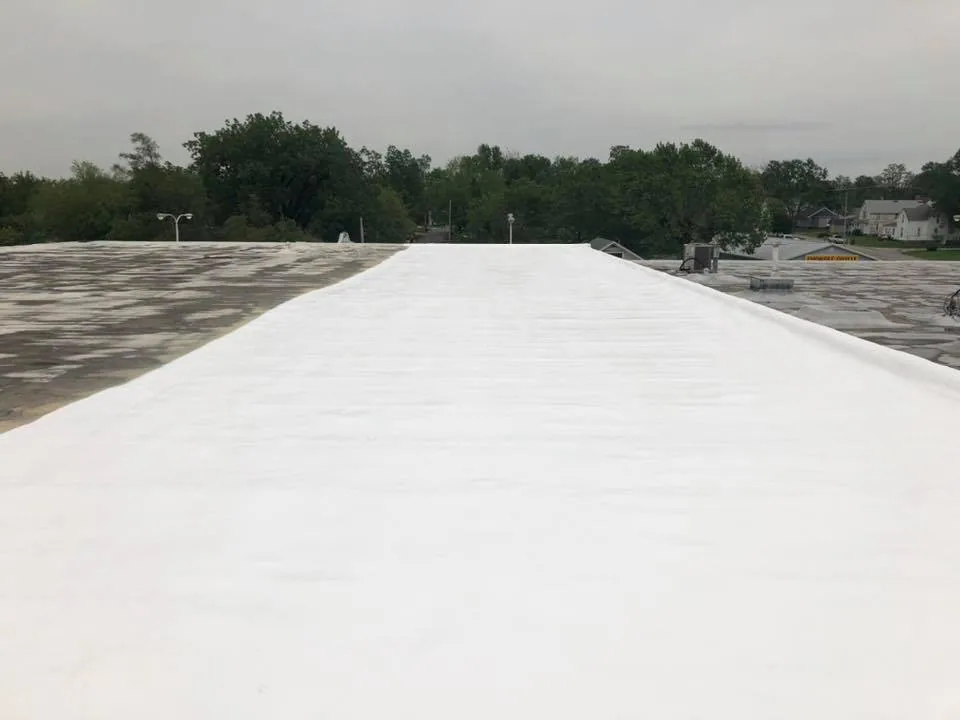
A facility manager steps onto a flat roof in the first dry week of April and feels the surface give underfoot near a drain. The membrane looks fine from the ladder, but the insulation under it has been holding meltwater, and the drift that sat against the rooftop units all February left stained seams behind it. That walk is usually where the question about foam begins. Spray polyurethane foam can turn a tired low-slope roof in South Bend, IN into one continuous, insulating, sloped surface, but only when the roof underneath is dry. Our first job is to find out whether yours is, and the answer decides everything after it.
Foam is sprayed, not rolled
Two liquid components meet at the spray gun, react within seconds, and swell into a rigid, closed-cell foam that bonds directly to the clean surface beneath it. There are no sheets to lap and no seams to fail, so water finds none of the weak joints that a membrane roof gives it. The foam also insulates, which is why owners with cold top-floor suites look at it twice. It goes on in thin lifts, each curing before the next, until the roof reaches the design thickness. Cured foam is not a finished roof, though. It is a base that needs a protective coating over it, and the two layers are always priced and scheduled together.
Dry substrate or no foam
Foam has no way to let trapped moisture out. If it is sprayed over wet insulation, the water stays in the old roof and the new assembly rides on top of it. So the sequence starts with an infrared moisture survey, usually flown or walked at dusk when the roof gives back the heat it stored all day, followed by core cuts at the places the scan marks. Wet pockets are cut out and replaced. Loose gravel, blisters and failed flashings come off. The surface is then cleaned and primed. A roof wet across its whole field is a different conversation, and the cores in the photo log show why.
Slope that lives in the foam
Because foam goes on as a liquid and rises, the crew can vary its depth from one part of the roof to another. That lets us build a gentle fall toward the drains on a roof that has been holding water in the same low spots for years. It matters here. Measurable precipitation falls in South Bend on roughly 148 days of a year, and a single August 1995 storm dropped 4.88 inches in 24 hours, the most on record, a load drains and scuppers must be able to pass. We mark the low points before spraying and check the result with a level after the foam cures. On a roof whose main complaint is standing water, ponding water repair may call for more than foam, such as an added drain or a reworked drainage path.
The coating is the working surface
Sunlight breaks down bare foam in a matter of weeks, so a coating goes over it as soon as the foam is ready. Most owners choose between silicone coatings, which handle standing water well, and acrylic coatings, which reflect heat and suit roofs that drain cleanly. The coat also carries the hail question. Foam is firm but not hard, and a stone can dent it. South Bend saw 1 inch hail on June 1, 2019, and 1.25 inch stones fell near Crumstown the same day. A coating of proper thickness takes that kind of hit far better than a thin one, and a post-storm walk catches any bruise before water works into it.
Snow removal is the other threat, since shovel blades and ice picks cut coatings. We mark walkways and tell the building staff which areas to clear by hand.
What a spray day looks like
Foam is picky about weather. It wants a dry surface, mild air and little wind, because overspray drifts and cold substrates make poor bonds. That narrows the season to late spring through early autumn, since the average last freeze falls near May 1 and the first fall freeze near October 18. On the morning of the work we cover rooftop air intakes, mask skylights and rooftop units, and shield vehicles and walls below. A fire watch stays up there while the crew sprays. A tenant notice goes out ahead of time naming the spray days and the odor that can linger while the foam cures. At a large Mishawaka manufacturing site like the Mishawaka manufacturing area, parking areas and delivery routes need their own plan before the first truck arrives.
Where foam fits and where it does not
Foam suits sound built-up roofs, older modified bitumen, and metal roofs where the seams are the problem, as long as the deck and insulation pass inspection. It is a poor match for a roof with widespread wet insulation, a roof that sees heavy daily traffic, or a building where ponding comes from a deck that sags. Foam added over an existing roof also raises the surface, so edges, curbs and flashings have to be raised with it, as they are on any roof recover. The commercial code in force is the 2014 Indiana Building Code, built on the 2012 International Building Code, and a rule to adopt the 2024 model code is pending with no effective date. We confirm the current position with the building department before the proposal is signed.
After the last pass
When the coating cures, the property manager gets a photo log from every stage: the cores, the repairs, the foam at several points across the roof, the finished coat. Thickness readings and the product used go on file with it. A follow-up visit after the thaw checks the drains and the coated surface once the roof has gone through a full freeze cycle. Because coatings wear before foam does, the long-term plan is a recoat on a schedule rather than a replacement, and a preventive maintenance program keeps that schedule honest. Tire Rack, based in South Bend, operated ten warehouses across nine states in 2017, adding to the region's distribution building stock, and an owner of any warehouse can hand that record to the next tenant or buyer.
Commercial Roofing Questions
Can foam go over a roof that leaked all winter?
Only after we find out where the water went. A leak that stayed in the membrane is a repair, while water that reached the insulation has to be cut out before anything is sprayed. We scan the roof, cut cores at the flagged spots, and replace wet board. If the wet area covers most of the field, foam is the wrong choice and we explain what to do instead, with the photographs next to the explanation.
How does foam handle drifted snow against a parapet?
Cured closed-cell foam resists compression well, so a drift load does not crush it. The weak point is the coating and the seam where foam meets the wall flashing, because meltwater and ice work at that joint all season. We build the flashing up tall at the parapet and inspect that edge first on every spring visit, once the snow has gone.
Will the smell bother the tenants downstairs?
Fresh foam and fresh coating both carry an odor for a short stretch, which is why the tenant notice goes out before the first spray day. Air intakes on rooftop units get covered or shut off with the facility team's agreement, and a medical or food tenant may need the work moved to a different day.
What happens if a hailstone dents the foam?
A dent that leaves the coating intact is usually cosmetic, but a cracked coating can let water into the foam. Keep foot traffic off the spot and have the coating checked; a small break needs compatible repair after the area is dry. The photo log can support an insurer review if a claim is needed.
Is foam a good fit for an older built-up roof on a masonry building?
Often it is, provided the old roof is dry and the deck is sound. The foam bonds to the existing surface, adds insulation and avoids a tear-off, which keeps debris and noise down for the tenants. Masonry parapets still need flashing and coping reworked to match the new height.
Related Roof Work
- Infrared Roof Moisture Surveys
- Ponding Water Roof Repair
- Silicone Roof Coatings
- Acrylic Roof Coatings
- South Bend and Mishawaka Industrial Area
- Roof Recover and Overlay
- Preventive Roof Maintenance
- Warehouse Roofing
Talk to Our Team
Tell us where the water is landing, what the roof is made of and when the building is easiest to reach.
Phone: 555-555-5555
Email: [email protected]