Second shift is half over when a line operator notices water running down a column beside the weld cell, and the maintenance lead has to decide in a few minutes whether to lock out the equipment. Nobody on the floor can see the roof, and the water has already traveled along a purlin or a duct before it reached the column. That is how a plant roof leak usually announces itself in South Bend, IN: far from the opening, close to something expensive. What we do first is the same each time. We learn what runs below, put a person on the roof to find the opening, and set a temporary dry-in so production can pick up again.
Water near live equipment
We ask the maintenance lead four questions on the phone: which cell or line is under the drip, whether it can be powered down, where the nearest electrical panel sits, and whether anything on the floor is flammable or chemical. Those answers set the order. While the plant team covers machines and moves product, our crew walks the roof along the same column line, since water on a metal deck runs along the flutes and purlins before it falls. We clear drains first, then check the base of exhaust fans, curbs and pipe boots, and we photograph the wet decking from below so the photo log shows both sides of the roof. Temporary protection for the opening is planned as part of the visit, based on access and conditions.
Stacks, fans and the film they leave
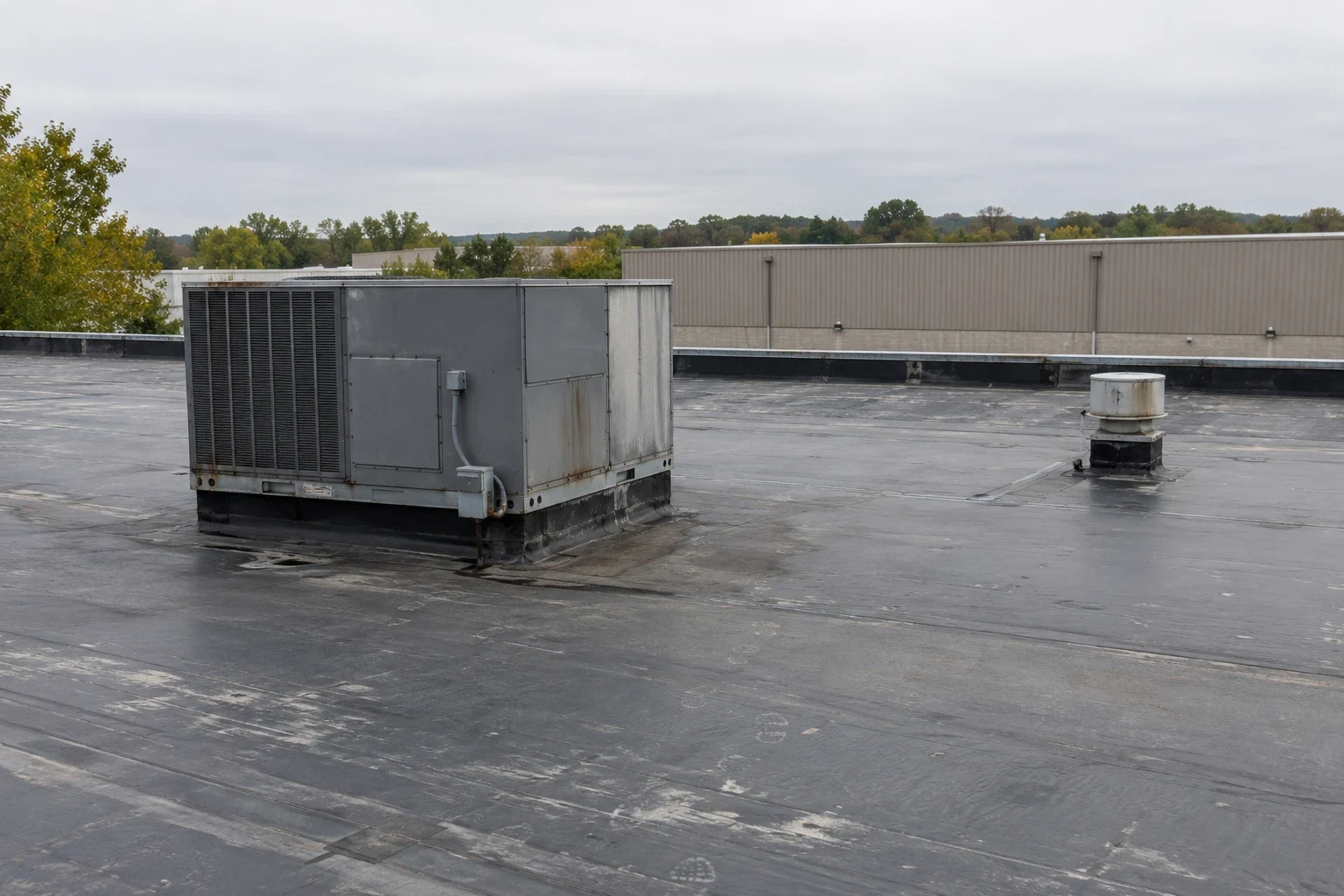
Process exhaust changes the surface of a roof. Oil mist, cooking residue, solvent vapor and fine dust settle around a stack and then bake onto the membrane, and some membranes tolerate that exposure far better than others. A KEE membrane is formulated for resistance to fats and oils, and PVC also resists many chemicals, while other single-ply sheets can soften or swell. We ask the plant what leaves each stack, look for discolored or tacky patches in the downwind direction, and sample the surface where we suspect trouble. If a membrane is failing from the chemistry, patching the seam only buys a short reprieve.
Plants from Mishawaka to Elkhart
Manufacturing shapes the building stock across this part of Indiana. The Mishawaka industrial area has built the Hummer since 1990 and vehicles for Mercedes since 2015, and about 15 miles east, Elkhart carries the title of RV capital of the world, with Thor Industries headquartered there and major plants across Elkhart County and in Middlebury. Manufacturing in South Bend fell after Studebaker closed in 1963, and the city now owns Ignition Park, 140 acres of former Studebaker land planned for roughly 3 million square feet of high-tech space. Buildings in all of these places share a need for roofs that hold up while production runs.
Hot work, fumes and air intakes
Before any torch, kettle or solvent comes near a plant roof, we ask three things: who issues the hot-work permit, where the fresh-air intakes sit, and whether any process on the floor is sensitive to dust or odor. Many plants prefer cold-applied adhesives and mechanically fastened or welded single-ply systems for that reason, and we plan the roofing method around the answer. Intakes near the work area get covered or shut off for a set period that the facility lead approves, and we station a fire watch after each hot task. A roof that contains a paint or finishing line may require a stricter plan, which we write down and share before the first day.
What the weather asks of a big roof
A plant roof meets the same climate as every other building here: 64.5 inches of snow a year, freeze-thaw from October to May, and a swing from minus 22 degrees to 104 degrees. Heat leaving a hot process warms the roof above it while the edges stay cold, and moist plant air can condense inside the insulation. Storms add their own load. The 92 mph gust of August 1996 and the 1 inch hail that fell on South Bend in June 2019 are reminders to check fasteners, edges and soft spots afterward, and a hail damage repair is far easier to prove when the plant already holds a dated condition record.
Repair, recover or reroof around production
Permanent work is cut into zones that follow the production layout, so one section of the roof can be open while the rest of the plant keeps running. A good first step is an infrared moisture survey, because wet insulation near a process tends to hide, and the map tells us whether the plant needs patching, a recover, or a replacement. Our approach to occupied building reroofing includes tenant notices, noise windows and protection for anything below the deck. Plant owners and manufacturing facility teams who plan new lines should tell us early, since a new unit changes the roof loads and openings. Distribution wings can be compared with distribution center roofs, and smaller production buildings with flex industrial roofs, using the same condition fields.
We agree on the route to the work zone before tools arrive. An exhaust line, intake, or overhead lift can change where a crew may stage and how long an opening can stay exposed. Marking those boundaries on the roof sketch keeps production access clear and gives the shift lead a simple closeout to check.
Commercial Roofing Questions
Our exhaust stacks leave an oily film on the roof. Will it eat the membrane?
It can, depending on the membrane and the chemistry. Fats, oils and solvents attack some single-ply sheets and barely touch others. We look at what the stack discharges, how far the film spreads and what the sheet looks like in that zone. A localized chemical-resistant overlay at the stack may be enough, while a heavily contaminated roof may warrant a different membrane across the affected area.
How do you reroof over a paint or finishing line without ruining product?
Quietly and in sections. We plan with the quality lead about dust, fumes and vibration, protect the equipment below with enclosures, and choose a method with minimal odor. Work over the sensitive zone often moves to a planned shutdown, and each day ends with the exposed deck dried in. The plan is written down, and the plant approves it before a crew shows up.
Do you use torches, and who signs the hot-work permit?
Torches are avoided where the plant has a fire-sensitive process, and many projects use cold adhesive or welded seams instead. When a hot task is unavoidable, the plant issues the permit, we follow its conditions, and a fire watch stays through the cooling period. We ask for the permit rules during the first walk so the method fits before materials are ordered.
Why does one patch of insulation stay wet near the process equipment?
Plant air carries moisture, and a warm interior meeting a cold deck in winter gives that moisture a place to condense. A leak can also travel to a low spot and stay there. A moisture scan tells the two apart, and core samples confirm what is inside. The repair differs: one needs a membrane fix, while the other needs better air sealing or vapor control.
We add a production line next year. Should the roof come first?
Usually before, since new equipment brings curbs, ducts and penetrations that are easier to flash into a roof that is still open. If the existing membrane has years left, we install the curbs and the openings with proper details and avoid disturbing the rest. Tell us the unit weights and locations early, and we will check the structure, the drainage and the warranty position.
Related Roof Work
- KEE Roofing
- PVC Roofing
- South Bend and Mishawaka Industrial Area
- Elkhart
- Hail Damage Roof Repair
- Infrared Roof Moisture Surveys
- Occupied Building Reroofing
- Distribution Center Roofing
- Flex and Light Industrial Roofing
Talk to Our Team
Tell us where the water is landing, what the roof is made of and when the building is easiest to reach.
Phone: 555-555-5555
Email: [email protected]