Ask anyone who walks commercial roofs where PVC earns its keep and the answer is usually a stain: a dark fan of grease or process residue running from an exhaust stack across the membrane, and a ceiling below that has never had a leak because the sheet underneath is not the kind that dissolves. PVC is a single-ply thermoplastic with welded seams, like its cousin TPO, but it is compounded to shrug off the fats, oils and many chemicals that attack other membranes. For a property manager in South Bend, IN with a kitchen, a lab, a plant or a mechanical yard on the roof, that resistance changes which system makes sense.
What lands on the roof
The first visit is about what the building throws onto its own roof. A restaurant hood puts animal and vegetable fat on the membrane around the fan, and a roof with years of that film behaves differently from a clean one. Industrial exhaust is a harder case, because the vapors and residues from work such as painting or fiberglass fabrication can soften or cloud some roofing sheets. Bremen lists light and heavy industry in fiberglass, custom cabinets, RV and van painting and roller bearings, and Elkhart has large-format plants of its own. We take photographs of every stack, note which way the prevailing wind carries the discharge, and ask the facility manager what is being exhausted. That answer, more than the age of the roof, tells us whether a PVC sheet is the right call and where it needs heavier walk pads or extra flashing.
What PVC cannot touch
PVC has a particular weakness that every installer must plan for. The plasticizers that keep the sheet flexible migrate when the membrane sits in direct contact with asphalt, coal tar or polystyrene foam board, and a sheet laid straight over an old bituminous surface slowly stiffens and shrinks. So a recover over an existing built-up roof or modified bitumen surface always gets a separation layer or a cover board, and the insulation under a new PVC sheet is chosen with the same question in mind. We also check for old tar-based sealants around penetrations, because a dab of them under a flashing can start the same reaction. A sheet that is kept clear of the wrong neighbors holds its flexibility for the life of the roof, which is exactly what you want in a climate with this much movement.
The sheet in a lake-effect winter
Winters bring about 64 and a half inches of snow, and the lake-effect burst of November 2022, when the airport collected 22.7 inches and Mishawaka 20.7, showed how quickly a roof gets loaded. A PVC roof stays flexible in that cold, which helps at corners and flashings, but the sheet still has to be handled with care. Rolls are stored warm before they are unrolled, the crew avoids folding the membrane in deep cold, and welds are made on dry material only. Once the roof is in service, snow removal needs the right tools. Plastic shovels and hand work near the drains protect a sheet that sheds snow well but can be cut by a careless blade. Ice at the drains is the real winter risk, so the sumps are cleared early and the heat trace or drain cover on each outlet is checked before the first hard freeze.
Hospitals, labs and sensitive air
Some of the strongest reasons to pick PVC come from the people under the roof. Memorial Hospital of South Bend, a 526 staffed bed Level II trauma center, and the single-story VA clinic at Mishawaka in Mishawaka are the sort of buildings where air quality, odor and noise carry weight with the facility team. Hot-air welding avoids the adhesive application used in some roof systems, which can help limit odors during the work. Coordinate intake locations and sensitive spaces with the facility team, then set work windows and weather protection around the building's operating requirements. The same approach carries over to hospital roofing projects and to labs, kitchens and data rooms that cannot tolerate a shutdown.
Repairing a PVC roof that has aged
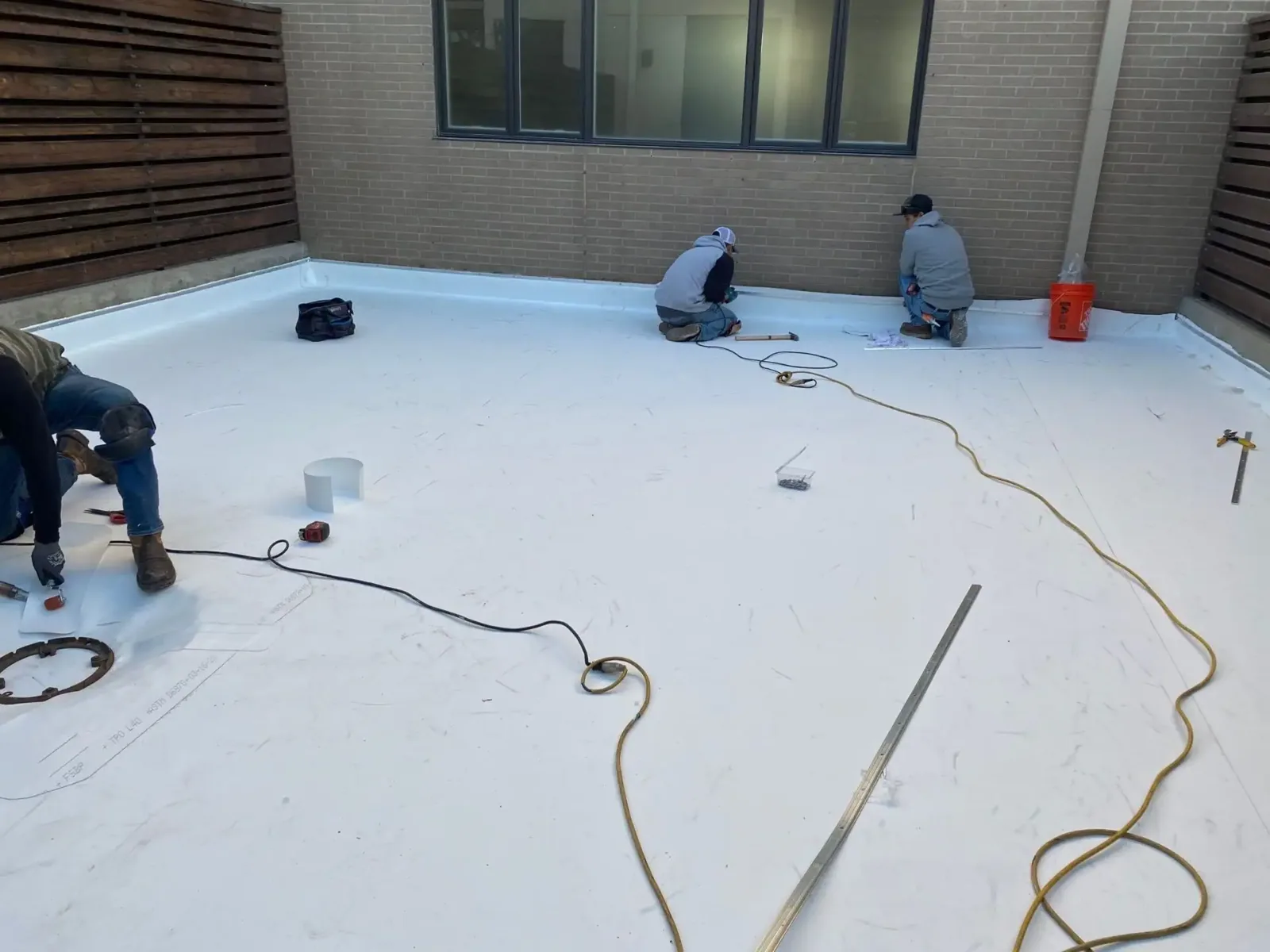
An older PVC roof usually announces trouble in one of three places: a welded seam that has opened at an intersection, a flashing that has pulled away at a wall, or a patch where something was dropped. New PVC does not weld cleanly to a surface that is dirty or chalky, so the repair starts with cleaning, then a weld test on a scrap, then a hot-air welded cap that overlaps the damaged area. Where a sheet has shrunk away from a corner, we replace the flashing rather than stretch it. A weld that peels under a probe is a seam failure and has to be redone, not glued. We photograph each repair before and after, which gives the property manager a record to keep with the roof.
Makers and records
Several manufacturers produce PVC, including Sika Sarnafil, which makes a membrane reinforced for welded seams, and Duro-Last, which fabricates sheets to size before they reach the roof. We install and repair to each maker's published details for the system that is actually in place. When the work is done, the property manager keeps the photo log, the weld probe results and the product documents, and a spring visit looks again at the welds, the drain sumps and the walk pads after the winter has had its say.
Commercial Roofing Questions
Our rooftop kitchen exhaust has stained the roof for years. Is PVC the only answer?
PVC can be a fit when grease is a primary exposure, because the sheet resists fats and oils that attack other membranes. Walk pads under the fan, a grease containment tray and regular cleaning also help any system. We look at how much film is on the roof today and whether the exhaust will change, then recommend PVC or another sheet with the reasons written out.
Can PVC go over my old built-up roof?
Only with a proper layer between them. Direct contact with asphalt will stiffen a PVC sheet over time, so we install a separation layer or cover board first, and we test the old roof for moisture before anything goes over it. If the insulation under the old roof is wet, a recover may not be suitable; testing and code review help determine whether replacement is needed.
Why do some PVC roofs turn brittle after many years?
The plasticizers that keep the sheet soft can leave it slowly, especially where it touches incompatible materials or sits in constant heat. A roof that stays clean, avoids contact with tar and gets periodic inspection tends to hold its flexibility longer. We look for chalking and stiffness during maintenance visits and flag it before it turns into cracking at the details.
We have a fiberglass and paint operation next door. Will drifting fumes harm a new PVC roof?
Neighbor exhaust matters, and a sheet that handles grease is not automatically safe from every solvent. We ask what is being discharged and how close the stack is, note the prevailing wind, and review the manufacturer's chemical resistance information for that sheet. If the answer is unclear, we raise the question before the order is placed, not after the roof is down.
How does PVC compare with TPO for a mid-size retail roof?
On a roof with few chemical exposures, the two behave much alike, and the choice often rests on the details, the insulation and the maker's approved assembly. PVC pulls ahead where grease or exhaust is present, while TPO is often more economical on a clean roof. We price both against the same scope when the building allows it.
Related Roof Work
- TPO Roofing
- Elkhart
- Roof Recover and Overlay
- Built-Up Roofing (BUR)
- Modified Bitumen Roofing
- Hospital Roofing
- Seam Failure Repair
- Sika Sarnafil Roofing
- Duro-Last Roofing
Talk to Our Team
Tell us where the water is landing, what the roof is made of and when the building is easiest to reach.
Phone: 555-555-5555
Email: [email protected]