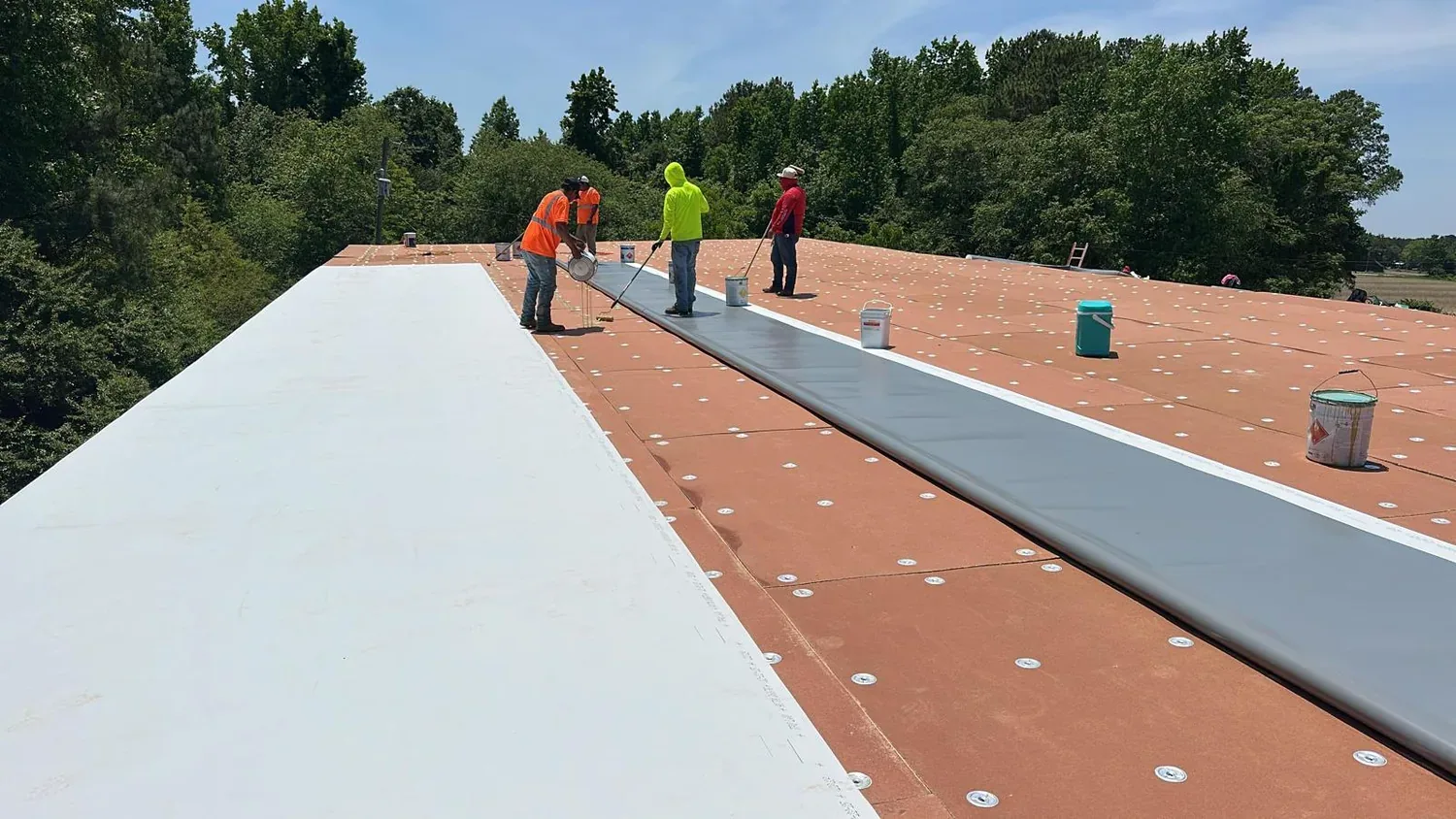
The property manager spots it from the parking lot on a late-October evening, when the sun is low and every small irregularity on a flat roof throws a shadow. A straight pale line runs across the field where the sheet stands a quarter inch off the surface, and it follows a seam as exactly as a pencil mark. No tenant has complained yet. Seam failure repair in South Bend, IN is the work of reaching that line before the first thaw sends water through it, and of finding out whether it is one bad lap or the first sign of a roof letting go along every weld.
Probe, mark and photograph every lap
We begin by walking every seam on the roof, not just the one seen from the lot. A blunt probe is run along the edge of each lap to find places where the bond is thin, and wherever it slips in, we mark the open length with paint and measure how far the opening runs. At intersections where three layers meet, the sheet is thickest and the weld or tape is least likely to have reached all the way across, so those get the closest look. We record whether the open edge is clean, which suggests a poor bond from the start, or dirty and curled, which suggests it has been opening for some time. Every mark goes into the photo log and onto a roof sketch with the open footage totaled by area, so the repair can be sized before the crew comes back.
One word, several kinds of lap
A seam is a different thing on different roofs. On TPO and PVC the laps are fused with hot air, and the two sheets become one piece. On EPDM the laps are joined with tape or splice adhesive over a primed surface, so the bond depends on how clean and dry the edge was on the day. Modified bitumen laps are heat-sealed or adhered with cold adhesive, and a bead of bitumen along the edge shows they are sound. Standing seam metal locks panels together mechanically and fails at clips, sealant and end laps rather than at a weld. Each system is repaired by its own method, so the first step is always to identify the membrane.
Why a lap lets go
Seams open for a handful of reasons, and the reason shapes the repair. A weld made on a damp or dusty sheet looks fine for a season and then separates when the roof moves. Thermal movement tugs at laps across a range in South Bend that has run from -22 F to 104 F, and rubber and thermoplastic sheets shrink as they age, putting tension on a seam that had none when it was new. Water that ponds on a lap works at it through every freeze, which ties many failures to ponding water in the same area. We name the cause in the report, because patching a seam without correcting why it opened buys only a short stretch of dry weather.
A patch that holds through the weekend
When a seam is leaking into a suite, we do not wait for ideal welding weather. A temporary cover of compatible tape, reinforced membrane or a cold-applied patch can limit further water entry while the permanent repair is planned. We dry the area first, clear any ice from the nearest drain so meltwater does not stand on the lap, and record the finding for the tenant notice. Insulation beneath an open lap often takes on water, so we check it with a moisture meter or an infrared scan before anything is sealed over it. Where a seam opened beside a wall, the repair usually crosses into flashing failure, and both are handled in the same visit.
Weld it, tape it or cap it
On thermoplastic roofs an open lap is cleaned, probed back to sound bond and re-welded with hot air, and a cap strip with rounded corners is welded over longer failures so water cannot catch an edge. On EPDM, the open lap is cleaned with the right cleaner, primed and rejoined with new tape, then rolled to full pressure. Modified bitumen laps are re-sealed with heat or compatible adhesive and finished to match the surface. Hot-air welding needs a dry sheet and workable temperatures, so permanent work is timed to the shoulder seasons, after the thaw and before the October freeze. When seams are opening because the sheet itself has shrunk, patching each one only moves the tension to the next lap, and the realistic choices become coating restoration over repaired seams or a section replacement.
A winter spent on a short list of laps
South Bend's average first freeze falls on October 18 and the last on about May 1, so a seam spends roughly six months stiffened by cold and loosened by thaw. The 64.5 inches of snow that falls in an average year, with January the likeliest month for a heavy storm, adds weight to a field of laps that must stay watertight under it. In November 2022 the first 20 days of the month alone brought 30.2 inches to South Bend, and a single lake-effect event left 22.7 inches at the airport while Mishawaka took 20.7, so a seam under that much snow has nowhere to shed it until the thaw. Seams that held in September can show their weakness in the first thaw, which is why a spring walk after the ice has gone is as useful as a fall walk before it arrives. Owners can schedule a fall walk ahead of South Bend's average first freeze, then compare the same roof details after the thaw.
When open laps point to the roof's age
A few open seams on a sound roof are a repair. Seams opening across the field, with brittle sheet at the edges and wet insulation beneath, are a roof telling its age. We report which situation applies, with the open footage per area, the condition of the sheet at each opening and any wet board found. The owner then sees the options side by side, including a recover overlay where the code and the existing roof permit one and full replacement where they do not. Owners compare those options against their reserves, and our part is to hand them a record they can plan against.
Commercial Roofing Questions
One seam opened on a roof we plan to replace in two years. Is a temporary patch enough?
For a roof with a known end date, a durable patch is usually the sensible spend, as long as the insulation under it is dry. We check that first, because a patch over wet board only hides a loss that keeps growing. If the board is dry, a reinforced patch or cap strip can carry the roof to the day the tear-off begins.
Do you test every seam on a large roof, or only the ones that leak?
Every accessible lap gets the probe. Leaks tell us where water entered the building, not where the roof is weakest, and a seam that is thin along one edge may not leak until the next freeze. The total of open footage by area is what lets us price the repair, plan the crew and set a follow-up date.
Can seams be repaired in January, or do we wait for spring?
Temporary protection goes on in any weather, and we carry the materials to do it on snow-cleared sections. Permanent welding and taping wait for dry surfaces and workable temperatures, so we schedule them for the first mild stretch after the thaw.
What is the difference between a re-weld and a cap strip?
A re-weld rejoins the two sheet edges that separated, and it works well on short stretches with sound material on both sides. A cap strip covers the entire line with a new band of membrane, welded or taped on both sides of the old seam, which makes sense when the laps are long, uneven or stressed along their whole run.
Will an infrared scan find a failing seam before it leaks?
It finds the water, not the seam, which is still useful. A scan after a wet week shows where moisture has already entered the insulation along a lap, and a probe walk then confirms the cause.
Related Roof Work
Talk to Our Team
Tell us where the water is landing, what the roof is made of and when the building is easiest to reach.
Phone: 555-555-5555
Email: [email protected]