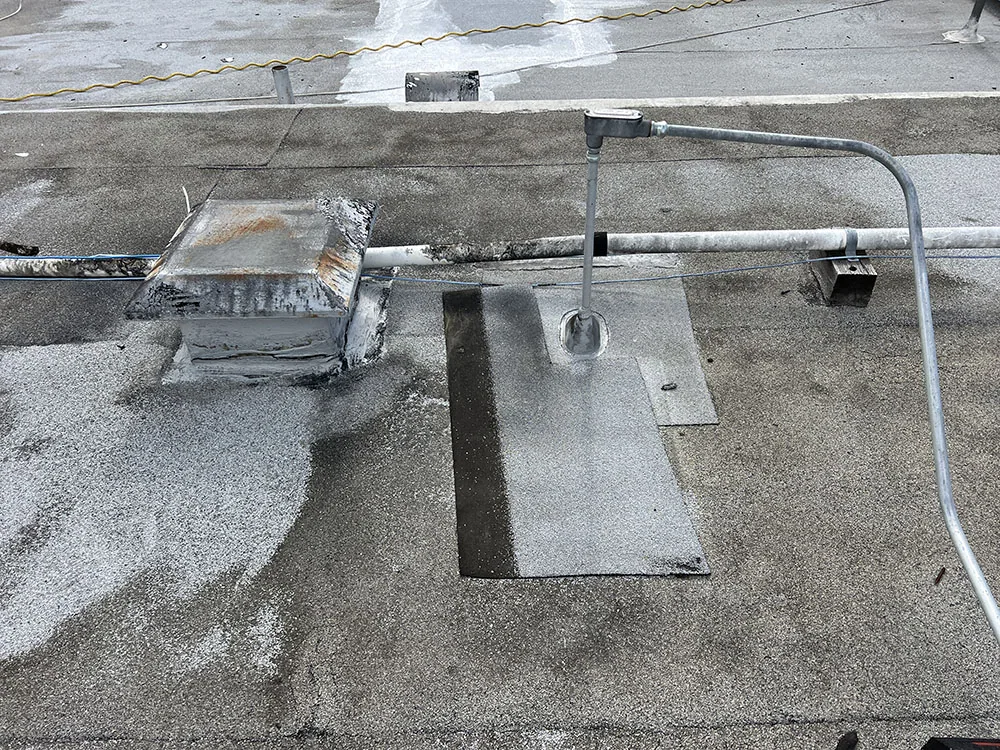
A painter prepping the north stairwell peels back a bubble in the wall paint and finds the drywall behind it soft to the touch. The roof above that wall has not been walked in a year, and the only complaint on file is a damp smell in the first week of every March. That is how failed flashing tends to introduce itself: slowly, at a wall, through a small opening that passes water into the building one thaw at a time. Flashing failure repair in South Bend, IN begins at that wall line and follows the water upward until the opening is found.
Following the wall line to its end
We start on the roof at the base of the wall and work along its full length, because flashing fails in short stretches that a glance from the hatch will miss. The base flashing should rise high enough above the membrane to stay clear of ponding and drifted snow, and its top edge should be locked under a termination bar or tucked into a reglet. We press the bar to see whether it moves, look for sealant that has pulled off the masonry, and check for open mortar joints behind the counterflashing where water can enter the wall itself. Inside corners, where the sheet is folded most tightly, get the closest look, along with every pipe boot, pitch pocket and curb. Each suspect area is probed, photographed with a tape in frame and placed on the roof sketch, so the list that follows has addresses instead of impressions.
What cold and heat do to a termination
Flashing is the part of the roof that moves against the part that does not. A wall holds still while the membrane beside it expands and shrinks across a range that has run in South Bend from -22 F on January 20, 1943 to 104 F on June 25, 1988, and every cycle tugs on the termination. Sealant that was supple in July goes stiff and splits on a January morning. Snow piles against a parapet in a northwest wind and stays for weeks, so a gap near the top of the base flashing sits under a wet drift rather than a passing shower. After the thaw, meltwater runs down the face of the wall and enters wherever the counterflashing has pulled loose. The stretch between the first freeze and the last lasts roughly six months here, which is a long time to ask a bead of sealant to hold.
Brick, limestone and glass meeting the roof
The wall behind a flashing decides how it is built. The VA clinic at Mishawaka in Mishawaka is a single-story building whose walls combine brick, Indiana limestone, aluminum storefront and curtainwall glazing, and each of those materials takes a flashing differently: brick accepts a reglet cut into the mortar, limestone wants a cap with its own drip, and a glass wall calls for flashing that tucks under the metal framing. Grape Road corridor's University Park Mall is mostly one story and fully enclosed, so any place where its roof meets a wall or steps up to a taller one is another flashing line. Different walls fail in different ways, so the repair is drawn up wall by wall, not as one generic detail repeated around the building.
Stop the water tonight, rebuild next
A bead of caulk across a failed termination is a temporary measure, and we call it that. On the first visit we do what stops the water tonight: dry the area, cut loose sealant back to sound material, press the termination against the wall, and cover the exposed base with a patch or temporary membrane so water cannot run behind it. Where an interior wall is wet, we open a small inspection hole so the tenant's maintenance staff and ours can see whether the drywall or the insulation inside the wall is holding water, and we advise on drying it. Units, skylights and pipes near the failed stretch are sealed during the same visit if they show the same condition, and everything left for the permanent repair is written into the photo log before we leave.
Re-flashing, in the order it has to happen
The permanent repair is a rebuild of the detail, not a thicker bead. We remove failed sealant and loose counterflashing, clean the substrate to sound material, install new base flashing in the same material as the field sheet, and fasten its top edge to the wall with a continuous termination bar sealed to the masonry. Compatibility matters at every step: TPO flashing is heat-welded to TPO, modified bitumen takes compatible membrane or cold adhesive, and rubber roofs rely on primer and tape. Counterflashing is reset or replaced, and the masonry joints behind it are repointed before anything covers them. Where the sheet is brittle near the wall, we replace a short strip of it rather than weld new flashing onto old material. Skylight curbs and pipes get the same rebuild, with skylight and penetration flashing reset to the new base sheet, and units sitting on equipment curbs are handled while the curb flashing is open.
What the property manager keeps
When the work is done, the property manager receives the photo log with before and after images of each wall line, a roof sketch with the repaired stretches marked, and a short written list of areas that are aging but still sound. A second visit follows the first hard freeze, so we can see the new terminations under load. If water reached interior finishes, the same file becomes the record for the leak repair and for the insurer. Where the opening began at a storm-struck corner, the cause is often wind damage to the edge, and where the laps beside the flashing have opened we deal with seam failure in the same visit.
Commercial Roofing Questions
Can maintenance seal the wall joint from the roof with a tube of caulk and skip the service call?
Caulk buys a few weeks at best, and it can make the next repair harder by covering the evidence. Sealant over a termination that has pulled loose from the wall is holding nothing, and the first freeze cracks it again. A rebuilt termination bar and fresh counterflashing last because they do not depend on the sealant alone.
How high should flashing stand above the roof surface, and who checks it?
Most membrane makers publish a minimum height for base flashing, and the number differs from one system to the next, so we read the detail for the membrane on your roof and measure what is actually there. Flashing that is too short is at risk from ponding and snow drifts. Our report lists the measured heights wall by wall next to the manufacturer requirement.
Water shows up inside only during a thaw. Does that point to flashing?
Thaw-only leaks frequently do. Meltwater from drifts that sat against a wall for weeks runs through gaps the dry months never tested, so the leak appears when the snow melts and then disappears. We look first at the wall line where the drift sat, and we check the drains as well, because ice can hold meltwater against the flashing.
We are replacing a rooftop unit this spring. Should the curb flashing be redone first?
Do it in the same window, before the new unit is set. The curb flashing is easiest to inspect and rebuild while the old unit is off, and once the new unit is placed it is much harder to reach. We coordinate with the mechanical contractor so the crane time is shared and the roof is closed before the unit goes back on.
How do we know the repair actually worked before the next storm?
A controlled water test on the repaired stretch is the quickest proof, with someone inside watching the wall while we run water from the top down in stages. Then we return after the first hard freeze for the follow-up visit, when the sealant and terminations are under real stress. Both results go into the file.
Related Roof Work
Talk to Our Team
Tell us where the water is landing, what the roof is made of and when the building is easiest to reach.
Phone: 555-555-5555
Email: [email protected]