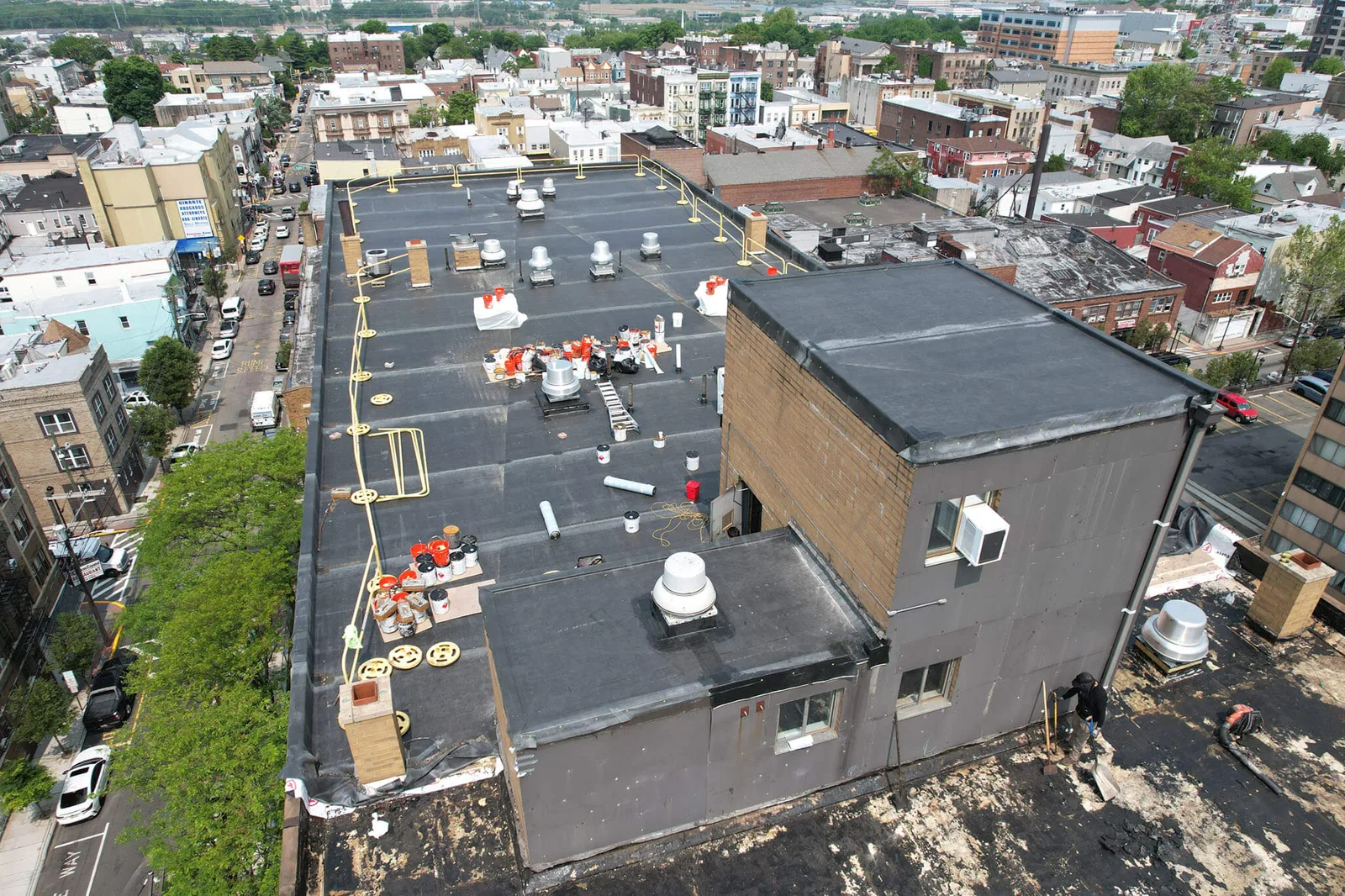
On a windy night the first sign of a loose rubber sheet is usually a sound: a slow flap against the parapet that a security guard reports long before any tenant sees water. That is how a bad EPDM edge announces itself, and the call that follows tells us a lot. EPDM is a cured synthetic rubber membrane, black as a rule, rolled out in large sheets and joined with tape or adhesive instead of heat. It stretches, it handles cold without complaint, and it has a long record on flat roofs in snow country, including South Bend, IN. It also asks for patient seam work and careful flashing, and a newer white TPO sheet is not always the better answer. The work starts with the sheet already on the roof.
What cured rubber forgives
EPDM stays supple where other membranes stiffen. South Bend has recorded -22 F in January and 104 F in June, and a roof here is asked to stretch and relax through that whole range. Rubber takes it in stride because it behaves the same on a cold morning as on a warm afternoon. Black rubber also warms quickly in winter sun, which helps snow melt off the surface. In summer the same dark color absorbs heat, so for buildings where cooling load matters we price white-faced EPDM or a different system. The sheet also resists ultraviolet light and ozone well, which is why many rubber roofs outlast the flashings that surround them. The membrane is rarely the weak link. The seams, the corners and the penetrations are.
Tape, primer and patience
Rubber seams are not welded. They rely on a primer, a splice tape or adhesive, and a roller that presses the lap flat. Each step has a clock. The surfaces must be clean and dry, the primer must flash off, and the tape must go down before contamination lands on it. That makes the work sensitive to wind-blown dust and to the cold, damp mornings of late October and April. We keep a log of the weather for every seam day, press and roll each lap, and inspect the edges for fish-mouths, small openings where the top sheet lifts. An old rubber roof with open laps rarely needs replacement on that evidence alone. A cover strip over the lap, set on cleaned and primed rubber, usually restores the seam if the sheet underneath is still sound.
Ballast, adhesive or fasteners
Rubber reaches the deck three ways, and wind is the argument between them. Ballasted systems hold the sheet down with stone or pavers, and they ask the structure to carry that dead weight on top of snow. They also move under strong wind, because stone at the edges can be blown loose. The record gust here is 92 mph, and the two EF0 tornadoes of October 12, 2016 brought straight-line wind damage along West Indiana Avenue and a microburst swath from Northside Boulevard to Longfellow Road. Fully adhered rubber resists that kind of uplift better, and mechanically fastened rubber sits between the two. On an existing ballasted roof we inspect the perimeter first, because that is where displaced stone and lifted edges show up. A wind damage repair often begins there.
Snow, drifts and ice at the drains
The roof sees about 64.5 inches of snow in an average year, and rubber copes with the weight and the thaw better than most. The trouble comes at transitions. Drift builds against parapets and rooftop units, then melts into the field and refreezes at the drains, where ice can lift a flashing or block an outlet. Around downtown South Bend and the Renaissance District, where the former Studebaker complex is being rehabilitated, any roof with tall parapets takes much of that stress at the wall flashing and counterflashing. On a multi-building campus such as Indiana University South Bend, which has 11 primary buildings, every EPDM roof adds its own list of wall terminations to maintain. We clear drains first, inspect terminations after every thaw and check that the sumps drain freely.
Rubber punctures easily
The softness that lets the sheet stretch also lets it tear. A dropped tool, a scraped ladder foot or an HVAC contractor dragging a panel across the field can open the sheet, often at a time when no one reports it. Walkway pads along the routes to equipment, protection boards under temporary work and a rule that service technicians sign in before they go up all make a difference. When a puncture does happen, we clean the area, apply primer and set a cured patch with overlap on every side, then record the repair in the photo log. Small openings are routine, and the membrane puncture repair that follows is quick if the insulation beneath has stayed dry. We check that with a moisture scan, because water that has entered through a small cut can spread far under the rubber.
Judging an older rubber roof
Age shows up differently in rubber. The sheet may shrink and pull at corners, flashings may crack where they were stretched tight, and the seams may have gone chalky. Before recommending repair, recover or replacement, we map the roof with an infrared moisture survey, cut a few cores and measure how much shrinkage has occurred at the walls. If the insulation is dry and only the details have failed, repair is the answer. If water has spread through a large area, the roof needs replacing, however good the rubber still looks. When the answer is replacement, Carlisle SynTec and Versico are among the makers of EPDM, and we install to the published details of the system on your roof. For another membrane comparison, PVC roofing has different seam and chemical-resistance considerations.
Commercial Roofing Questions
Why does a black roof matter when the building is cold six months a year?
Heat gain in July is the cost, and quicker snow melt in January is the benefit. For a building with heavy cooling load, a white-faced sheet or a different system is worth pricing. For a warehouse with little air conditioning, black rubber's winter behavior often wins. We tie the answer to your utility use and the insulation already under the sheet.
Is ballast still a good idea where gusts have reached 92 mph?
Ballast holds only as long as the stone stays put, and perimeter stone is the first to move. Many owners keep a ballasted roof and add heavier stone or pavers at the edges. Others choose to convert to an adhered sheet when the roof is replaced. We check the structural capacity before either plan, because stone weight and drifted snow arrive on the same deck.
The laps on our rubber roof are lifting in several places. Do we need a new roof?
Lifting laps alone seldom justify replacement. We clean the lap, prime it and cover it with a strip of cured rubber, then check the insulation for moisture. If the sheet is brittle, shrunk or heavily contaminated, a cover strip will not hold, and the findings will point toward a recover or replacement instead.
What happens when a mechanical contractor drags equipment across the rubber?
Rubber stretches until it does not, and a sharp edge can open it without a sound. Walkway pads along the route and a sign-in rule for service crews prevent most damage. After a contractor visit, we look at the field and the flashings. If we find a cut, a patch with generous overlap closes it, and a photo shows exactly where it went.
Can we move from EPDM to a white membrane without tearing off the old roof?
Sometimes. A recover works only over insulation that tests dry and a deck that still holds fasteners. A cover board separates the new sheet from the old, and the heights at every edge and curb are checked again. Wet insulation anywhere on the field changes the answer, which is why the survey comes before the bid.
Related Roof Work
Talk to Our Team
Tell us where the water is landing, what the roof is made of and when the building is easiest to reach.
Phone: 555-555-5555
Email: [email protected]