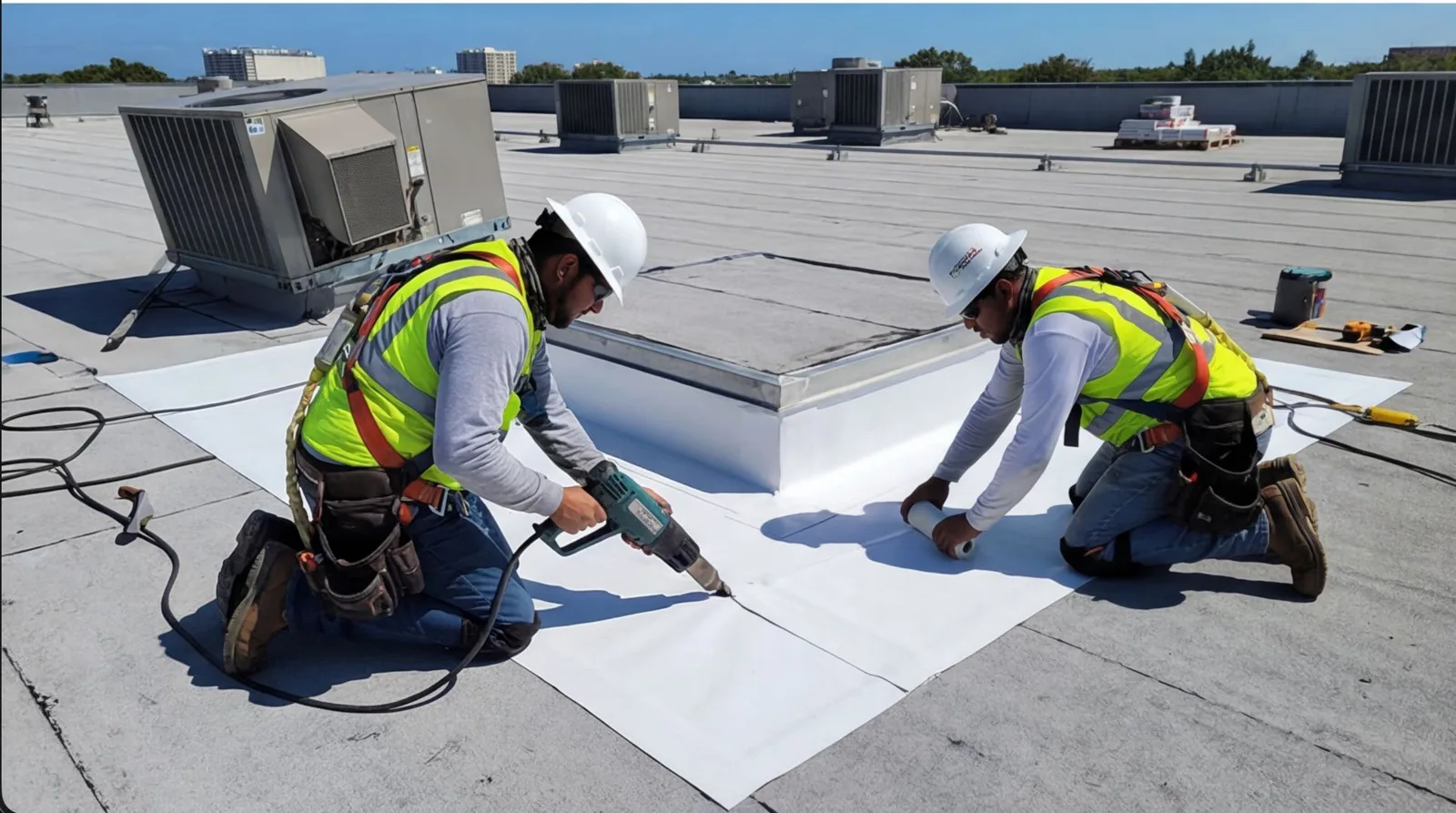
The service call was for a rooftop unit, and the damage was done on the way to it: a single path of scuffed membrane running from the roof hatch to the compressor, with a gouge halfway along where a screwdriver landed point-down. Nobody saw it happen, and nobody will notice until a ceiling tile stains two weeks later in a suite nowhere near the unit. Membrane puncture repair in South Bend, IN is the job of finding every hole like that, closing it properly, and then protecting the path so the next service call does not make another.
Finding holes nobody saw
Punctures are small, and the roof is large. We walk the roof in a grid, in raking light where we can, looking for gouges, scuffs, burn marks from welding or grinding, blisters over damaged spots and the dark patches of dirt that collect in a cut. Around rooftop equipment and along the route from the access point we slow down and look at every foot, since that is where the traffic has been. Each damaged spot gets a number, a photograph with a scale in frame and a position on the roof sketch. We also judge the depth of each cut, because a scratch in the surface layer of a reinforced sheet is cosmetic, while a cut through the reinforcement or down to the insulation is an open leak waiting for the next thaw.
Why a cold roof breaks more easily
Membrane that bends easily in July turns stiff in January, and South Bend's all-time low is -22 F. A stiff sheet cracks under a boot or a dropped tool rather than giving way. Winter brings its own hazards: snow removal with a metal shovel or a blade that rides too low can slice a sheet in one pass, and ice chipped from a drain bowl can take the membrane with it. After a lake-effect week the pressure to clear a roof quickly is high, and careless clearing over a season does more harm than the snow did. On every winter inspection we look for snow-removal marks, especially long parallel scrapes that run toward drains and parapets, where the pile is usually pushed.
Tools, trades and the walk to the unit
Most punctures come from people who were never hired to work on the roof. Mechanical technicians, cable and antenna installers, window washers and electricians all cross the membrane on their way to something else, carrying tools and sometimes leaving debris behind. Hospitals and data facilities, the building types behind Memorial Hospital of South Bend and the Union Station Technology Center in the Renaissance District of downtown South Bend, run equipment that gets serviced often, and on any roof with that kind of traffic a walkway plan pays for itself. Walk pads laid from the hatch to each unit give feet a place to go. Our work on equipment curbs and supports includes protecting the sheet where units are serviced, and a preventive maintenance visit finds new damage while it is still a patch.
A hole is a door into the insulation
Even a pinhole lets water into the insulation, where it spreads sideways beneath a membrane that still looks fine. The first visit therefore includes a temporary patch of compatible tape or a reinforced square pressed onto a cleaned surface, and a check of the board beneath. For a cluster of punctures we scan the area with infrared after a rain, then cut a small core to see whether the board is dry. Wet board is cut out and replaced, and dry board is left alone. When the damaged area sits over an occupied space, the tenant receives a notice naming the date and the section, so a stain that appears later can be traced to a specific visit and a specific patch.
Patch the hole, then protect the path
The patch has to match the sheet. On TPO and PVC, a heat-welded patch cut with rounded corners and extending past the damage in every direction restores the surface to a single piece. EPDM is repaired with primer and a patch of the same rubber rolled to full contact, with lap sealant along the edges. Modified bitumen takes a granulated cap sheet patch set in compatible adhesive or heat. Where punctures cluster because the board beneath has gone soft, we replace the board and add cover board, since a firmer base resists the next dropped tool. Last, we lay walk pads along the routes the trades actually use and photograph them in place, so the next technician and the next inspection start from the same record.
Hail, ballast and what falls from above
Not every hole comes from a boot. Hailstones, tree limbs, windblown debris and ballast stone moved by a gust can all break a sheet. On June 1, 2019, hail up to an inch across fell on South Bend, with smaller stones of 0.7 inch reported in Mishawaka, and stones that size can bruise or crack a membrane that looks sound from a ladder. When a scatter of small breaks shows up across the field rather than along a path, we treat it as hail damage and document it that way. Damage that follows a wall line points the inspection toward flashing failure instead, and the record we keep says which cause we found and why.
Before a patch goes down, we check whether a cart wheel, dropped tool, branch, or stone made the opening and whether nearby protection needs to change. A puncture beside a service path may recur unless the route is marked and a walk pad is added. That distinction separates a one-time repair from a repeat leak call.
Commercial Roofing Questions
A technician dropped a tool on the roof and says nothing broke. Should we still look?
Look within the week. A dropped tool can leave a small cut or a bruise in the reinforcement that does not leak until water freezes in it. A quick walk with photographs of the spot costs little, and the dated record protects you if a leak appears later.
How large can a puncture be before a patch is the wrong repair?
Count and location matter more than size. One hole in an otherwise sound sheet is a patch at any size we would reasonably see. Many holes along a traffic route, or a soft area where the board beneath has crushed, point to replacing a section of membrane and board instead of stacking patches.
Who pays when another trade damages the roof?
That question belongs to your contracts, but the record helps. A set of dated photographs taken before and after the trade works on the roof shows what changed, and our written findings name the location and the likely cause. An owner can require a roof walk before and after any trade goes up.
Do walk pads really protect the membrane, or are they a nuisance?
Pads spread a boot's weight over a wider area and, more usefully, mark the route, so technicians stop wandering across the field to reach a unit. They also give us a place to look first during inspections. Pads need to be bonded or welded in place and checked, because loose pads can shift and trap grit against the sheet.
Our snow removal contractor clears the roof. What should we tell them?
Give them a written plan before the first storm: plastic blades or hand shovels only, no metal edges on the membrane, a thin layer left on the surface, drains cleared by hand, and a map showing where rooftop units and skylights stand. We can supply the map and a short checklist, and we inspect after the first heavy clearing.
Related Roof Work
- Downtown South Bend
- Rooftop Equipment Curbs and Supports
- Preventive Roof Maintenance
- EPDM Roofing
- Mishawaka
- Hail Damage Roof Repair
- Flashing Failure Repair
Talk to Our Team
Tell us where the water is landing, what the roof is made of and when the building is easiest to reach.
Phone: 555-555-5555
Email: [email protected]