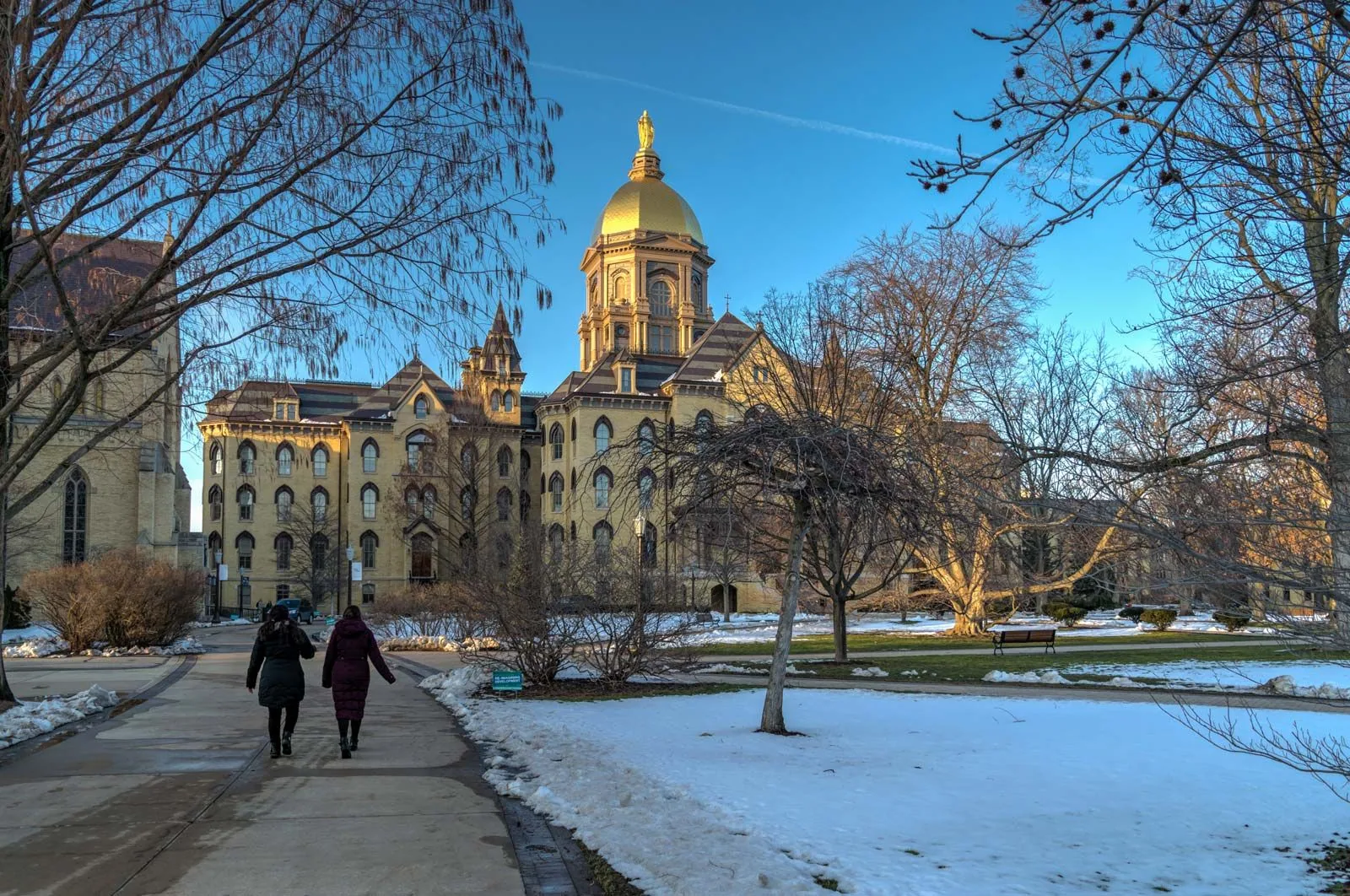
Commercial roofs in the Notre Dame area of South Bend, IN need decisions based on the building in front of you, not on a nearby name. Notre Dame is a U.S. Census-designated place with 7,234 residents counted in 2020, and its broader community includes the University of Notre Dame, Saint Mary’s College and Holy Cross College. That makes the service area larger than one campus or one owner. A school, office, church, retail property or other commercial building each needs its own roof history, drainage review and access plan. We start with the leak or decision that brought you to us, then trace the condition back to the roof detail that controls it. For a first look, commercial roof inspection gives the owner a record to act on, whether the next step is a repair, a maintenance visit or a larger project.
One recognized place, several kinds of roofs
The Notre Dame area is a named geographic community, not a synonym for the University alone. Three institutions are located here, but commercial roofing decisions also follow the needs of each individual property and its owner. A low-slope roof over an office, a steep roof over a church, and a metal roof over a service building do not share the same drainage paths or repair details. The first inspection notes membrane type, seams, curbs, penetrations, perimeter metal and drains. We identify the roof assembly from visible evidence and records rather than infer it from the building’s name or use. A college or university roof may involve several structures under one owner, while a church roof may have steep transitions, valleys and tall wall flashings. Those are different scopes, even within the same small community.
Make the roof record useful to the next decision
A roof report should separate what is urgent from what can be planned. We photograph open seams, loose flashing, failed sealant, soft insulation and blocked drains, then mark each condition by location on the roof plan. A wet ceiling does not prove the leak sits directly above it; water can travel along a deck or insulation before appearing inside. We compare the interior stain with roof transitions, penetrations and drainage before recommending a patch. If the membrane is sound outside one failed detail, a targeted repair can make sense. If water has reached several layers or the same repair keeps returning, the owner needs a wider view of the assembly. The findings also create a baseline for preventive roof maintenance, so future visits can check the same details instead of starting from memory.
When a project is on institutional property
The University of Notre Dame operates its own police, fire, water and power systems. The University is one part of a broader place where property owners manage different buildings and roof systems. If the building being inspected is on that campus, we coordinate roof access and work controls with the owner’s designated staff. Before hot work, we confirm the permit path and fire-watch requirements; before isolating equipment, we identify who controls the utility. Deliveries, lifts, occupied rooms and sensitive entrances need a sequence that fits the property’s operating rules. A campus project also benefits from a roof-by-roof condition table, because the person approving a repair may not be the person managing daily access. For work over occupied rooms, occupied-building reroofing should protect interior operations as carefully as the membrane.
Plan around roads and event traffic
The Indiana Toll Road’s Exit 77 reaches the University by State Road 933, and State Road 23 crosses South Bend from southwest to northeast. Those roads connect the broader area with South Bend and Mishawaka, two distinct service communities with their own access routes. A roof visit still begins with the property’s approved entrance, safe parking and a clear route for ladders or lift equipment. Notre Dame Stadium is open-air and seats 77,622; on a home football weekend, traffic and pedestrian movement can affect work near the campus. We schedule noisy work, crane lifts and material drops for a window that does not conflict with the property’s use. For other buildings across the area, the same planning starts with the owner’s calendar and site conditions, not the stadium schedule.
Repair, recover or replace with the layers in view
Choosing a roof system starts with what is already there. We check how many layers exist, whether insulation is wet, how much the deck moves, and whether drains and scuppers can clear water. A coating is not a cure for trapped moisture or a failed substrate. A recover can avoid tear-off when the existing roof and structure qualify, but adding material changes load and edge height. Replacement opens the assembly for a full review and may create a chance to improve insulation or drainage. On a metal roof, fasteners, panel laps and movement at penetrations need close attention. In each case, we explain which observations support the recommendation and which unknowns would change it. The owner can then compare a repair with commercial roof replacement using the expected service life, disruption and maintenance needs rather than a generic promise.
South Bend freeze and snow demand a drainage check
South Bend averages 64.5 inches of snow in a year, with an average first freeze on October 18 and last freeze on May 1. South Bend averages 64.5 inches of snow a year, with the first freeze near October 18 and the last near May 1. Snow and freeze-thaw cycles make drain bowls, scuppers and low points worth checking before winter. If water sits at a seam and freezes, the movement can stress a repair that was already weak. We clear drainage paths, inspect flashing where walls meet the roof, and look for ponding that remains after a thaw. The roof record should distinguish snow accumulation from a structural concern; we do not treat one observation as a load calculation. A scheduled fall inspection can flag details while access is easier, and snow and ice damage repair addresses damage after conditions expose a failure.
Commercial Roofing Questions
We have a leak but cannot see damage from the room. What should happen first?
Put a container under active dripping and move contents away from the wet area. Tell us which room, when the water appeared and whether it followed rain or a thaw. We trace that point upward through the roof rather than cutting a large opening based on the ceiling stain alone. A temporary dry-in can protect the interior while the roof is wet, with permanent work scheduled once the failed detail is clear.
Can we repair one section while we plan a full replacement?
Yes, if the repair can stop active water without hiding a broader failure. We check the membrane, insulation and deck around the leak, then mark what needs immediate work and what can remain under observation. If moisture is widespread or the roof has several incompatible layers, a patch may only delay the decision. The report explains that distinction so the interim work has a defined purpose.
How do you handle roof access on University property?
The owner identifies the people who control access, hot-work permits, fire protection and utility isolation. We coordinate the visit with those contacts, confirm where equipment may travel and keep the work area clear of occupied routes. Those arrangements apply to University property; another owner in the Notre Dame area sets its own procedures.
What should we do before a snowstorm?
Have drains, scuppers and overflow paths checked while the roof is safe to access. We look for leaves, loose edge metal, open seams and low spots that hold water. A snow visit is not a substitute for structural review, and roof access during unsafe conditions can wait. If a leak appears after a storm, photos from inside and the time it began help us locate the likely path.
When is coating a reasonable option?
Only after the existing roof has been inspected and the substrate is suitable. We check adhesion, moisture, seams, penetrations and drainage, then confirm the proposed coating is compatible with the membrane. A coating does not correct saturated insulation or a failing deck. If those conditions are present, the repair or replacement options should be compared before a coating is considered.
Related Roof Work
Talk to Our Team
Tell us where the water is landing, what the roof is made of and when the building is easiest to reach.
Phone: 555-555-5555
Email: [email protected]