A facilities office usually hears about a campus roof leak from the wrong end of the building: a circulation desk, a lecture hall instructor, or a residence hall assistant who finds water running down a stairwell wall in the middle of finals week. Nobody on that call can say where the water is entering, only where it has landed, and the building may hold laboratory equipment, library collections or students asleep upstairs. For a campus in South Bend, IN the first job is the same each time: protect people and contents, stop the water from traveling, and then climb up and find the opening. Only when the area is dry do we talk about the permanent repair, and on a campus that conversation involves more people than on any other kind of property.
The first call from facilities
A campus call starts with what lies under the leak. We ask whether the room is a classroom, a lab, a collection space, a dormitory corridor or a server closet, whether the ceiling is sagging, and whether power or fire alarm devices sit near the wet area. Then we ask who controls access, because a campus is never one owner. The University of Notre Dame runs its own police, fire, water and power systems, so any roof crew on that campus works through the university's own departments for entry and utility shutdowns, and every other campus has a similar chain of approvals. We arrive with a make-safe plan, clear the drains, set a temporary dry-in, and leave the facilities manager a photo log before we come off the roof.
Buildings from several eras
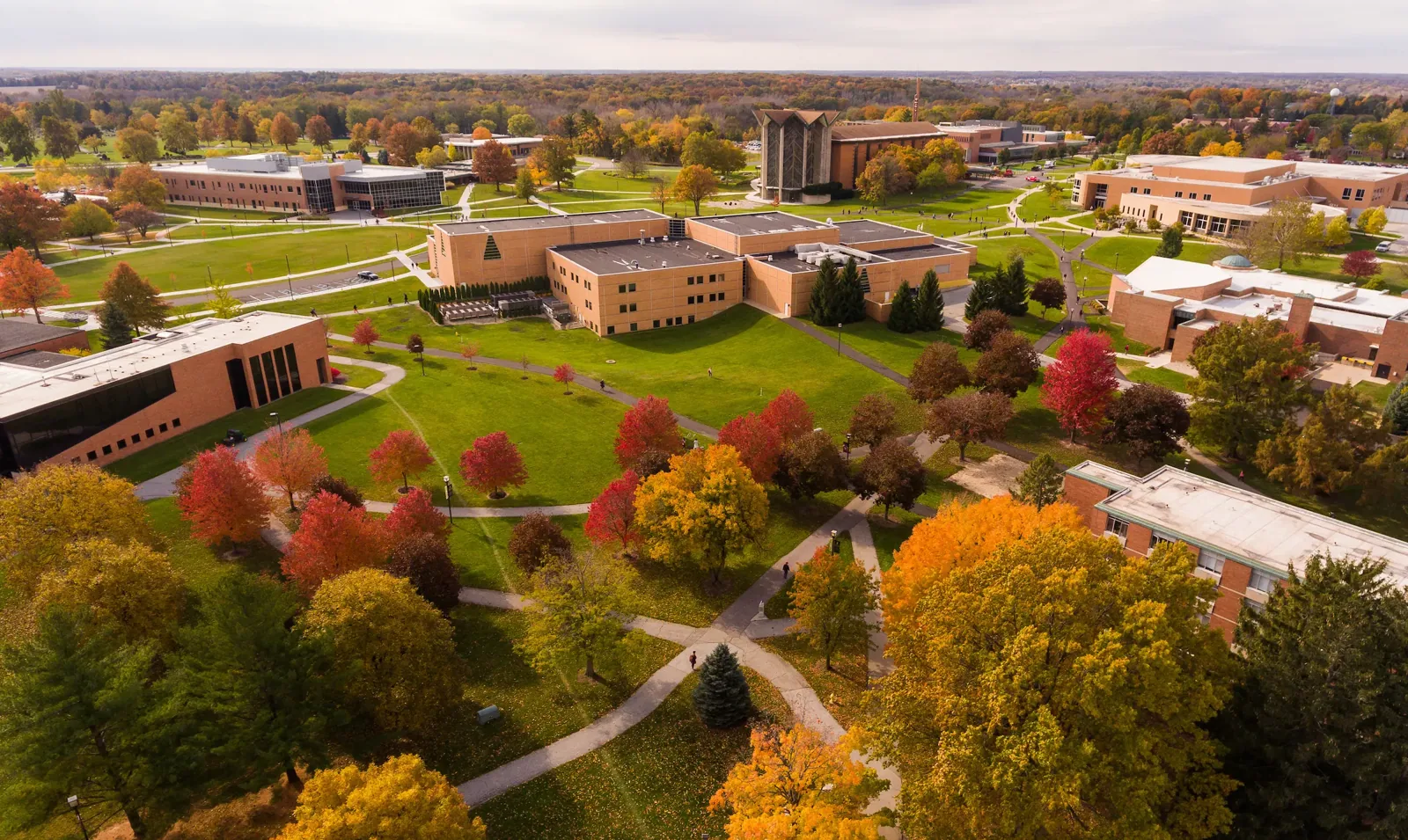
Campus roofs vary because campuses grow. Indiana University South Bend has 11 primary buildings on 80 acres beside the St. Joseph River, including 1961 Northside Hall, the 1989 Schurz Library and a 100,000 square foot Student Activities Center finished in 2004. Whatever has been done to their roofs since, a facilities office needs a record that says which roof is which. Notre Dame's Campus Crossroads project added Duncan Student Center, O'Neill Hall and Corbett Family Hall around the stadium between 2014 and 2017, so even a modern campus holds buildings of several ages.
We walk each roof on its own terms: membrane, seams, parapet and wall flashings, drains, penetrations for laboratory exhaust and air handlers, and the connections where one structure meets another, such as a pedestrian bridge. Those joints move differently from the buildings on either side, and the flashing there is where we expect to find a split.
Working between terms
A campus calendar has two long gaps: the weeks after spring commencement and the weeks before fall move-in. Large replacements get scheduled into those gaps, which leaves a narrow run of dry weather and a crowded field of crews. A residence hall carries a hard date, because students and families arrive on a day that cannot slide, so we sequence the work by section and close each one watertight every evening. Notre Dame Stadium seats 77,622 and has three Campus Crossroads buildings around it, so on a campus like that, crane picks, deliveries and staging on a home-game weekend need an agreed plan before the first truck rolls.
Term-time work is possible as well: reroofing an occupied building means keeping noise away from exam rooms, protecting fresh-air intakes, and giving staff a written notice of the dates and the roof areas in use each day.
Weather across open ground
Campus buildings stand apart from one another, so each roof takes the weather on its own. South Bend sits about 20 miles southeast of Lake Michigan, a normal year brings about 64.5 inches of snow, and one lake-effect storm in November 2022 left 22.7 inches at the airport beside 20.7 in Mishawaka, a load that drifts onto any lower roof beside a taller wall. Freeze-thaw runs from roughly October 18 to May 1, working open seams and cracked sealant. The October 24, 2001 F3 tornado, which touched down near Crumstown and tracked across northwest South Bend toward Niles, is a reminder that copings, edge metal and rooftop equipment need secure attachment even on a low building. After any storm we walk the roofs in priority order, starting with the buildings that hold the most vulnerable contents and finishing with storage and service buildings.
A roof program that outlasts the budget cycle
A campus roof program is a long list that someone has to keep honest. We begin with a condition report on every roof: system, drainage, past repairs, and moisture findings from an infrared scan or a drone roof inspection on the larger or harder-to-reach roofs. Each roof is then ranked by what lies below it and by remaining life. A library or laboratory roof with wet insulation goes ahead of a maintenance building roof that is merely worn. Spring and fall visits through preventive roof maintenance keep small repairs small, and the records let a facilities director argue for a replacement with photographs instead of memory.
Cost follows roof area, how much of the system comes off, rooftop equipment that must be lifted and reset, hoist access on busy walkways and the number of phases the term calendar forces. Roof capital planning lays those drivers across several years so a committee sees the whole sequence.
Each campus sets its own rules
No two campuses in the metro run alike. The Notre Dame area is home to Saint Mary's College and Holy Cross College as well as the university, IU South Bend sits on its river site, and Goshen has Goshen College among its larger institutional sites. A campus with the range of Notre Dame, from the Basilica of the Sacred Heart and Hesburgh Library to the Joyce Center, needs each roof treated as its own asset. The same habits carry over to a K-12 district with several wings, and to student housing, where, as on an apartment roof, a ceiling stain in a bedroom reaches the resident within hours.
Commercial Roofing Questions
Can a university roof be replaced while classes are in session?
In most buildings, yes, with limits. The crew works in sections, closes each one watertight every evening, keeps hot work and tear-off dust away from air intakes, and schedules the loudest steps for hours when lecture rooms below are empty. Labs and recording spaces may need a different sequence, and a written notice to the department names the dates and the rooms most affected.
Who has to approve roof work on a campus?
Expect several offices: facilities, the department that owns the building, risk management for insurance, and campus security for access. Where a university runs its own utilities, as Notre Dame does with water and power, the utility group joins for any shutdown. Raise those names at the first meeting, because a missing signature can cost more dry days than the weather does.
How do residence hall roofs differ from academic building roofs?
Residence halls carry more small penetrations, from bath exhaust to vent stacks, and every leak lands on a student who will call a parent. Academic buildings carry fewer but larger penetrations, such as laboratory exhaust and air handlers, and a leak can damage equipment worth more than the ceiling. We plan inspections and repair priority around those different consequences.
What should a facilities director ask for after a storm?
Ask for a dated photo log of every roof walked, the findings ranked by urgency, and a separate line for temporary work. That package serves the insurer and the capital committee at once. After wind or hail, request a close look at edge metal, seams and rooftop equipment before the next freeze, since water entering a small fracture in November expands it by January.
Is a coating or recover reasonable on an older campus building?
Sometimes, once the roof has been tested. An infrared survey and a few core cuts show whether the insulation is dry and the deck sound. If they are, a coating or a recover can extend the roof's service for a budget cycle or two. If the insulation is saturated, covering it only hides the problem, and replacement is the honest recommendation.
Related Roof Work
Talk to Our Team
Tell us where the water is landing, what the roof is made of and when the building is easiest to reach.
Phone: 555-555-5555
Email: [email protected]