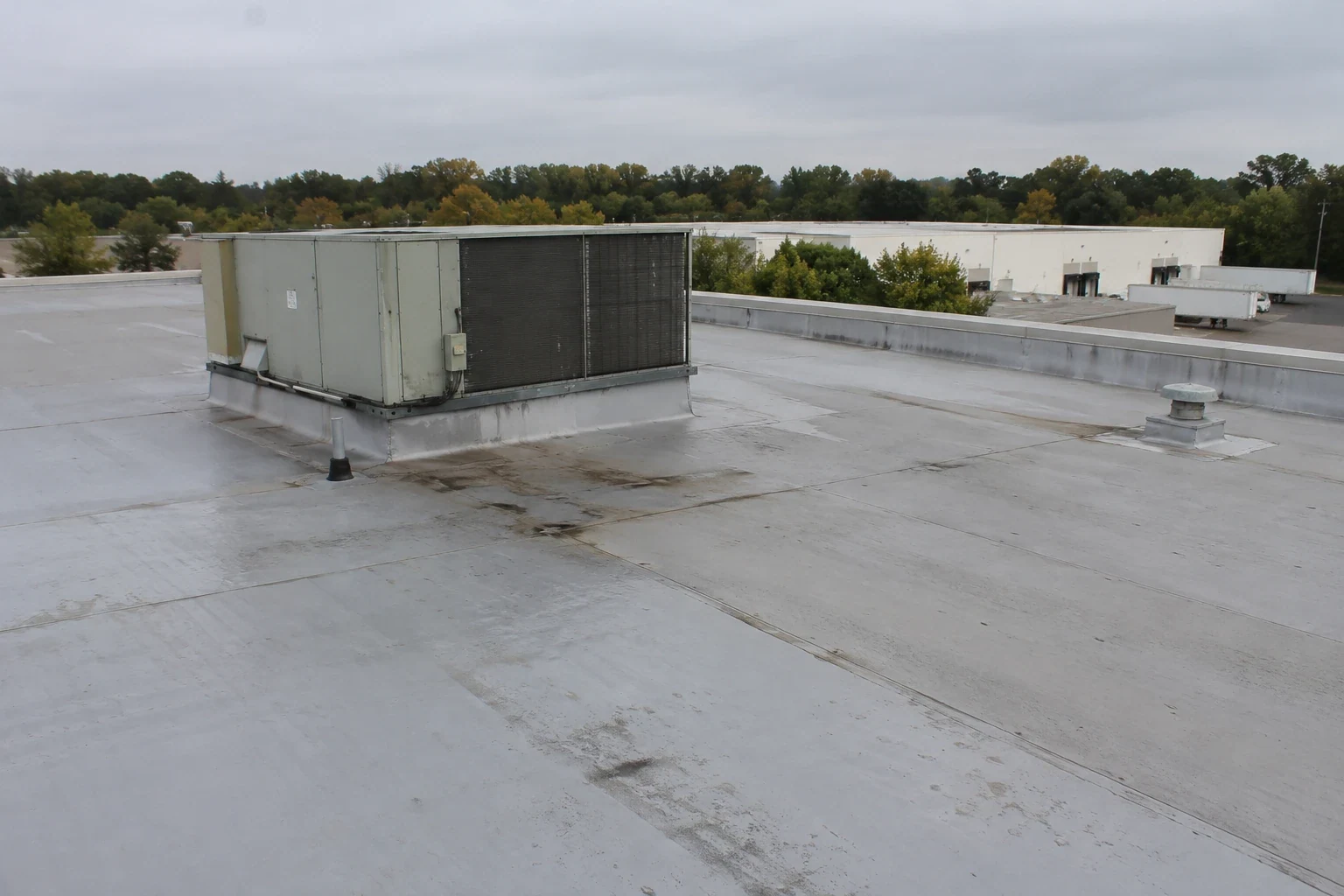
A refrigeration tech climbing a ladder inside the freezer notices a ring of white frost on the deck above the door, in a spot that was bare when the building went into winter. Nothing is dripping, no one has called about a leak, and yet the ring has grown since last week. In a cold storage building in South Bend, IN that frost is the leak, arriving as vapor instead of liquid, and it is already building ice in the insulation overhead. The first visit is about finding the path that moisture is taking, because the roof above a freezer has more than rain to keep out.
Frost before water
On the first call we ask where the frost sits, how long it has been growing, and what lies beneath it: pallets, racking, an evaporator coil, a door. Product that cannot warm up sets our priority, so the refrigeration contractor and the facility lead join the conversation early. Our crew goes to the roof above the frost, checks for open seams, failed flashing and any penetration that lets warm, humid air slip into the assembly, and photographs what it finds. Where an opening is clear, a temporary dry-in goes over it during the visit. Where the path is air rather than water, we mark the location for a closer look with infrared scanning.
Vapor drive runs both directions
A freezer roof lives between two extremes. South Bend has seen 104 degrees in June and minus 22 degrees in January, and the inside of the building holds near zero all year, so in summer the vapor drive pushes from warm outside air toward the cold deck, and in winter the air inside the building tries to leak outward through every gap. Moisture that gets into the insulation freezes, expands and forms ice lenses that lift the membrane from below. The answer is an assembly with a continuous vapor retarder, tight laps at the deck, and insulation and cover board chosen for the cold side of the building, not borrowed from a standard warehouse specification.
Wet insulation costs twice
Insulation in a cold storage roof is thick for a reason, and wet insulation loses much of the value of that thickness. The building pays once for the repair and then again every hour the compressors run harder to make up the difference. Because a roof like this can hide wetness under an intact surface, we often begin with an infrared moisture survey, followed by core cuts at the cold spots to confirm what the scan suggests. The map shows the owner which areas are dry, which are damp and which have frozen into the assembly. Replacing a defined wet section can cost less than replacing the full roof; the moisture map helps compare the scope. A dry warehouse that adds a chilled bay should be scanned the same way before the new room goes in.
Penetrations that breathe
Refrigerant lines, conduit, drain pipes and exhaust sleeves all pass through the roof of a cold building, and each one is a small chimney for warm air. Where the seal fails, moist air rises through the opening, meets the cold deck and freezes into a frost cone that grows all winter. The fix has two parts: a watertight flashing on the outside, and an air seal around the pipe on the inside. We inspect every one of them, since a penetration flashing that looks sound from above can leave a gap beneath it. Mismatched sleeves can cause trouble after a refrigeration contractor adds a line.
Condensers, curbs and weight
The rooftop equipment on a cold storage building is heavy and runs constantly. Condensers, fans and piping put sustained loads on curbs and supports, and a unit that vibrates or leaks condensate can wear the membrane beneath it. We look at each stand, the walking pads that serve it, and the drain path for condensate, and we check that the roof was framed for what now sits on it. When a unit is replaced, the curb and support work happens in the same visit, since an open curb on a cold roof is an invitation for moist air to find the deck. A distribution building that adds freezer rooms later may be asking its roof to carry loads it was never framed for, which is worth checking before the first condenser is lifted.
Fixing the roof without warming the room
Permanent work on a freezer roof moves in small sections and closes each one before the day ends. An open section lets warm air reach the insulation, so we stage the removal and the new assembly to minimize the time any part stays exposed. Industrial listings in the county are concentrated in South Bend, Mishawaka and New Carlisle, where the Indiana Enterprise Center lists spaces from 108,150 to 992,620 square feet, and a freezer or chilled bay in a building like that runs on tight truck windows, so we plan each section around loading hours and the refrigeration schedule. A spray foam system is one option when the owner wants continuous insulation and an adhered surface in a single pass.
At the cold side, a small gap can draw warm, moist air toward the roof and leave condensation below the deck. We trace the vapor-control layer as well as the membrane, because sealing only the outside opening may leave the interior moisture path active.
Commercial Roofing Questions
There is frost on the ceiling near the freezer door, but nothing is dripping. Is the roof the cause?
Often it is, though the water arrives as air. Warm, humid air moves through a gap in the seal or a failed penetration, meets the cold deck and freezes. The frost marks where that path ends. We start with the roof above the spot and check the door seals and penetrations from inside. A moisture scan then shows how far the damage has spread.
Does wet insulation make our compressors work harder?
It does. Water in the insulation carries heat across the assembly much faster than dry foam, so the refrigeration system runs longer to hold the setpoint. The effect is gradual, which is why owners tend to notice the energy bills before the roof. Surveying the roof when consumption rises is a reasonable way to find out whether the insulation has been compromised.
Can you open the roof over a freezer without warming the room?
A plan comes first. We cut and replace in small sections, coordinate timing with the refrigeration lead, and protect each opening as work progresses. The insulation takes on moisture quickly once the deck is open, so sections stay small to keep exposure short.
Who talks to our refrigeration contractor during the work?
We do, beginning at the first walk. The roof and the refrigeration system share penetrations, curbs and condensate lines, and a mistake at either one shows up on the other. We exchange drawings, agree on who shuts down which unit and when, and put the sequence in writing for the facility lead before any equipment is touched.
What does a cold storage roof inspection look at that a standard one skips?
Air paths and ice. Besides the usual seams and flashing, we look for frost cones around penetrations, staining on the underside of the deck, signs of ice in cores, and gaps at the vapor retarder. We also read the building's energy use alongside the condition findings, since a roof that leaks conditioned air or vapor rarely announces itself the way a leaking roof does.
Related Roof Work
- Roof Insulation, Tapered Systems and Cover Board
- Infrared Roof Moisture Surveys
- Warehouse Roofing
- Skylight and Penetration Flashing
- Rooftop Equipment Curbs and Supports
- Distribution Center Roofing
- New Carlisle
- Spray Polyurethane Foam Roofing
Talk to Our Team
Tell us where the water is landing, what the roof is made of and when the building is easiest to reach.
Phone: 555-555-5555
Email: [email protected]