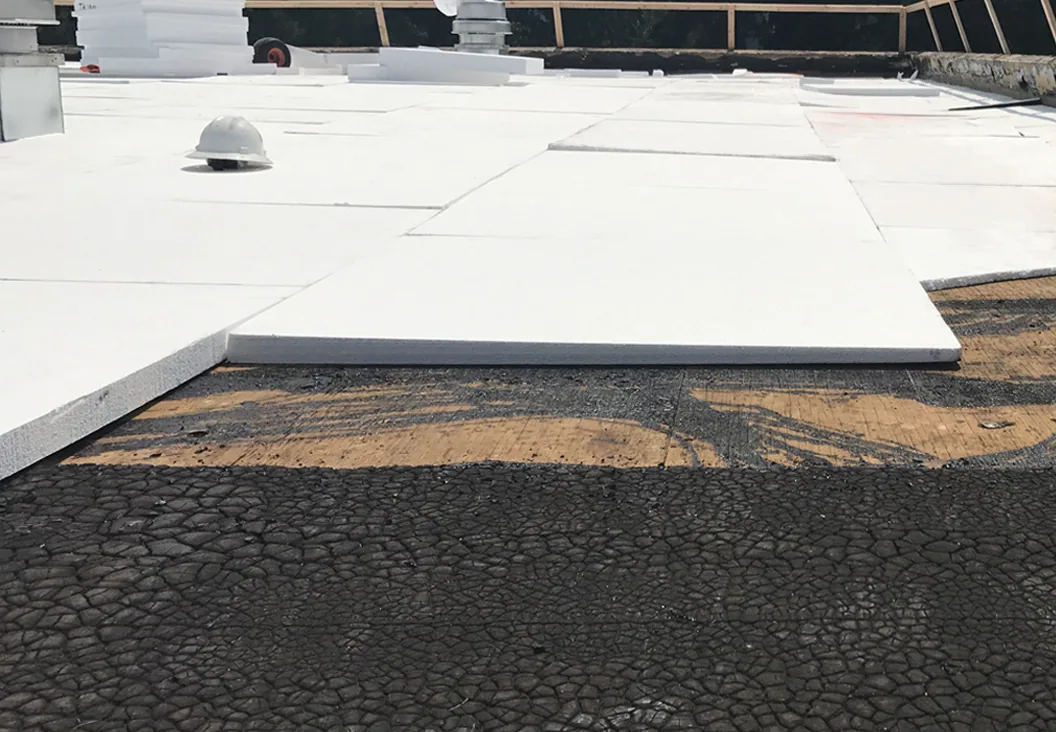
A technician steps near the middle of the span, and his boot leaves a dent in the roof that does not spring back. Under the membrane, the insulation has turned to a soft, wet sponge, and nobody can say how long it has been that way. Insulation is the part of a roof nobody sees and everybody pays for, in heating bills, in comfort near the roof deck, and in the strange soft spots that appear after a few winters. In South Bend, IN the insulation also does two jobs the owner never asked it to do: it supports the membrane against foot traffic and hail, and, when it is tapered, it is the thing that sends water toward the drains.
What the insulation is doing up there
Rigid insulation boards lie over the deck, under the membrane, and they slow heat from leaving the building through the roof. This region spends roughly six months of every year between the average first freeze on October 18 and the average last freeze around May 1, so the heating season is long and the benefit is steady. The boards also provide a flat, firm surface for the membrane to bear on. When water gets in, the boards lose both jobs at once: wet insulation conducts heat poorly and softens, and the membrane above it flexes, wears and cracks at the seams. That is why a leak that is patched but never traced into the insulation keeps returning, and why the infrared moisture survey is so often the next step.
Insulation and the energy code
When a roof is replaced, the insulation must meet the energy code in force for the permit. Indiana's commercial energy code is the 2010 edition, based on ASHRAE 90.1-2007. The state has proposed using the 2024 International Building Code for its next 2026 edition, but it has not published an effective date. We confirm the edition used by the local building department and specify the insulation thickness before pricing, so the owner can compare the roof assembly with the permit requirements.
Tapered boards that move water
Tapered insulation is cut in wedges that form a slope across the roof. Laid out correctly, it carries water to drains and scuppers, fills in low spots and builds small saddles around rooftop units so water goes around them. A roof that ponds after every storm often has a flat or sagging deck with no slope to help it, and a tapered system corrects that without rebuilding the structure. We draw the layout before ordering, marking each drain and each ridge and checking that the finished height clears the edge metal and door thresholds. The drains and scuppers must work with the new slope, and a ponding water repair built on tapered boards is among the longer-lasting fixes for ponding.
The board between insulation and membrane
Cover board is a thin, dense panel that sits over the insulation and under the membrane. It does several jobs that the softer insulation cannot. It resists impact, and South Bend saw hail up to an inch across on June 1, 2019, which is plenty to bruise a membrane over soft foam. It takes foot traffic from technicians who service rooftop units. It gives adhesives a better surface to bond to, and it adds a layer of fire resistance beneath the membrane. Gypsum-based boards, high-density polyiso and mineral-fiber boards each have strengths, and our choice depends on the membrane above and how the roof will be used. Owners recovering from hail damage frequently add cover board as a safeguard against the next storm.
How the boards are held down
Insulation is attached with mechanical fasteners, with adhesive, or in a few cases with ballast, and the choice sets how well the whole assembly resists uplift. The highest gust on record at South Bend is 92 mph, and the roof edge and corners take much more force than the field, so the fastener pattern is denser there. Adhesive attachment keeps the deck free of penetrations and can quiet a roof over occupied space, while mechanical attachment is faster in cold weather when adhesive will not cure. We work from the manufacturer's attachment tables and confirm the numbers on the plan before the first board goes down. Elkhart is about 15 miles east of South Bend and has large-format manufacturing and assembly buildings. On a plant roof, the attachment plan gets particular attention at corners and edges, where wind pressure is higher.
Cutting out what is wet
Not all wet insulation has to come out. A core cut and a moisture scan tell us how much is saturated and how much is merely damp at the surface. If the wet area is small, we remove and replace it in sections, matching the thickness so the finished surface stays level. If it is widespread, replacement of the membrane and insulation together is usually the better investment, and we say so in the proposal. Where conditions allow, a roof recover can retain dry insulation and add cover board with a new membrane above it. For roofs headed toward full replacement, we fold the insulation upgrade into the same scope so the work happens once.
Commercial Roofing Questions
How do I know the existing insulation can stay in place?
We test it, and the answer comes from core cuts and a moisture scan rather than the age of the roof. Dry, firm boards of the right thickness can usually stay, especially under a recover with new cover board. Boards that are crushed, wet or badly curled have to go. The test results go to the owner with photographs of each core, which also helps if a lender or a buyer asks about the roof later.
Is cover board worth adding if we have never had hail trouble?
Often yes, because the benefit is not limited to hail. A cover board spreads foot traffic and tool drops, stabilizes the surface under adhered membranes and adds a measure of fire resistance. It adds material cost and installation time, but it can extend the membrane's useful life on roofs that see regular service visits. For a roof with almost no rooftop equipment, a thinner approach might be enough, and we say so.
Can we add insulation for the energy code without replacing the membrane?
A code upgrade can sometimes be paired with a recover, using new insulation and a membrane above the existing roof. That option depends on dry retained materials, structural capacity and edge height. If those conditions do not fit, the upgrade belongs in a tear-off scope. We compare the applicable code, roof condition and parapet or threshold limits before recommending a route.
Will tapered insulation raise the roof too high at the parapets and doors?
It can, which is why the layout is drawn before anything is ordered. Tapered boards add height toward the high points of the roof, and the finished surface has to leave enough upturn for flashing at walls, curbs and thresholds. When the numbers are tight, we reduce the slope, shift the high point or add sumps to keep the height down. We measure each door and edge in advance, so surprises stay off the roof.
What happens to insulation that sits open overnight if the weather turns?
It gets wet, and wet boards are a loss. That is why each opened area is covered before work pauses and the tie-in is sealed against weather, even when the sky looks clear. Material stacks are covered and kept off the surface. In cold weather, a surprise snow squall at five o'clock is something we plan for, not something we react to.
Related Roof Work
Talk to Our Team
Tell us where the water is landing, what the roof is made of and when the building is easiest to reach.
Phone: 555-555-5555
Email: [email protected]