Two days into a thaw, a pool the size of a parking space sits at the low corner of the roof, and the drain beside it is a ring of ice with a little meltwater circling above it. Nothing is leaking yet. The property manager sees the standing water from a window, photographs it and sends it over with a one-line question. Water that cannot leave a flat roof in South Bend, IN is already searching for the weakest lap, flashing or fastener it can find. The drains, scuppers and slopes decide whether that search ends in a dry building or a wet ceiling, which is why we treat them as the first thing to check and the first thing to fix.
Ice at the drain
Freeze-thaw is a leading reason drains fail in this climate. The average first freeze falls around October 18, the last arrives near May 1, and in between a drain bowl can freeze overnight, thaw by noon and refreeze before dawn. Water from a melting roof reaches a frozen bowl and spreads across the surface instead of going down. We clear the ice by hand and with low-pressure steam where the situation allows, never with a hammer or a blade near the membrane, since a chipped flashing creates a worse problem than the one it solves. After the drain is open, we trace the leader down to see where the ice formed, because a downspout that is frozen at the bottom will back water up to the roof again by evening.
Reading how the roof drains
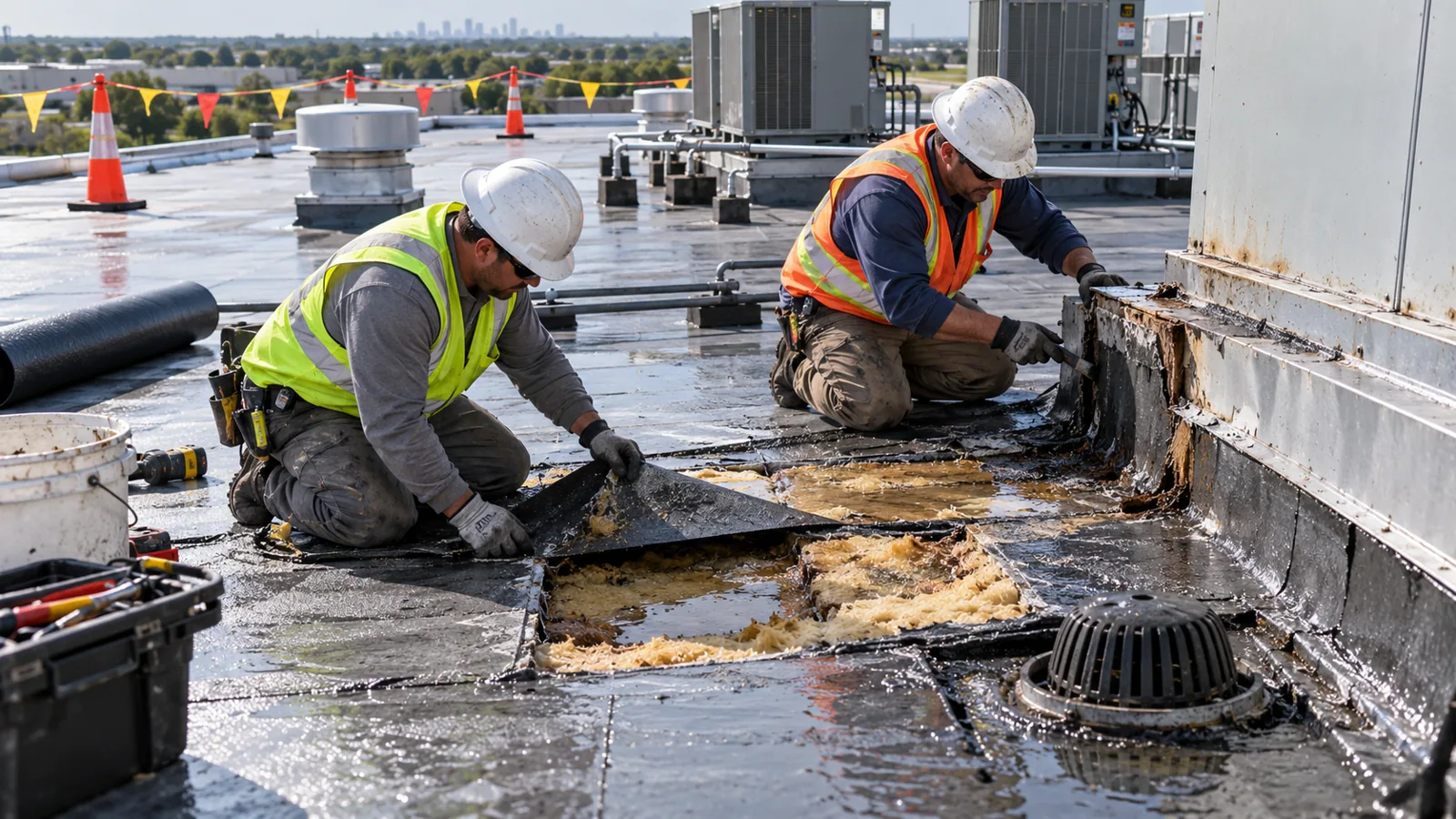
Every roof has a drainage plan, though not every owner has a copy. We map it. We find the primary drains, trace the interior piping when it exists, and locate the overflow scuppers set higher in the parapet, which are the roof's safety valve when the main drains cannot keep up. Then we look at the parts that go wrong: a cracked clamp ring, a missing strainer dome, a drain sump that sits proud of the membrane so water bypasses it, and a cast bowl whose flashing has separated from the roof. We note whether each opening is sized for the area it serves and whether debris catches on the way in. The result is a sketch the manager can keep, showing where water should go and where it actually goes.
Crickets and tapered fixes
Many roofs hold water because the deck sags, the insulation settled, or the roof was never pitched toward the drain to begin with. Water that stays more than about two days after rain counts as ponding, and it speeds up membrane wear, collects dirt and ices over in winter. A cricket is a small tapered section built behind a rooftop unit or at a parapet corner so water turns toward the drain instead of resting against the curb. Where the low spot is shallow, we correct it with tapered boards or a built-up sump, and where it is broad, the answer is a larger tapered insulation system. A ponding water repair that skips the slope only hides the pool for a season, and our spring and fall maintenance visits keep checking it.
Scuppers through the parapet
A scupper is an opening through a parapet or edge wall that lets water leave the roof sideways, usually into a collector head and downspout. Problems begin at the opening. The membrane has to be flashed into it cleanly, the metal liner has to be sealed to the wall, and the sill has to sit low enough to drain the roof without leaving a lip that holds water. On a building that has been renovated over the years, a scupper cut in later often leaves sealant doing more work than it should, and that is as true on a plant near Elkhart as on a downtown office. We replace failed liners, enlarge undersized openings when the wall permits it, and tie the new metal into the edge metal and gutters so the whole path stays watertight.
What a hard rain asks of a drain
The 24-hour rainfall record at South Bend is 4.88 inches, set on August 2 and 3, 1995, and measurable precipitation falls on roughly 148 days of an ordinary year. A flat roof that is merely adequate on a mild day can overload in a storm like that one, because water backs up behind the parapet faster than the drains can pass it. A rapid melt after a heavy lake-effect stretch, like the 30.2 inches that fell on South Bend in the first twenty days of November 2022, puts the same load on the system for days once warmth arrives. We check whether the overflow openings sit at a sensible height, whether a leader is undersized for the area, and whether the roof would shed water if one drain clogs. Where it would not, we recommend a fix before the next big weather event.
Adding or replacing a drain
Installing a new drain means cutting through the deck, so the work is planned around what sits below. We confirm where piping can run, protect the space under the opening, and coordinate with the tenant when a ceiling must be opened. The old bowl comes out, a new body and clamp ring go in, and the membrane is flashed to it with a reinforced collar that is tested before the crew leaves. For a building that stays open, we schedule the cut on a day when the interior space is quiet and send the tenant the same notice we use for a leak repair visit. In a park like the South Bend Airport Business Park, which lists 12 industrial spaces, an owner with several buildings can have the drains on each checked in a single mobilization.
Commercial Roofing Questions
Why does water stand near a drain that is not clogged?
Usually the drain sits higher than the surrounding membrane, either because the sump was installed proud or because the insulation around it compressed over time. Water then lingers in a shallow ring instead of falling in. A second cause is a roof pitched away from the drain, which only a slope correction fixes. We measure the height difference with a level before deciding, so the owner pays for the right repair, not a cleaning that will not change the outcome.
Can a drain be added without replacing the roof?
Yes, in most cases. The deck is cored, a drain body is set, piping is connected below, and the membrane is cut back and flashed to the new body with reinforced material that matches the existing system. The condition of the surrounding roof matters, because a worn membrane next to the new flashing can fail around it. We inspect a wide area first, and if the membrane is near the end of its life we say so before cutting.
Who is responsible for keeping drains clear, our staff or the roofer?
Whoever the lease and the maintenance agreement name, and that is often unclear. Building staff can clear surface debris from drains they can reach safely, but they should stay off the roof in winter. Our maintenance visits include the drains and scuppers every time, with a photo of each opening before and after, which gives the manager a clear record of who cleared what and when.
Do we really need overflow scuppers if the main drains work fine?
An overflow path gives water another exit if the primary drains clog. On a parapet roof, water otherwise has nowhere to go until it reaches a weak detail or adds load to the structure. If an overflow starts flowing, it is a sign that the main drainage system needs inspection.
What can be done about a downspout that freezes at the bottom?
Start by finding where the discharge goes. A downspout that ends over a sidewalk or a flat slab will puddle and freeze, and ice then climbs back up the pipe. Extending it to an open grade or tying it to storm piping solves most cases. Heat cable can help in a pinch, but it needs power and regular checks. We look at the whole path from roof to ground before recommending anything.
Related Roof Work
- Roof Insulation, Tapered Systems and Cover Board
- Ponding Water Roof Repair
- Preventive Roof Maintenance
- Elkhart
- Edge Metal, Coping and Gutter Repair
- Commercial Roof Leak Repair
Talk to Our Team
Tell us where the water is landing, what the roof is made of and when the building is easiest to reach.
Phone: 555-555-5555
Email: [email protected]