A bucket sits under the skylight well in the lobby every time the snow melts, and the maintenance technician has stopped calling it a leak and started calling it the lobby drip. Everyone in the building has seen it, and nobody has fixed it, because the last two attempts with sealant held until the next freeze. Openings through a roof are where water wins most often, and in South Bend, IN the climate tests every one of them. Every skylight, vent, conduit and pipe is a place where one material meets another, and flashing is the work of making that meeting hold through snow, sun and a wide temperature swing.
East Bank Village is a mixed-use city redevelopment area; skylight openings and closure work still need coordination with each property's schedule.
Skylights on curbs
Most commercial skylights sit on a curb, a short raised frame built into the roof. The membrane turns up the curb as base flashing, a metal cap or counterflashing covers the top edge, and the skylight unit seals to the curb with a gasket or a bead of sealant. Failure can begin in any layer. The glazing seal dries out, the flashing laps open, the corner of the curb was never reinforced, or the unit itself cracked. Hail damage makes it worse, because stones of about an inch, like those recorded in South Bend on June 1, 2019, can crack acrylic domes without touching the membrane nearby. We examine the dome, the gasket, the curb and the flashing separately, so the repair fixes the part that actually failed.
Pipes, conduit and vents
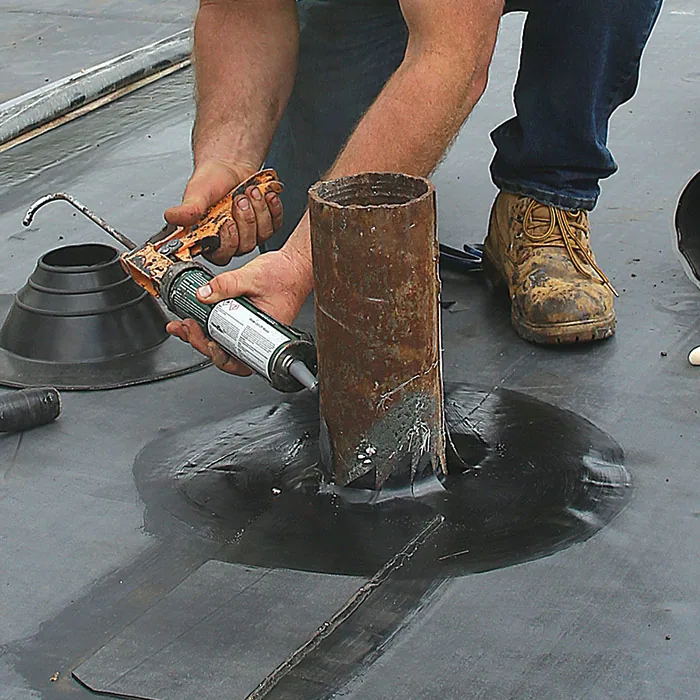
Smaller penetrations fail for a different reason: they are easy to install badly and easy to forget. A rubber boot around a vent pipe cracks in the sun and splits in the cold. A pitch pocket, the open box filled with sealer around a cluster of pipes, shrinks and pulls away from the pipes as it ages. A clamp collar loosens, and a conduit that was added later may have only a smear of caulk around it. Buildings that carry heavy mechanical and electrical service, data centers among them, accumulate penetrations over time, and downtown South Bend is home to the Union Station Technology Center, billed as northern Indiana's largest data center. We map every opening, rate each by condition and replace the weak ones with fitted boots, welded flashings or premanufactured curbs.
Snow piles against the curb
Snowfall here runs about 64.5 inches in a typical year, and drift builds on the lee side of every raised object on a flat roof. A skylight or a vent stack collects a bank of packed snow that can sit against the flashing for weeks. When the weather warms, melting water runs along the base of the curb, refreezes at night and works its way under any lap that is not fully sealed. Counterflashing that was set too low, or a curb that is shorter than a typical drift, can let water in over the top. We raise flashing heights where the roof allows, add a small cricket on the uphill side so water goes around the curb, and set sealant joints in places where they stay out of standing water.
Finding which opening is leaking
A roof with six openings and one drip needs a systematic test. We start inside, mapping the wet area and checking whether the stain follows rain, melting snow or only humid weather, because condensation on a glass unit can mimic a leak. Then we go up and water-test one opening at a time, beginning at the lowest point and working uphill so the result is not confused by water from above. When a test is inconclusive, an infrared moisture survey shows which part of the insulation is wet and points to the entry. The sequence matches a full roof leak repair, narrowed to the openings.
Reflash, replace or remove
Once we know the cause, there are usually three paths. Reflashing keeps the existing unit and rebuilds the base flashing and cap, which suits a skylight in good condition on a curb that has simply worn out. Replacement installs a new unit on a new or rebuilt curb, and it brings the energy code into play. Indiana's energy code is still the 2010 edition, which points to the 2007 ASHRAE commercial standard, so a replacement unit has to meet the glazing requirements written into it. Removal means deciding whether the daylight is worth the maintenance, and some owners choose to infill the opening. Daylight has real value in buildings that bring it in through glazing, such as the VA clinic in the Mishawaka with its three clerestory atrium entrances, and an owner weighs that against upkeep before removing anything.
Protecting the space below
Skylight work happens above rooms that are in use: lobbies, atriums, corridors and open offices. Before we open anything we tell the manager what we will do, protect the floor and furniture below the opening, and agree on a window when the space can be closed. A replacement day can be loud and dusty, so we plan the cutting and handling around the building's quietest hours. If the skylight leaks during the repair, we have tarps and a dry-in plan staged on the roof, which prevents an unexpected shower in the lobby. After the work, we photograph the finished flashing from several angles and leave the manager with a record of the unit, the curb and the materials used. Where the wall flashing around the roof has failed too, the same documented steps carry into flashing failure repair, and the record stays in one file.
Commercial Roofing Questions
How do I know whether the skylight is leaking or just sweating?
Look at when the water appears. Condensation forms on cold glass on humid, cold days and drips from the underside of the frame, and it often stops once the interior humidity drops. A leak follows rain or melting snow and shows up at corners, curb joints or ceiling tiles beside the unit. If it is hard to tell, we mist the unit from outside and watch from inside, which separates the two in a single visit.
Can a leaking skylight be sealed over instead of replaced?
Sometimes, if the curb and glazing are sound and only the sealant has failed. A bead of the right sealant on a clean joint can last for a few seasons, but sealing alone rarely fixes a flashing problem, and sealant applied to a wet or dusty surface does not bond. We usually recommend rebuilding the flashing correctly and sealing only the final joints, so the repair does not depend on caulk alone.
Why does the same pipe boot keep leaking after every repair?
Often the pipe moves. Pipes that carry hot or cold fluids expand and contract, and a boot that is clamped rigidly will tear at the same place each winter. Another cause is a boot that was sized for a smaller pipe or set in a roof that ponds at that spot. We look at the movement, the water pattern and the age of the surrounding membrane, then choose a flashing that fits the actual condition.
Who flashes the equipment that another trade installed on the roof?
Whoever the contract names, but in practice it is often nobody, which is how leaks begin. A mechanical contractor sets a unit and a cable installer adds a conduit, and neither one is responsible for the membrane. We recommend that the roofer be present for any new penetration, or at least inspect it afterward. We can flash each new opening, set the equipment curbs properly, and add everything to the roof plan, so the next inspection knows it exists.
Does hail damage skylights even when the membrane looks fine?
Yes, and it is one of the first places we check after a storm. Acrylic and polycarbonate domes crack or craze when struck, and cracks may be too fine to see until water collects in them. Metal curbs and caps dent. We photograph each unit with a raking light and note chips, spider cracks and bent flanges. If the owner files a claim, those photographs become part of the record of the storm's impact.
Related Roof Work
- East Bank Village
- Hail Damage Roof Repair
- Downtown South Bend
- Infrared Roof Moisture Surveys
- Commercial Roof Leak Repair
- Mishawaka
- Flashing Failure Repair
- Rooftop Equipment Curbs and Supports
Talk to Our Team
Tell us where the water is landing, what the roof is made of and when the building is easiest to reach.
Phone: 555-555-5555
Email: [email protected]