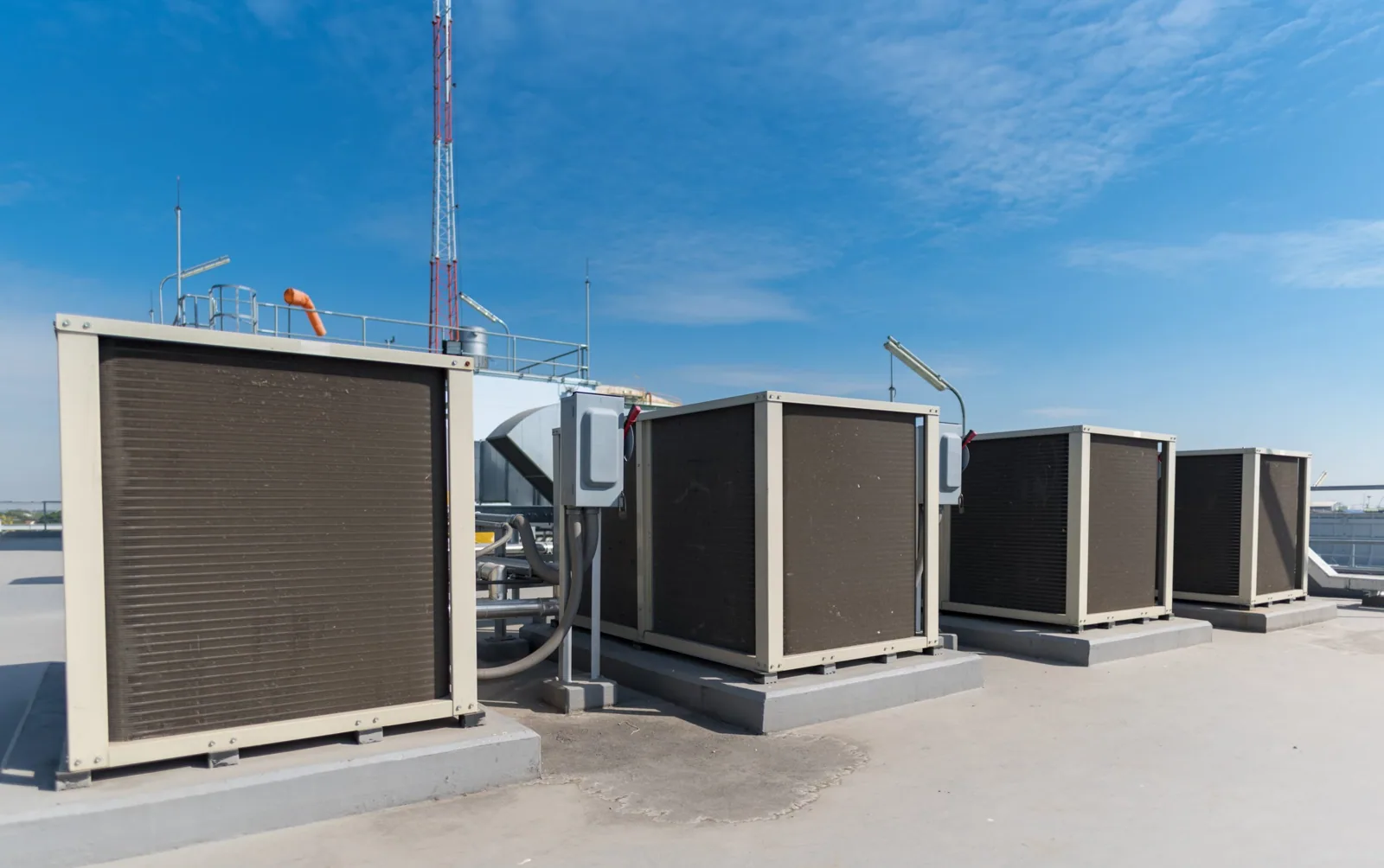
A mechanical contractor swaps a rooftop unit on a Friday afternoon in November, and by the following Wednesday a tenant in South Bend, IN is calling about a damp ceiling tile directly beneath the new equipment. Nothing about the membrane looks wrong from the hatch. The leak is at the curb, where a new unit sat on an old frame, a gap opened at one corner, and the first thaw sent meltwater down the side of the box. Curbs, equipment supports and pipe supports are the places where a roof is cut open, built back up and sealed by hand, which is why they leak long before the open field of the roof does. We build them, repair them and reflash them so the equipment on your roof stops opening the roof underneath it.
Where the leak starts at a unit
The first visit is on site, and we start at the equipment rather than the open field. We look at the flashing where the membrane turns up the side of the curb, the counterflashing or storm collar above it, the curb cap, and the sealant at every corner and fastener. We check whether the curb stands tall enough to stay above ponded water and the snow that stacks around it, because a curb that clears the membrane by only a few inches will take water over the top during the first thick melt.
Then we look at what the unit hides. Rusted pans, loose condensate lines and wet insulation under the footprint all show up once the panels are open. Each finding goes into a photo log with its position on the roof plan.
Drift load and ice at the units
Lake-effect weather does particular things to rooftop equipment. Snowfall averages 64.5 inches a year in South Bend, and the wind packs it against a tall unit the same way it packs it against a parapet. The lake-effect event of November 2022 left 22.7 inches at the airport and 20.7 inches in Mishawaka. Drift load like that can bury lower louvers, hold meltwater against a curb flashing for days, and push ice into the seam between the cap and the unit.
Where a drain sits close to a curb, ice at the drains backs water up against the frame from the low side. We study where the drifts build and where the water goes, and when we reflash a curb we raise the upper termination and slope the cap so water leaves instead of waiting. We clear the drains and scuppers near the equipment on the same visit.
Building a curb that holds
A new or rebuilt curb follows a sequence. The frame is set square and fastened to the deck or to a structural member, with blocking where the deck needs it. Insulation is cut tight to the frame, a cover board goes over it, and the membrane turns up the curb in as few pieces as the size allows, with welded or adhered corners rather than a patchwork of field seams. A counterflashing or cap closes the top edge over the membrane.
Pipe supports get the same attention. We set pads or pedestals on a protected layer of membrane so each support spreads its weight, and the pipe can move with heat and cold without rubbing a hole through the roof. Where a pipe or duct passes through the roof itself, the work overlaps with penetration flashing, and we treat the two together.
Replacing a unit without hurting the roof
Many curb leaks begin on the day a unit is replaced. The new equipment often has a different footprint from the old, so someone sets an adapter, shifts a frame or cuts a new opening and leaves the old flashing behind. We prefer to be on the roof before the crane lifts, not after. That means marking the curb height and the membrane termination, protecting the surrounding roof with boards, and agreeing with the mechanical contractor on who flashes what.
The opening matters as much as the new work. If freezing rain is in the forecast, agree on a temporary dry-in before the old unit comes off and keep the opening protected during the changeout. A tenant notice goes out ahead of any shutdown that could affect heat or cooling inside, and a follow-up visit after the first rain or thaw confirms that the new flashing is doing its job.
Data rooms, hospitals and malls
Equipment density changes the plan. The first phase of Ignition Park included a Tier III data center. A data center cannot pause its cooling without consequence, and Memorial Hospital of South Bend, a Level II trauma center with 526 staffed beds, is the same problem from another side. Buildings that house servers and patients depend on mechanical systems that are rarely allowed to pause, so a data center roof or a hospital roof gets flashing work in small sections, with equipment kept running whenever the sequence allows.
A multi-tenant retail property like University Park Mall on Grape Road brings a different habit. Many tenants mean many mechanical contractors, each with a reason to be on the roof, so protected walk routes and a clear record of what was repaired keep their visits from undoing the work.
Wind, attachment and code
The highest gust recorded at South Bend was 92 mph on August 22, 1996, and the October 2016 straight-line wind damage ran along West Indiana Avenue and from Northside Boulevard to Longfellow Road. Wind finds loose equipment and thin curb caps first. A unit should be fastened to its curb, and the curb to the structure, in a way that suits the weight of the unit and the pressure at that part of the roof, which runs higher at corners and edges. Our crews note loose or missing fasteners on each visit and flag them for the equipment installer.
Local building departments, including South Bend, apply the 2014 Indiana Building Code, which is based on the 2012 International Building Code. Repairs that touch curb height, flashing or wind damage are written up with that in mind, and the photo log goes to the owner and, when it matters, the insurer.
Commercial Roofing Questions
Our HVAC contractor wants to set a new unit next week. When should we call you?
Call before the crane date. The best moment is when the unit is ordered, so curb height and flashing details are settled before anyone is on the roof. If the date is already close, we will still meet the contractor on site, mark the membrane termination, and agree on a temporary dry-in for the opening so the building stays dry if the weather turns.
Can a curb be reflashed while the unit keeps running?
Most of the time the work can be staged one side at a time, with the panels left in place and the unit serving the building. The membrane is cut back, the old flashing removed and new material installed along one face, then the next. A few cases need a short shutdown, and then tenant notice goes out early.
Why does the leak only show up when snow melts?
Meltwater is slow, steady and persistent, and it finds the small gap that a rain shower runs past. Snow packed against a curb holds water against the flashing for hours, and a freeze at night pushes it into any open seam. A February ceiling stain often traces back to a sealant joint that failed the summer before.
Do pipe and conduit supports really damage a membrane?
They can, slowly. A rigid support that sits directly on the membrane concentrates weight in a small spot, and every expansion and contraction cycle rubs it a little more. Over a few winters that wear can open a hole. A pad or pedestal spreads the load and gives the line room to move. We replace worn supports during repairs and photograph the ones we leave.
If the original contractor cut the opening badly, who fixes the flashing?
We document the curb, roof cut and flashing with photographs, then explain whether the opening, frame, membrane or equipment transition needs correction. If another trade owns part of the assembly, the findings show where the scopes meet and what must be coordinated before the unit is reset.
Related Roof Work
- Mishawaka
- Roof Drains, Scuppers and Ponding Correction
- Skylight and Penetration Flashing
- Data Center Roofing
- Hospital Roofing
- Wind Damage Roof Repair
Talk to Our Team
Tell us where the water is landing, what the roof is made of and when the building is easiest to reach.
Phone: 555-555-5555
Email: [email protected]