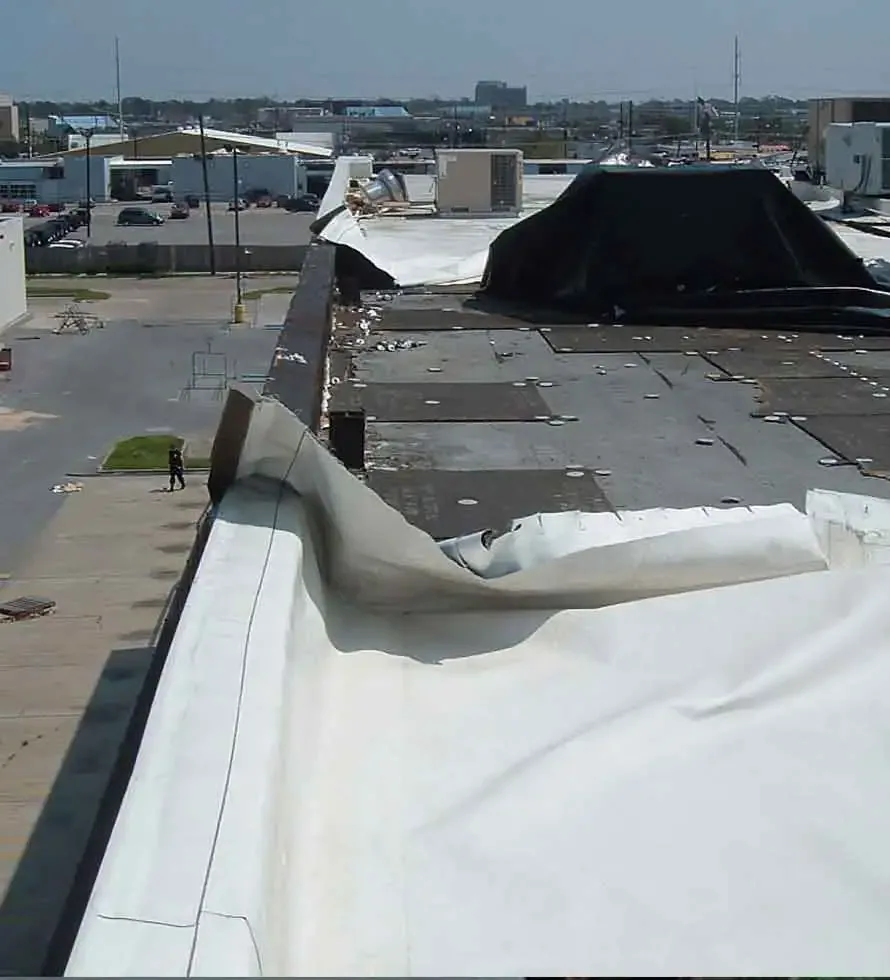
The first report is rarely a phone call. It is a photograph from a tenant's truck window: a strip of membrane folded back over a parapet in a Mishawaka lot, the insulation beneath it already dark from the rain that followed the gust. By the time that picture reaches a property manager, the roof has stopped being a roof and become an open edge, and every hour of weather after that adds water to a building that was dry the day before. Wind damage repair in South Bend, IN starts with that image and works backward, from what lifted to what held, in a sequence that protects the interior first and the paperwork second.
The first hour is a walk around the building
When the call comes in, we ask where the pieces landed before we ask where the membrane tore. Debris tells us which way the gust travelled, and the direction tells us which corner of the roof took the load. A crew arrives on site, walks the ground first for fallen edge metal, torn sheet and anything that could drop onto a sidewalk, and fences off whatever cannot be moved safely. Only then does someone climb. Up top we start at the windward corners, because uplift concentrates there, and work toward the middle, putting every lifted lap, every missing fastener plate and every shifted piece of equipment into a photo log with its position on a simple sketch of the roof. The property manager receives the photographs with a plain statement of what remains open to weather.
Where a gust gets under the sheet
A membrane rarely fails in the middle of the field. Moving air finds the perimeter first, so we inspect the edge metal and the cleat that holds it, the termination at the parapet, and the first few feet of sheet along the edge where attachment is meant to be densest. In a mechanically attached system we look for fasteners that have backed out or pulled through the deck, and for the ridges that show a sheet has been fluttering. In an adhered system we lift the edge of each loose area gently to learn how far the bond has released, because the visible tear is often a fraction of the damaged zone. Rooftop units and exhaust fans are checked for curbs that have walked, since a unit that moved a quarter inch has moved the flashing around it too.
Make safe before anything is replaced
Temporary protection comes ahead of the permanent repair, and with wind damage the order matters more, because a loose sheet cannot simply be taped down and trusted. Where the membrane is still attached on three sides we cut away what is flapping, secure what can be saved, and install a temporary dry-in, the kind of emergency repair a storm calls for, over the opening with battens that spread the load across many fasteners instead of a few. Where edge metal is gone we close the gap so neither air nor water can get under the field sheet. If the building is occupied, the property manager hears what noise and access to expect overnight, so the dry-in does not arrive as a surprise to the tenant underneath it.
Rebuilding the edge so it holds next time
A permanent repair that only restores what was there will fail the same way, because the edge was the weakest part of the attachment to begin with. We rebuild it with closer fastener spacing at the perimeter and corners, edge metal re-hung on continuous cleats instead of spot nails, and coping and edge metal that locks under the membrane instead of resting on it. The code that applies is Indiana's 2014 edition, which tracks the 2012 IBC and is enforced by local departments such as South Bend's, and the state has a rule pending to move to the 2024 IBC. Uplift for a roof covering is figured from ASCE criteria, so a repair that opens a large share of the roof may bring the attachment pattern under review. We ask the permit office before the work is priced, not after.
Gusts this market has already recorded
South Bend does not need a hypothetical windstorm to make the case. The highest gust recorded here reached 92 mph on August 22, 1996, which is the number edge metal, copings and membrane attachment have to be able to meet. Earlier in 2016, on April 1, a storm of high wind and rain collapsed part of the roof over the county services building in Mishawaka, and water damaged the top floor extensively. On October 12 of that year, two EF0 tornadoes struck St. Joseph County, wind damage showed up along West Indiana Avenue, and a microburst swath lay between Northside Boulevard and Longfellow Road. A big-box store along the Grape Road corridor or an industrial building near New Carlisle should have its repair detailed for gusts of that size, since this market has already produced them. When the wind comes with a funnel, the damage is usually wider and deeper, and tornado damage repair starts with a debris field and a structural check before any membrane work.
What the insurer needs to see
Wind claims are decided on evidence gathered early. Before anything is cut away or swept up, we photograph the damage in place: the lifted sheet, the displaced metal, the debris field and the direction it points. The photo log is dated and tied to the roof sketch, and it separates new storm damage from older wear such as dried sealant or fasteners that were already loose, because an adjuster will draw that line and the property manager is better served when it has been drawn first. The claim moves faster when the adjuster receives a written summary of what was found, what temporary work was done and what the permanent scope includes, which is most of what roof insurance claim assistance means after a wind loss.
Afterward, drifting snow and ice can load the same exposed edges.
Commercial Roofing Questions
A run of edge metal blew off but nothing is dripping. Can it wait until the weather settles?
Treat it as a priority even with a dry ceiling. Once the metal is gone, the edge of the membrane is exposed to the next gust and to water running behind the sheet, and the damage grows quietly until a stain finally appears. We can usually make the edge safe on the first visit, and the permanent metal can then be scheduled for a stretch of mild days after the thaw.
How do we separate storm damage from a roof that was already failing?
The pattern gives it away. Storm damage concentrates at the windward corners and perimeter, with fresh tears and clean, bright edges where material let go. Wear from age is scattered across the field, with dirty cracks, old patches and softened sealant. Our photo log records both, and the summary we write lists them separately so an adjuster and an owner are reading the same facts.
Our ballasted roof lost a lot of stone to the wind. Is that a repair or a replacement?
Start with how much sheet is now exposed and whether it has been punctured or stretched. If the membrane is intact, the repair is usually to restore ballast to the weight the roof was designed for, with extra attention at corners and edges. If the sheet is torn or the insulation under it is wet, the scope grows, and a moisture scan will show how far.
Should the roofer or the insurer hear about it first?
Call us to make the opening safe, then notify the insurer the same day. Photograph the damage before material is moved, save displaced components, and keep the temporary-protection invoice with the claim file. Our dated log separates fresh damage from earlier wear.
A rooftop unit shifted in the wind. Can the mechanical contractor just reset it?
Have the roof checked before the unit goes back down. A unit that moved has usually dragged or cracked the curb flashing, and setting it back on a damaged curb hides the problem under a fresh coat of paint. We repair the flashing first, confirm the curb is sound, and then the mechanical contractor sets the unit on a roof that is ready for it.
Related Roof Work
Talk to Our Team
Tell us where the water is landing, what the roof is made of and when the building is easiest to reach.
Phone: 555-555-5555
Email: [email protected]