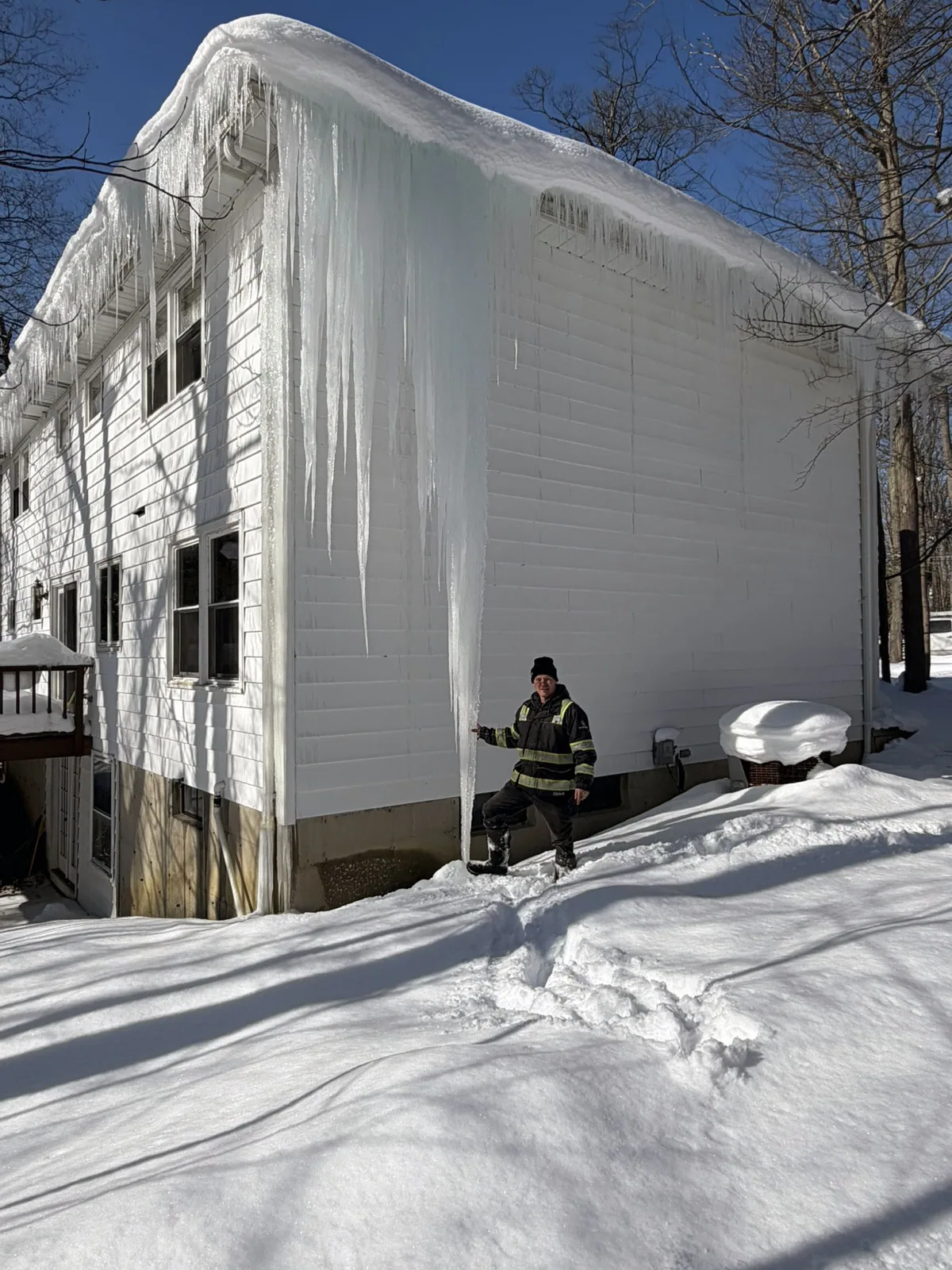
It is the mild afternoon in the middle of a hard winter that gives it away: a steady drip from the canopy over the main entrance, and fresh ice on a walk that was clear at breakfast. Up on the roof, a week of snow has been sitting against the parapet, the sun has softened it, and the meltwater is running toward a drain that is packed with ice, so it backs up to the nearest lap or flashing instead. By the time the property manager calls from South Bend, IN, the questions are how much weight the roof is carrying and where the water is going next. The assessment follows that order: structural warning signs, drainage and ice, the damage left behind, then a permanent repair scope.
Weight comes first
An average year in South Bend brings 64.5 inches of snow, but a single week says more about a roof than the yearly total. In November 2022 a lake-effect event put 22.7 inches on South Bend International Airport and 20.7 inches on Mishawaka, and the first twenty days of that month added up to 30.2 inches, the most on record for that stretch. A flat roof does not hold that snow as an even blanket. Wind scours the open field and drops the snow behind parapets, rooftop units and any wall where a tall roof meets a low one, so a corner can carry far more than the middle does.
We watch for a ceiling grid that has dropped, a door that binds or a sprinkler line that has shifted. Those signs call for the owner to bring in the building's structural engineer before anyone accesses the affected area. A dip that lingers after the thaw still matters, because it becomes a pond, and the answer for that is the same as for any ponding water roof repair.
Ice builds where heat leaks
An ice dam starts with warmth that was never meant to reach the snow. Heat escapes through a thin spot in the insulation, around a curb or along a wall, and melts the snow above it. The meltwater runs to the coldest part of the roof, which is the edge, a gutter, a scupper or a drain sump, and freezes there. The next melt cannot get past, and the water rises behind the dam until it reaches a seam, a flashing termination or the base of a wall, all of which are built to shed water and not to hold it. In South Bend, the average first freeze is around October 18 and the last around May 1, so the city sees repeated freeze-thaw conditions across much of the cold season.
With interior drains, the trouble is a sump frozen solid while the field above it melts. A gutter fills and pulls away from the fascia under the weight. Snow lets go from metal in a sheet, which is why retention matters on a standing seam metal roof.
What the thaw shows us
The thaw is when damage can be read, so we schedule the follow-up visit for that window and not for the week of the storm. On the membrane we look for tears from shovels and ice tools, laps that opened where ice lifted them, fasteners that backed out, and splits at parapets and curbs. A lap that opened is a seam failure, and it gets repaired as one. At the perimeter we check coping, edge metal and gutters, and at the equipment we check whether a curb shifted under a drift.
Water that got in during the ice is the part nobody can see. Wet insulation stays wet through the summer and keeps feeding the leak, so where a ceiling has stained we recommend an infrared moisture survey before anyone patches.
Clear it without cutting it
Snow removal starts where the water leaves: the drains, scuppers and gutters, then the drifts against parapets and units, then the field. We leave a thin layer of snow on the membrane, use plastic or rubber-edged tools, and never chip ice off a seam or flashing. The crew works inward from the edges in a balanced pattern, tied off, because a skylight under a drift looks like flat ground. The outlets get first attention, whether they are interior roof drains and scuppers or gutters.
Where water is already coming in, we make safe first: a temporary dry-in at the leak, tarps over the tenant's equipment inside, and a sketch of the wet area. That is the same temporary work as in any emergency roof repair, and it holds only until the weather allows the permanent fix, because sealants do not cure properly in the cold.
Fixing the cause for next winter
A drain that froze may need a larger sump, a heated drain body, or tapered insulation that gets water to it sooner. A drift that crushed a curb may call for a taller one with proper flashing, and a gutter that pulled loose may return in heavier metal. Each is a line on a repair list sorted by urgency. Changes that affect structural load or add rooftop equipment should be reviewed with the appropriate building official and a qualified engineer before work proceeds.
Buildings that collect it
Grape Road corridor in Mishawaka stands mostly one story tall inside a parking field of more than 4,300 spaces, and wind crossing open ground like that drops its load at the first wall or unit it meets, so the roof edges at the storefronts get checked first after a lake-effect week. The South Bend Airport Business Park lists 12 industrial spaces of 70,000 to 165,000 square feet each at an airport with three runways, open ground where wind moves snow until a wall stops it. In Elkhart, about 15 miles east of South Bend, large-format plants dominate the building stock, and a flat roof with interior drains can hold a pond for days behind one frozen drain.
The record for insurers and tenants
We photograph the roof before and after clearing and record the condition of the membrane, flashings and drains as found. An insurer will want to separate sudden damage, such as a torn membrane or a fallen gutter, from earlier wear, and located photographs make that line easier to draw. For the paperwork we offer roof insurance claim assistance. Tenant notices can identify the affected area, expected noise and any suites that could need protection. After thaw, a follow-up inspection can check whether repaired details have moved or show new moisture.
Commercial Roofing Questions
How do I know whether the snow on my roof has become a structural concern?
Look inside the building before you look at the roof. A dropped ceiling grid, sticking doors, new cracks near columns and sagging sprinkler lines all suggest the deck is carrying too much. Keep people out of that area, call a structural engineer, then call us so the snow comes off in a planned order.
Should my maintenance staff shovel the roof themselves?
Staff can clear a drain from a hatch or an edge, which prevents many winter leaks. Beyond that, leave the field to a crew with fall protection and soft tools, because the usual failures are a shovel through the membrane and a boot through a skylight under a drift. If the drain is frozen solid, call before chipping at it.
Why does the leak show up on the warm day instead of the cold one?
Because a cold day keeps the water frozen where it fell. Once the temperature passes freezing, snow melts faster than a drain can take it, ice holds the water back, and a lap that stayed dry in December leaks in the thaw. The first dry day after the melt is the time to trace it.
Is heat cable at the drains worth adding?
We look at the insulation and the slope around the drain first, because removing the cause often beats heating around it.
Related Roof Work
Talk to Our Team
Tell us where the water is landing, what the roof is made of and when the building is easiest to reach.
Phone: 555-555-5555
Email: [email protected]