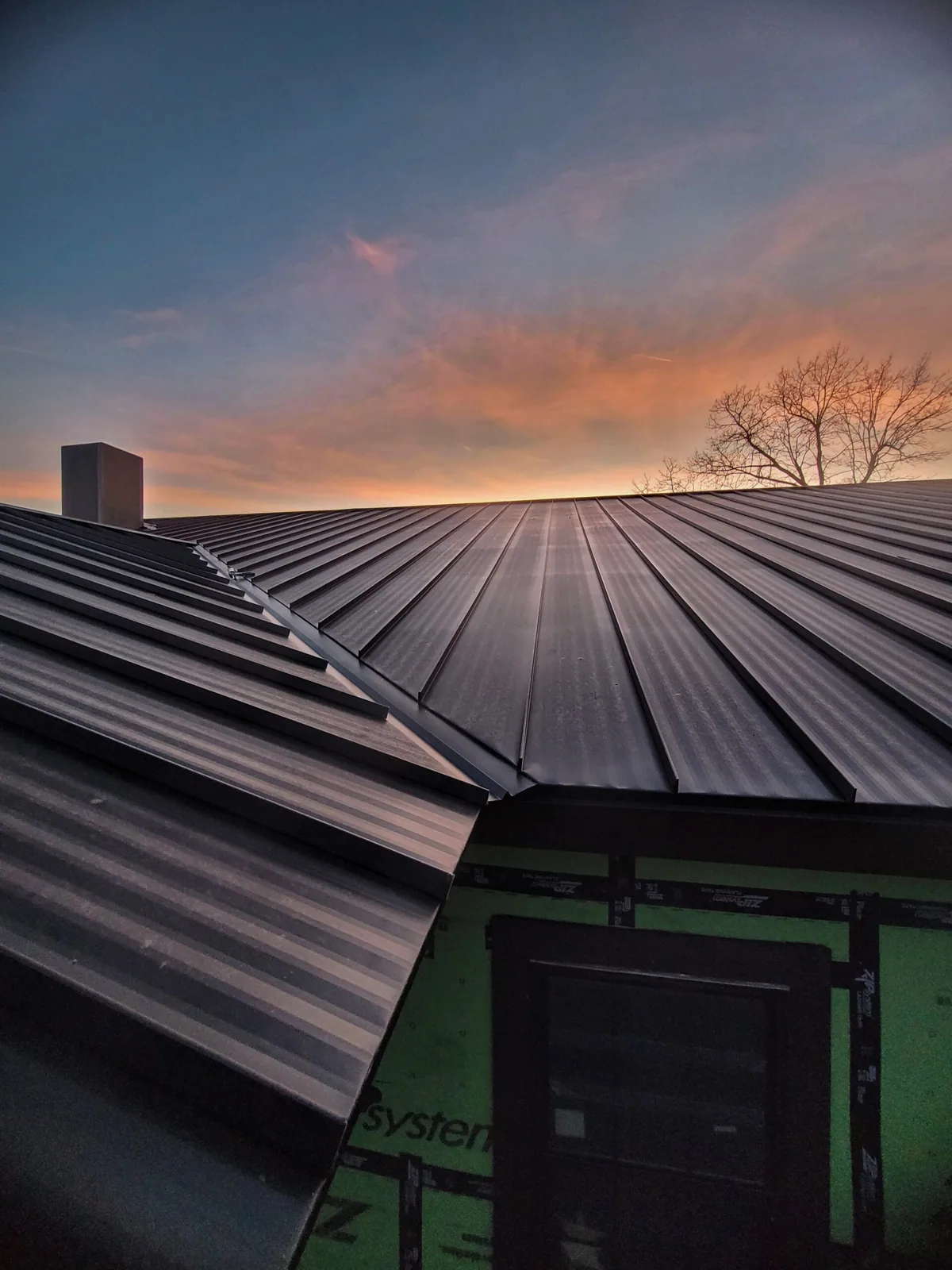
A sheet of snow lets go from a metal roof without warning and lands where the walkway meets the entrance. Everyone in a snow market has heard that story, and it is the best reason to plan a standing seam roof as a whole system and not only as panels. In South Bend, IN, where the roof sees months of cold, wet snow and a sudden thaw, the panels, clips, seams, trim and snow retention all work together. A standing seam roof has raised seams that lock the panels side by side, with clips hidden underneath so that no screws pierce the weathering surface. Done carefully it is among the longest-lived options a building owner can choose, and the details are where that length is earned.
Snow does not stay put
Metal can release snow quickly, which may help above a loading dock but creates a hazard over a front door. Snow here averages roughly 64.5 inches a season, and in November 2022 a single lake-effect event put 22.7 inches on the airport. After a week like that, the question is whether the snow slides all at once. Snow guards or rail systems break the slide into small pieces, hold the load on the roof and protect people, vehicles, gas meters and rooftop equipment below. We lay out retention by mapping the walkways, entrances, drives and mechanical equipment under each slope, then spacing the guards by roof pitch and panel length. Eaves and gutters get their own attention, because ice that forms at the drip edge can tear a gutter away, and a slide that lands on a roof below is a snow and ice damage call waiting to happen.
Clips, seams and movement
A metal roof moves. Over a range from a recorded -22 F to 104 F, a long steel panel grows and shrinks by a visible amount, and the system has to let it. Standing seam roofs use floating clips that hold the panel down while letting it slide, with one fixed point near the middle or the ridge so the movement goes where the trim can handle it. Penetrations, curbs and transitions are placed to avoid pinning a moving panel in place. The seams themselves are either snap-locked or mechanically seamed with a tool that folds the edge tight. On lower slopes the mechanically seamed type, often with sealant, is the one that matters, because water backs up under a loose lock during a thaw. Every seam gets inspected before the crew moves on.
Wind at the edges
Wind finds the corners and the eaves first, so the clip spacing is tighter there and the trim is heavier. Wind here has peaked at 92 mph in a recorded gust, and the pair of EF0 tornadoes that struck St. Joseph County on October 12, 2016 left straight-line wind damage along West Indiana Avenue. After any wind damage report we check clips and trim before anything else. Those numbers are why we ask for the manufacturer's tested assembly for the panel, clip and deck combination, instead of assuming that a heavy panel is a safe one. Ridge, hip and rake details also matter, because they are where a lifted edge starts. The October 24, 2001 F3 tornado that tracked across northwest South Bend toward Niles was a reminder that the worst events are rare but possible, and that metal roofing is only as strong as its weakest cleat.
Dents, finish and the insurer
Hail leaves marks on metal that other surfaces do not show. The June 1, 2019 storms dropped stones up to 1.25 inches near Crumstown and one inch in South Bend, and a stone that size can dent a thin panel without breaking the seal. The question is whether the dent is cosmetic or functional. A cosmetic dent leaves the coating and the seam intact, while a functional one cracks the paint, opens a seam or deforms a clip. Many insurance policies treat the two differently, so we photograph each slope, test the finish and record what we find in a form the adjuster can use. Our roof insurance claim assistance keeps that evidence organized, and a heavier gauge or a textured panel can reduce visible denting on a new roof.
Clips, curbs and solar
Standing seam is popular where panels will be added, because arrays can clamp to the raised seams without drilling through the roof. The Honeysuckle solar station, a 188 MWdc project in service at New Carlisle since 2024, shows how close solar is to this market. Large industrial buildings, like the spaces listed at the Indiana Enterprise Center in New Carlisle, which range from 108,150 to 992,620 square feet of floor space, are where the question of solar comes up. We review the clamp loads, the snow retention and the walkway layout before an array goes on, and our solar-ready roofing work follows the same checks. For rooftop units, a proper equipment curb with its own flashing keeps the panels free to move.
Older metal and the next step
If the building already has an older metal roof, the choice may be to restore it. Exposed-fastener panels with failing screws and sealant are better handled through a metal roof retrofit, which can add a new standing seam layer over the old one when the structure and the code allow. We install and repair with a record that the property manager keeps: the photo log, panel and clip documentation, the snow retention layout and the follow-up after the first thaw. That visit checks seams, trim, gutters and guards after the roof has been through a freeze cycle. Low-slope wings on the same property may use EPDM roofing, with membrane seams and edge details documented separately from the metal panels.
Commercial Roofing Questions
Where does the snow go when it slides off a metal roof?
Straight onto whatever is below, unless the roof has retention. That could be a walkway, a loading dock or a parked truck. We map the areas under each slope and install snow guards or rail systems so the snow melts in place or releases in small pieces. A roof that drains toward an entrance usually gets more retention than one that drains over a lawn.
Do we need snow guards on every standing seam roof here?
Not every one. A steep slope over open ground may need none, and a low slope may hold snow without help. Anything above doors, drives, meters or equipment deserves retention. We look at the pitch, the panel length and what stands below before recommending guards, and we place them so they do not damage the seam.
Why does the metal roof pop and tick on cold mornings?
Panels contract overnight and slide on their clips as the temperature changes. A little noise is normal. Loud popping or banging can mean a clip is binding or a panel is pinned by a curb or trim. We inspect those spots and free the panel, because a restrained panel can crack a seam over time.
Will hail dents hurt the roof or only its looks?
Dents in the flat of the panel are often cosmetic if the coating and seams are intact. Cracked paint, a deformed clip or an opened seam is functional damage and needs repair. We photograph each slope and test the finish, then put the findings in writing for you and the adjuster. Policy wording on cosmetic damage varies, so we do not guess at coverage.
Is standing seam practical on a low slope roof?
With mechanically seamed panels and sealant at the laps, yes. Snap-lock panels belong on steeper slopes where water drains quickly. On a low slope the seam closure, the substrate and the end laps all need extra care, and some buildings are better served by a membrane. We recommend what the slope and the detailing support.
Related Roof Work
- Edge Metal, Coping and Gutter Repair
- Snow and Ice Roof Damage Repair
- Wind Damage Roof Repair
- Roof Insurance Claim Assistance
- Indiana Enterprise Center, New Carlisle
- Solar-Ready Roofing
- Rooftop Equipment Curbs and Supports
- Metal Roof Retrofit and Restoration
- EPDM Roofing
Talk to Our Team
Tell us where the water is landing, what the roof is made of and when the building is easiest to reach.
Phone: 555-555-5555
Email: [email protected]