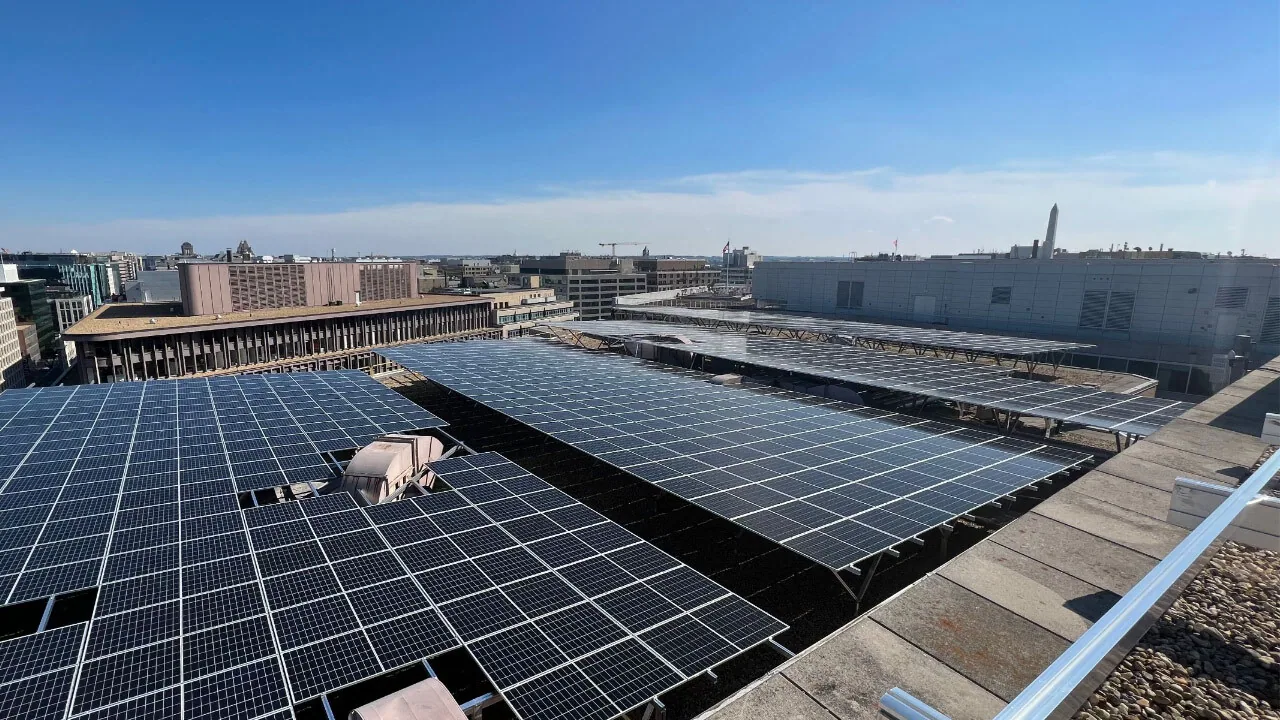
A solar proposal arrives with a roof plan attached, and somewhere near the corner of the drawing is a line asking who will stand behind the membrane under the panels. The owner has a roof to protect, a lender who wants a payback schedule, and an installer who needs a signature by the end of the month. The answer to that line decides whether the array is a good decision or a future leak. In South Bend, IN the roof under those panels has to live with roughly 64.5 inches of snow in a typical year, shed meltwater through a long freeze-thaw season, and still be watertight when the array comes off. We prepare commercial roofs so the answer is yes before the first rack is set.
Roof age against array life
A solar array is a long-term investment, so the roof under it should be evaluated before installation. Setting panels on a membrane with a few good years left means paying twice, once to lift the array and again to replace what was underneath. So the first step on site is an honest look at the roof: the membrane, the seams, the flashing and what the insulation is holding. An infrared moisture survey shows wet insulation that no walk-through can see, and core samples show how much life the layers have left.
If the roof has years to spare, we repair weak spots and set a plan. If it does not, the better order is a new roof first and solar second, and we write that up with photographs so the owner and the installer are reading from the same record. Our commercial roof replacement sequence can be timed to the installer's calendar.
What goes down before the first rack
Preparation is mostly about the layers under the load. A cover board and insulation with enough compressive strength spreads the weight of ballast blocks and keeps racks from crushing the layer beneath them. Drains are cleared and tested, and low spots that hold water are corrected, because standing water under a rack stays there for weeks and ice forms in it by January.
We also help set the routes. Conduit gets its own supports so it does not lie across the membrane, and walkways go where the electrician and the cleaning crew will actually walk. A TPO or similar membrane is fine under panels when it is detailed properly, and the details are what we spend time on.
Ballast, attachment and wind
Racks are held down by weight, by attachment through the deck, or by both. Ballast adds dead load that the structure has to carry, and attachment adds penetrations that have to be flashed and kept sealed. Neither is free. A structural engineer sets the load, and the array installer designs the rack; our part is to make sure the roof surface and flashing details can live with whichever method is chosen.
Wind matters at the edges. The 92 mph gust of August 22, 1996 is South Bend's record, and the October 2016 storms brought wind damage to West Indiana Avenue and a microburst swath between Northside Boulevard and Longfellow Road. Uplift is highest at corners and perimeters, so those zones get closer attention and often set the limit on where panels can sit. The commercial code that applies statewide is the 2014 Indiana Building Code, which rests on the 2012 International Building Code, and the rack design and roof plan are expected to line up with the adopted loads.
Snow behind the rows
Panels change how snow lies on a roof. Rows catch drift on their leeward side, and a warm afternoon can release a sheet of snow and ice that slides into the next row or toward a drain. In November 2022 the airport took 22.7 inches of lake-effect snow in one event, with 20.7 inches falling on Mishawaka, and a roof carrying an array through that kind of load needs clear paths for snow removal and for meltwater.
We look at where drifts will form around the rows, how far a sliding sheet can travel before it meets a scupper or an edge, and whether the lowest panels sit high enough to clear a normal snow depth. After the thaw, we check the membrane under the panels for scuffs and low spots, and our snow and ice damage repair work picks up what the array has hidden.
Who works on the roof afterward
A roof with an array has more visitors. Electricians, cleaning crews and the people who monitor inverters all have reasons to walk it, and each visit is a chance for a dropped tool or a worn pad. A leak under a rack is harder to trace than a leak in an open field, because the water can travel under the panels before it shows below.
Before the array goes on, we record the roof in a photo log, a clean baseline that makes a later claim or repair easier to sort out. Afterward, preventive maintenance visits include the ground under the rows. When a repair does land beneath panels, the installer's electrician disconnects and lifts the affected section, we repair the membrane, and the section goes back once the work is dry. Ask the membrane manufacturer in writing what it requires of other trades before anything is drilled or set.
Power projects around South Bend
Solar is already part of the county's power picture. The Honeysuckle solar generating station at New Carlisle entered service in 2024 at 188 MWdc. That is a generating station rather than a rooftop array, but it shows that solar is no longer a stranger in St. Joseph County. The University of Notre Dame runs its own power systems, and Ignition Park was pitched on the power capacity of the Studebaker corridor, so buildings in those places are sitting close to the question of where their energy comes from.
For commercial owners, the roof is where those energy decisions meet the weather. We prepare the roof and leave the output of the array to the installer and the sun. What we offer is a dry roof, a clear plan, and a record that stands up when the panels need to move.
Commercial Roofing Questions
How much life should the roof have left before solar goes on?
Plan for a roof that will outlast the array, or replace it first. The cost of lifting panels later, with an electrician and a crane, usually exceeds the saving from squeezing a few more years out of the old membrane. We inspect, core and survey, then tell you whether the roof is a good host or should be replaced before the racks arrive.
Will the solar installer's work affect the roof warranty?
Membrane manufacturers set conditions on what other trades may do to a warranted roof, including penetrations and ballast. Get the warranty paperwork to the installer before the contract is signed and ask the manufacturer in writing what it needs. We follow the written details for flashing and walkways so the roof is not the weak link in the paperwork.
Can panels be lifted so you can repair a leak?
Usually, in sections. The installer's electrician disconnects and removes the affected modules or racks, we open the membrane, repair it, and test before everything goes back. A photo log taken before the install makes the search faster, because a leak found in February under a snow-covered array is a slow job.
Is a ballasted array easier on the roof than an attached one?
Each trades one risk for another. Ballast adds weight and can crush weak insulation or rub the membrane, while attachment adds penetrations to flash. On a roof with good insulation strength, ballast is often gentler on the membrane. The structural engineer and installer make that call, and we detail the surface to match.
Who clears snow on a roof that has panels?
Snow removal crews need a map of the rows and instructions to keep shovels and blades off the modules and the membrane. We help build that map, mark the drains and the safe walk lanes, and recommend hand tools near the edges. Sliding snow from the panels is a reason to keep lanes open all winter instead of waiting until a drain is already iced shut.
Related Roof Work
- Infrared Roof Moisture Surveys
- Commercial Roof Replacement
- Roof Insulation, Tapered Systems and Cover Board
- TPO Roofing
- Snow and Ice Roof Damage Repair
- Preventive Roof Maintenance
- New Carlisle
- Ignition Park
Talk to Our Team
Tell us where the water is landing, what the roof is made of and when the building is easiest to reach.
Phone: 555-555-5555
Email: [email protected]