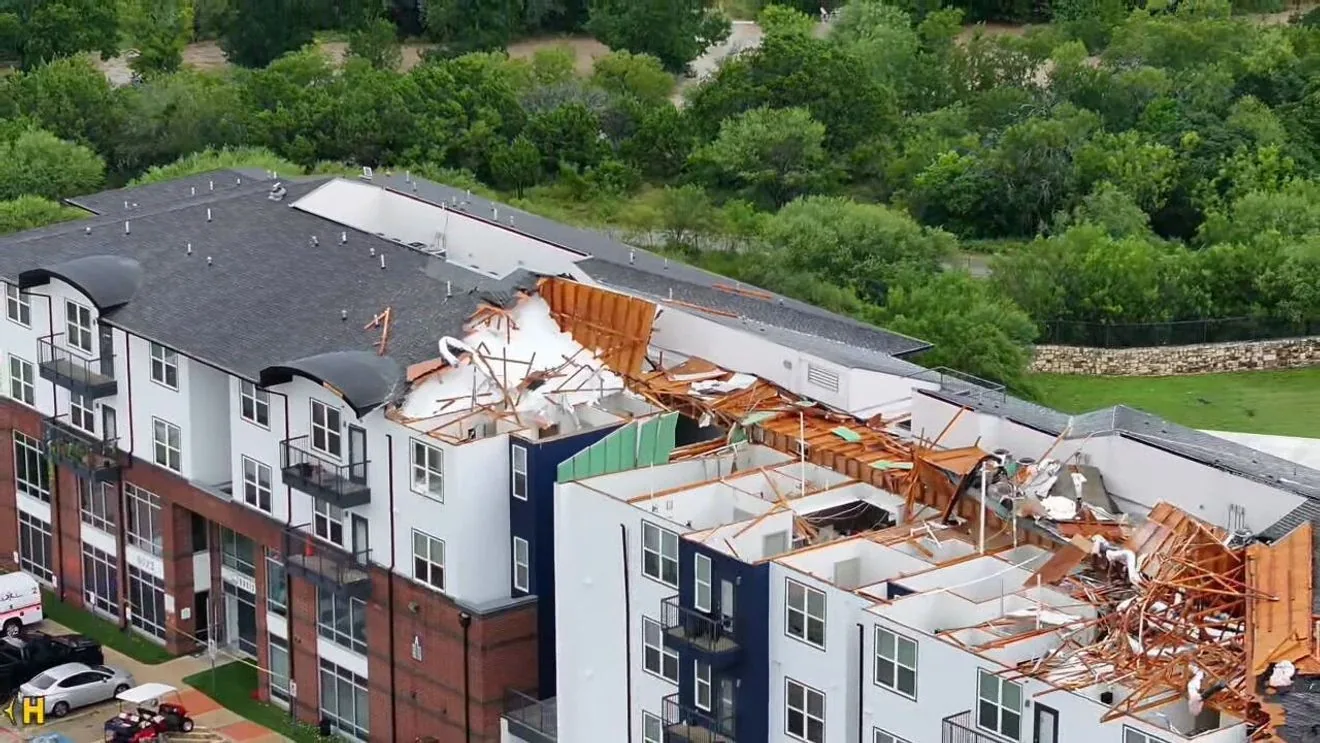
The sirens have been quiet for an hour when the property manager reaches the lot and finds a section of somebody else's roof lying across the parked cars, with no clear idea yet of what is missing from their own. The tenants are standing outside. A gas smell is being checked by the utility. Water is already finding its way in through whatever the storm opened. Tornado damage roof repair in South Bend, IN follows a strict sequence: people, structure, weather, then the roof.
The first call comes before the first ladder
Nothing about the roof is urgent until the building is known to be safe. On the phone we ask whether the utility has cleared gas and power, whether the fire department has released the site and whether any walls or parapets are leaning, and we stay off the roof until the answers are in. From the ground and from a drone we document the pattern of damage, the debris field and the condition of the edges, and we flag anything that looks ready to fall onto a sidewalk. A structural engineer then walks the building. Where a wall has moved or a deck has shifted, no one climbs until shoring is in. The initial visit is a safety assessment; the photo log starts before debris is moved.
Which building, which roof, in which order
A tornado seldom damages just one roof, and a campus or shopping center may have several buildings open to the weather at once. We sort them by what the occupants need: a space holding records, medicine or equipment comes ahead of a storage building, and an occupied suite comes ahead of an empty one. The sequence goes onto a single page the property manager can share, listing the building, the work, the crew and the expected time for temporary protection. On a multi-tenant retail property along Grape Road corridor that page names tenants, and on a single-tenant building it is one line. Having the order in writing stops the daily argument about whose roof is next.
What a funnel does that ordinary wind does not
Straight-line wind pushes on a building from one direction, and the damage points the same way. A tornado adds a sharp drop in pressure and rotating winds that pull on the roof from above and from several sides in a few seconds. Whole sections of membrane and deck can lift together, parapets and walls can fail, and rooftop units can be carried off their curbs. Debris from other buildings arrives with enough force to puncture, crush or tear the sheet, and each of those holes is repaired as a membrane puncture. The damage pattern is mixed, with sound sections beside sections that are gone. When the evidence shows only straight-line wind and no rotation, the roof is a wind damage repair instead.
Two Octobers and what they left
St. Joseph County has a tornado record of its own. On October 24, 2001, an F3 tornado came down close to Crumstown and ran northeast through the northwest side of South Bend in the direction of Niles, while an F2 tornado struck between Mishawaka and Osceola with its worst damage on South Shore Avenue. On October 12, 2016, two EF0 tornadoes touched down in and near South Bend, wind damage showed up along West Indiana Avenue, and a microburst path stretched between Northside Boulevard and Longfellow Road. Each came within about a week of the average first freeze on October 18, which means a temporary roof put on after a tornado here has to last through the winter, not just through the next rain.
A dry-in built to last until spring
Temporary protection after a tornado is built to outlast a season. Open decks are covered with sheathing or heavy membrane, fastened to the structure that is sound and battened so wind cannot lift an edge, and shored parapets and walls are tied into the covering. Interior spaces are dried, and wet insulation is cut out. South Bend averages 64.5 inches of snow a year, so we inspect the temporary cover after each major snowfall and clear drifts from it, and the property manager receives a written update each time. It is emergency roof repair stretched over months instead of a single night.
Rebuilding to the code in force
Permanent work starts after the engineer's report and the permit. Indiana enforces a 2014 building code that follows the 2012 IBC, and a pending rule would carry the state to the 2024 IBC, so the new attachment has to answer to current uplift requirements rather than copy what failed. Where much of the roof is gone, full replacement is often cleaner than splicing new sheet into a patchwork of old. After a widespread storm, crews and materials are in demand across the county, so we give the property manager an honest estimate of timing and a priority list, and the work is scheduled in stages. Edge metal and parapet caps are rebuilt with continuous cleats and heavier attachment to resist the next event.
Sorting funnel, hail and water for the claim
One storm can leave several kinds of damage, and a claim reads better when they are kept apart. The photo log separates damage from the funnel and flying debris, damage from hail, damage from straight-line wind and damage from the water that followed, and it marks which parts of the roof predate the storm. Samples are kept for the adjuster, and we walk the site with the adjuster when invited. The file for insurance claim assistance is built from those layers, and where stones fell in the same storm the roof also needs hail damage repair.
Commercial Roofing Questions
Debris from the next building is on our roof. Whose is it, and can we move it?
Photograph it where it landed, then leave it unless it is a hazard to people below. Where it sits and how it hit the membrane is part of the record, and moving it first can erase that. We bring it down safely once the photographs are taken, and the neighbor's owner can be told where it ended up.
How soon can a crew actually be on the roof after a tornado?
Not until fire officials, the utility and an engineer have each cleared the building for the work. The wait can feel long, but a crew on a weakened deck is a second emergency. We use the time to document from the ground, prepare the temporary materials and set the order for the properties that need us.
Our walls look fine and only part of the roof is gone. Why does an engineer need to see it?
Walls that look plumb can have cracked connections at the top, where the roof attaches, and a deck that looks flat can be pulled from its supports. An engineer checks the connections before anyone loads the structure with new materials, workers or a snowfall.
Will the temporary cover actually survive until spring?
A properly fastened cover will, if it is checked on a schedule. We look at it after high winds and after each major snowfall, and we keep drifts and ice away from its edges. Each check is written up, so if conditions change before the permanent work is ready, the record shows when and why.
What should a property manager photograph before the cleanup starts?
The roof from every side, the debris where it landed, any displaced equipment, and the ceilings and walls inside that took water. Add the date and the weather if possible. We take a full set on our own visit, but pictures from the first morning are often the ones that settle a disagreement later.
Related Roof Work
- Grape Road in Mishawaka
- Membrane Puncture Repair
- Wind Damage Roof Repair
- Osceola
- Emergency Commercial Roof Repair
- Commercial Roof Replacement
- Roof Insurance Claim Assistance
- Hail Damage Roof Repair
Talk to Our Team
Tell us where the water is landing, what the roof is made of and when the building is easiest to reach.
Phone: 555-555-5555
Email: [email protected]