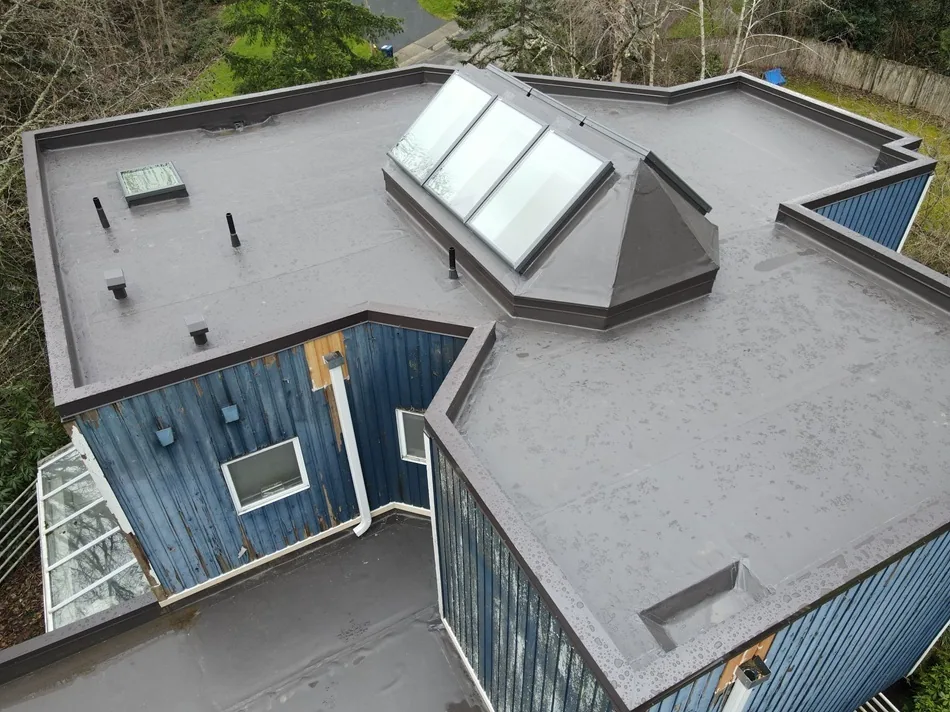
Water is running down a column beside dock door nine, a forklift lane is blocked with cones, and the operations lead wants to know whether the pallets staged below can stay where they are. In South Bend, IN a call like that can come on a day after thaw, when snow has melted into a low spot and found a seam. The roof paperwork lists Versico, and the sheet is likely a VersiWeld TPO or a related Versico membrane. The first move is the same whatever the label says: get someone on the roof to find where the water is entering, protect the inventory from inside and open a photo log. Then, once the water is controlled, we match the permanent repair to the sheet and write down what we did.
The first hour at the dock
A warehouse leak has a clock on it, because every hour of drip puts product at risk. A crew arrives, checks the interior with the operations lead and traces the wet area from the ceiling to the likely entry point on the roof. The roof side starts with the drains and scuppers, since meltwater with nowhere to go will find every weak lap, and then moves to the nearest seams, penetrations and wall flashing. If the source is clear we make a temporary repair; if it is not, we cover the suspect zone and mark it for a closer look. The manager gets a text with photos and a plain description of what was found and what comes next, before the crew leaves the roof.
Long seams, long exposure
Large low-slope buildings use wide sheets with seams running a long way, and a defect in one weld can let water travel a considerable distance under the sheet before it appears inside. That is why the entry point and the stain are often far apart. We probe the welds in the area, look for lifted edges and check how the sheet is attached to the deck, because a loose fastener can raise a ridge that traps water. VersiWeld TPO is a heat-welded thermoplastic, and repairs are made with a hand welder on a clean, dry surface, followed by a probe test of the finished edge. If moisture has gotten into the insulation, we mark the extent with a meter or an infrared scan before closing the roof.
Fleece, adhesive and bare fasteners
Versico also sells fleece-backed sheets, which are bonded to the substrate with adhesive, and mechanically attached systems that rely on plates and screws. A fleece-backed roof grips well across its whole surface, but the bond is only as good as the substrate beneath it, so wet board breaks it. A fastened roof leaves the sheet free between rows of plates and can flutter in wind; South Bend has recorded a 92 mph gust, so we check the perimeter rows and the corners closely. Each system calls for a different repair, and the right one depends on the roof plan and a core cut when documents are missing. We record the attachment on the plan, because it governs wind repairs and any future maintenance program.
Two named parks, one routine
Look at where industrial space is listed in St. Joseph County and the same names recur: South Bend, Mishawaka and New Carlisle, with the South Bend Airport Business Park and the Indiana Enterprise Center among the named parks. A dozen industrial spaces, each from 70,000 to 165,000 square feet, are listed at the business park by South Bend International Airport, and the Indiana Enterprise Center lists nine spaces, the smallest at 108,150 square feet and the largest at 992,620. A distribution building of the kind leased in either park gets the same walk: dock walls first, then rooftop units, then the drains in the order they sit on the plan. A tenant that holds several buildings in a park needs the repair history to travel with each one.
Drift load behind the parapet
Snow does not land evenly on a big flat roof. Wind pushes it into drifts against parapets, rooftop units and any change in roof height, and those drifts hold far more weight than the surrounding field. In the lake-effect storm of November 2022 the airport collected 22.7 inches in one event, and by the twentieth of the month the total had reached 30.2 inches. After a week like that we look at the drift zones for sagging, torn flashing at the wall and ice built up at the drains, because meltwater from a drift runs hard along the base of the wall. Where the sheet has been stretched against a curb, we add slack and a proper termination as part of the repair.
Sorting buildings by urgency
Tenants who lease several buildings, or owners who hold a handful in a warehouse district, need an order of work. We rank by active leaks first, then by wet insulation, then by edge and flashing wear, and we explain the ranking in the report. A building in Plymouth, reached by the US 31 freeway, may be a real drive from the one near the airport, so we plan the crew's day to avoid wasted travel. Roofs from Carlisle SynTec, GAF or other makers are handled the same way, with a roof plan, a photo log and a clear next step, so records line up across the portfolio.
Commercial Roofing Questions
Pallets are under the leak. What should the operations team do while the crew is on the way?
Move product that can be moved, cover what cannot with plastic and put a bucket or a pan under steady drips, but keep people out of any area with a sagging ceiling or wet electrical gear. Tell the dispatcher what the leak is over, because we staff and sequence the visit around that. Then send a photo of the ceiling stain so we can trace the likely entry point.
Why is the stain on the floor so far from the hole in the roof?
Water travels along the deck, through insulation seams and down columns before it drips. A defect in one seam can show up many feet away, which is why we trace from both the inside and the roof. We map the stain and the moisture, and the repair goes where the water enters, not where it lands.
Does a fleece-backed roof need a different repair than a fastened one?
Yes, in method. A fleece-backed sheet is adhered and needs a clean, dry bond for any patch, while a fastened sheet needs attention to plates, screws and the rows around them. We identify the attachment on the first visit, mark it on the roof plan and repair to the detail that suits it.
We are leasing a unit in a multi-tenant building. Who handles the roof?
Your lease says, and the landlord usually holds the roof. We can still document the leak, the interior damage and the dates for your records and for the landlord. If the landlord asks us to repair, we coordinate access and keep your operations running.
How do we plan a roof program across several large buildings?
Start with a condition survey of each roof, then rank the buildings by leak history, moisture and age of the system. We write each building's findings as its own scope, then sequence the work by weather, tenant schedules and budget so the plan reads like a calendar.
Related Roof Work
- Preventive Roof Maintenance
- New Carlisle
- South Bend Airport Industrial Park
- Indiana Enterprise Center, New Carlisle
- Distribution Center Roofing
- Warehouse Roofing
- Plymouth
- Carlisle SynTec Roofing
- GAF Commercial Roofing
Talk to Our Team
Tell us where the water is landing, what the roof is made of and when the building is easiest to reach.
Phone: 555-555-5555
Email: [email protected]