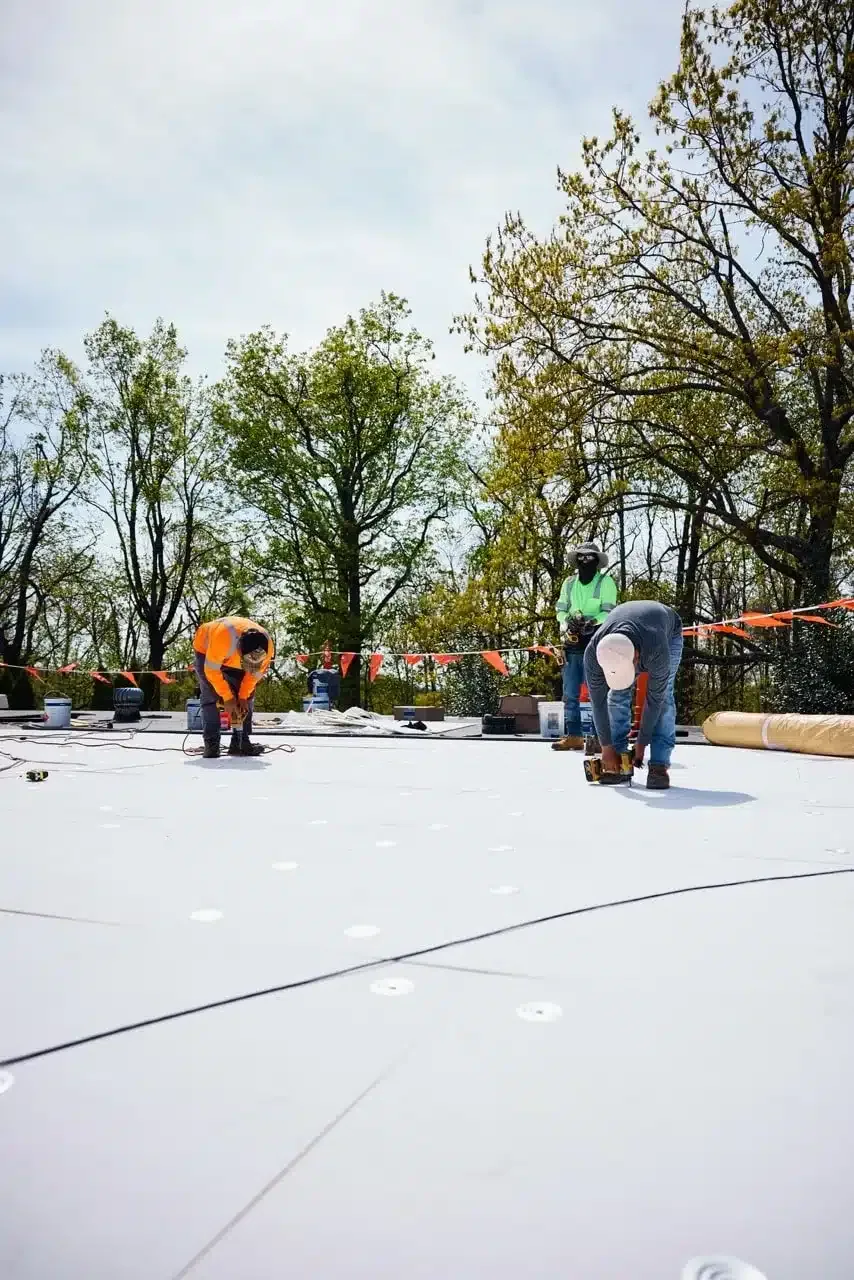
A property manager in Mishawaka opens the roof file after a tenant call and finds one word on a warranty sheet: GAF. Nothing on the page says which membrane it was, how it was attached or which crew laid it, and that single word is where our first call starts. GAF sells commercial roofing in more than one family, and the repair that suits a heat-welded EverGuard TPO sheet is the wrong repair for a self-adhering Liberty cap sheet. So before anyone climbs a ladder at your building in South Bend, IN, we ask what is printed on the roll labels, what the paperwork says and whether anybody kept a photo of the roof from the week it was finished. The first visit is spent confirming the system, because a patch that is wrong for the sheet will fail again at the next thaw.
Reading the sheet on your roof
On site, the first job is identification. A white single ply with seams that feel fused and a faint ridge along each lap is usually a thermoplastic such as EverGuard TPO. A dark, layered surface with granules or a smooth cap and visible side laps is bitumen, and GAF has sold modified bitumen under names such as Ruberoid and the self-adhering Liberty line. We look at the edge metal for stamped data, check the underside of a lifted corner, and cut a small test sample in a spot the membrane can spare, because thickness and reinforcement tell us as much as color does. We photograph each finding against a roof plan so the property manager can see what we saw.
What a thermoplastic sheet goes through here
More than five feet of snow falls in an average year, and one lake-effect event in November 2022 left 22.7 inches at South Bend International Airport. A TPO sheet under that load sits cold and stiff for weeks, then flexes when meltwater and sun arrive together. Freezing weather typically arrives in the second half of October and lingers into early May, so the sheet works through its expansion and contraction for about half the calendar. That movement pulls hardest at the walls, at curbs and at the corners of the sheet, which is where we look first after the thaw. We press a probe along the welded laps, check the plates and fasteners where the sheet is mechanically attached, and look for dirt lines that stop short of a seam, a small sign that a lap has started to lift. Other makers sell TPO as well, including Carlisle SynTec and Versico, and a patch cut from one maker's sheet does not simply bond to another's.
Bitumen in cold and heat
Modified bitumen behaves differently. Its strength comes from layers, so a repair has to keep the plies bonded and the laps sealed without scorching what sits under them. Self-adhering sheets need a clean, dry, primed surface and a temperature the adhesive can work in, which narrows the window from late fall through early spring. Heat-applied sheets need a careful hand near insulation and wood blocking. The roof may sit on a multi-tenant building like the 43,000 square foot one in the first phase at Ignition Park or on an older building along US 20 in Mishawaka, and either way the system underneath decides the method. We confirm what the deck is, what the insulation is and how the sheet was laid before we choose a method.
Repair before the warranty is read
Manufacturer warranties come with conditions, and many of them say who may repair the roof and by what method. Nobody should discover that after a patch is already down. When a GAF roof is leaking, we make it safe first, which means clearing drains, covering the opening and drying what we can reach. Then we ask for the warranty document and the installation record, and we compare them with what we found on the roof. If the paperwork asks for notice to the manufacturer before certain work, the owner makes that call with the facts in hand. The permanent repair follows the published detail for the sheet we confirmed, and it is photographed at each stage so the file shows the opening, the repair and the finished seam.
After hail or a straight-line wind
Hail on June 1, 2019 measured an inch across in South Bend and as much as 1.25 inches near Crumstown, and the 92 mph gust of August 1996 is the highest on record at South Bend, the kind of wind that edge metal and attachment have to resist. After an event like either one, we walk the field on a GAF roof looking for the round bruises of hail damage in the sheet, crushed insulation below and loosened edge metal at the parapet. Single ply over soft board can look fine from above and still hold a fracture underneath, so we press and probe rather than just look. What we find goes into a dated photo log that an insurer can read, and the log separates storm damage from ordinary age so the claim conversation stays on the roof itself.
What lands in your file
When the work is finished, the property manager receives the photo log, a marked roof plan, the product identification we confirmed and the details of every repair, including where each patch sits and how it was made. Tenants get notice before noisy or odorous work, and we schedule the sequence so the loudest tasks fall outside business hours where the lease calls for it. We return in April, once the frost is out, to pull on the repaired laps and the wall flashing, because a weak bond shows itself then.
Commercial Roofing Questions
How can I tell whether my roof is a GAF TPO or a GAF modified bitumen sheet?
Look at the surface and the laps. A smooth thermoplastic with welded seams is single ply, while a sheet with granules or a rolled cap and visible laps is bitumen. Your closeout documents or roll labels will name the product, and if they are missing we confirm it on site with a small cut sample and a check of the edge metal and flashing details. Send us what you have and we will tell you what else to look for.
Will a repair by our crew affect the manufacturer warranty on the roof?
Warranty terms vary by document, so read yours before work starts or send it to us and we will point to the clauses that touch repairs. Many warranties limit who may repair the roof and how, and some require notice before certain work. We install and repair to the published details for the system on the roof. Anything that affects the warranty is your call to make with the manufacturer, and we document the work so your side of that conversation is clear.
We had hail last summer and the roof looks fine. Should we still have it checked?
A sheet over soft insulation can hold a bruise or a fracture that shows only under pressure, and a leak may not appear until the next freeze. A walk of the field, with probing of suspect spots, takes far less time than a repair after water gets into the board. We document the findings with dates, which matters if the carrier has a notice period.
Can an older GAF roof be recovered instead of torn off?
Sometimes, if the deck is sound and a moisture survey shows the insulation below is dry. A wet core means water will keep working under a new membrane, so tear off the wet sections and keep the dry ones. We take readings and core cuts first, then lay out the options in writing, including the roof drainage and the code requirements that come with a recover.
Why does the repair schedule change when it is cold out?
Adhesives, primers and welded seams all need conditions the weather does not always allow. When a roof is open and temperatures drop, we dry it in with a temporary measure, then return for the permanent repair when the surface is dry and warm enough for the bond. That sequence protects the tenant now and the roof later.
Related Roof Work
Talk to Our Team
Tell us where the water is landing, what the roof is made of and when the building is easiest to reach.
Phone: 555-555-5555
Email: [email protected]