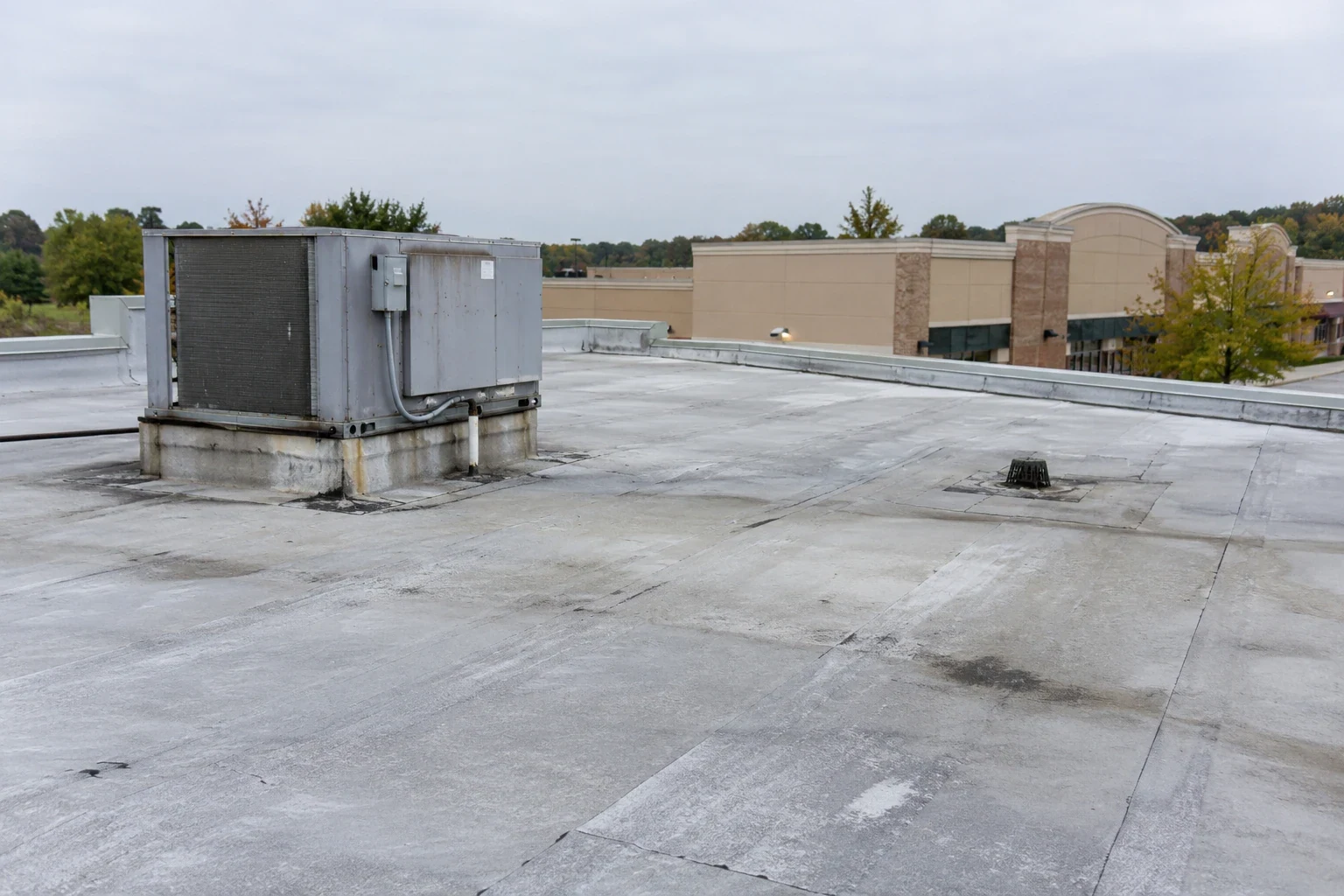
The roof call at a shopping center rarely comes from the person who needs the answer. It comes from a tenant: a salon owner who watched a ceiling tile drop onto a chair on a Saturday afternoon, or a shoe store manager who found a puddle under the rear stock shelves after the thaw. By the time the property manager is on the phone, water has already traveled along a joist from one suite into the next, and each tenant has a different account of where it started. Across South Bend, IN, lake-effect snow and later melt put drains, seams and tenant areas through repeated winter checks. Our job is to find the single opening behind all of those accounts, make the building safe, and hand the manager a record every tenant can accept.
Tracing the water across suites
We ask for the suite numbers where water has appeared, the order in which tenants noticed it, and what the weather did that week. The order matters, because water entering at a rooftop unit curb can run along a bar joist or a deck flute and surface far from the real opening. On site we clear snow and ice from the drains and scuppers first, then work backward from the wettest ceiling to the likely entry: a seam, a parapet flashing, a split at a penetration, or a unit that a tenant had installed or serviced. A temporary dry-in goes over the opening so stores can keep trading, and the manager receives a photo log with each stain, each roof finding and the time we arrived.
One roof, many leases
A strip center is a single roof over many leases. Demising walls divide the suites below, but above the ceiling the deck, the insulation and the membrane run straight through, so a flashing failure over one tenant becomes a problem for four. Every tenant adds penetrations: rooftop units on curbs, kitchen and bath exhaust, satellite dishes, sign supports and conduit. Each is a flashing detail, and the original detail is rarely the last one, since a later tenant's contractor may have cut, patched and left. We inspect each penetration, check curb flashings and fasteners, and walk the edge metal and the canopy roofs along the storefront, where water so often shows first.
University Park Mall is mostly single-story, so tenant space sits directly below the roof; the curbs and supports under rooftop equipment deserve a close check.
Keeping stores open through the work
Retail cannot close for a reroof. We schedule the loud and dusty steps before opening hours where we can, stage materials away from customer entrances, and protect canopies, sidewalks and parked cars below the roof edge. At a large retail property, staging has to preserve fire lanes, dock approaches and customer entrances regardless of the size of the parking field. Each tenant gets a written notice naming the dates, the hours of noise and the roof areas in use. During the busiest retail weeks, the manager can prioritize short repair visits and move disruptive tear-off to an agreed work window. Where an insulation test supports it, a roof recover over a sound existing roof makes less noise and fewer dumpsters than a full tear-off.
Storms in Mishawaka and along the bypass
The June 1, 2019 storms dropped 0.7 inch hail in Mishawaka and 1 inch in South Bend, and on June 23 of that year a storm damaged buildings along the Mishawaka bypass near SR 331. Wind and hail find the parts of a center that stand up from the roof: rooftop units, copings, sign supports and edge metal. Snow adds drift load against the same obstructions, and the November 2022 event left 20.7 inches in Mishawaka. After a storm we walk the roof, log damage with photographs, and write the findings so a landlord can file one clear claim instead of answering several tenant complaints. The Grape Road corridor sits at the center of retail development in northern Mishawaka, where the commercial routes are US 20 and SR 23, 331 and 933, so one storm reaches a great many storefront roofs at once.
Empty suites and the vacant box
A vacant space has no one inside to report a leak. University Park Mall has a vacant former Sears box beside active stores such as Barnes & Noble, JCPenney and Macy's, and Michigan City's Marquette Mall closed in 2017 after JCPenney left. An empty building needs the same checks as a full one: drains cleared after each storm, flashings looked at after each thaw, and a walk after any big wind. Water can sit for weeks in a dark space before the first stain appears, and by then the insulation is wet. A yearly infrared moisture survey catches it early, and the photographs make the file useful to a lender, an insurer or a buyer.
Patch, coat or replace
Owners ask early which of the three it should be. A sound roof with isolated leaks calls for targeted repair and a yearly visit. A dry roof with an aged surface may suit a coating or recover. Wet insulation under much of the field points to replacement. Cost follows roof area, the system chosen, tear-off, the number of units that must be lifted and reset, the tenant phases and the access. Lease language on who pays is a question for the owner's counsel, but a clear scope and a photo log shorten that conversation. Tenants who cook add exhaust and grease to the roof, which changes the membrane and the maintenance much as it does for a free-standing restaurant. A single big-box store raises different questions, and a retail chain with many locations weighs the choice across all of them.
Commercial Roofing Questions
Who is responsible for the roof over a tenant's suite?
The lease answers that, so read it before anyone argues. Many leases place the structure and roof with the landlord and the rooftop equipment with the tenant, but wording varies. We document what we find, including who installed each unit and penetration, which lets owners and tenants settle the question on facts.
How do tenants find out when roof work starts above their store?
In writing, about a week ahead when the schedule allows. The notice gives the dates, the hours of noise, which part of the roof is open and whom to call. A store with a food counter, a salon or a medical suite gets a call as well, since fresh coating odors and dust matter more to them.
A tenant replaced a rooftop unit last month and a leak has appeared. Where should we look first?
Begin at the curb. A crew that sets new equipment can leave a loose counterflashing, a missed sealant joint or fasteners driven through the membrane, and the water shows up in the suite below within a few storms. Ask for a photo log of the curb, and have the unit installer and the roofer look at it together.
Can a leak be stopped on a Saturday before a busy retail weekend?
Emergency response is available at any hour. The first step is to make the affected area safe, check whether the roof can be reached, and place temporary protection when access and conditions allow. The permanent repair follows the inspected assembly, and photographs record the work completed.
Is it worth coating a center that is partly vacant?
Often yes, provided a survey shows the insulation is dry. A coating extends the roof for a lower price than replacement, and an owner can pause the project without losing the work. If the survey finds wet insulation, the better route is replacement of those sections, since coating over water traps it.
Related Roof Work
Talk to Our Team
Tell us where the water is landing, what the roof is made of and when the building is easiest to reach.
Phone: 555-555-5555
Email: [email protected]