The prep cook notices it before anyone else: a brown bead growing on the ceiling tile above the line, an hour before the Friday dinner rush. Within minutes it is a drip, and by the time the owner calls, the question is whether the kitchen can run at all with water coming down near fryers, a hood and electrical outlets. In South Bend, IN the risk peaks in the weeks when snow melts off a flat roof by day and freezes at the drains by night, and the person on the phone needs two things from a roofer: someone on site fast, and a plain account of what happens next. We give both. A person answers at any hour, a crew heads for the roof, and the owner hears how the kitchen will be kept safe while the opening is found and closed.
Kitchen first, dining room second
Water near cooking equipment is a safety problem before it is a roofing problem, so the first call sorts out where the water lands. If it falls near a fryer, a hood, a panel or a walk-in compressor, the owner decides whether that line shuts down, and we tell them what we can see from the roof. The crew keeps clear of running exhaust fans, clears the drains, finds the opening and installs a temporary dry-in, a sheet patch or sealed membrane section that holds through the next freeze. A dated photo log records the conditions found, while the dining room and kitchen teams can protect affected areas below.
Fans, grease and the roof beneath them
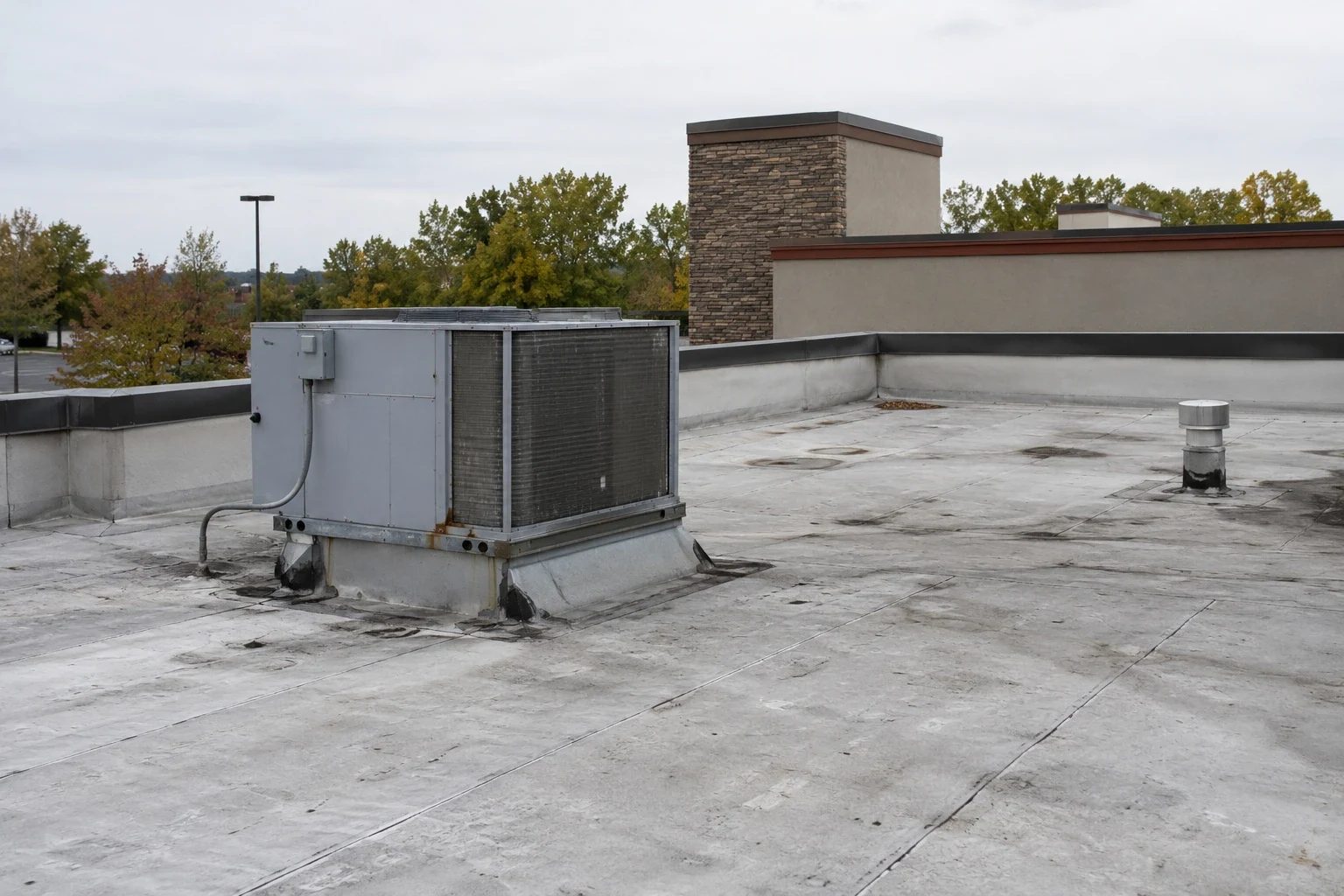
A restaurant roof is a working surface for the kitchen below. Upblast exhaust fans, makeup air units, flues and refrigeration condensers sit on curbs, and every fan sheds grease onto the membrane around it unless a containment pan is doing its job. Grease softens some membranes, collects dirt, and makes the surface slick for anyone servicing the fan. We check the pans, the curb flashings, the membrane in the fan's drip zone, and the drains, which can clog with cooking debris. Where grease is steady, a KEE membrane, made to resist fats, can outlast a standard single-ply near the fans, with a TPO roof covering the rest. Walk pads protect the route between the hatch and the fans, which service technicians cross every month.
Steam, heat and condensation
Not every ceiling stain in a restaurant is a leak. A kitchen produces steam and heat, and when moist air reaches a cold roof deck in winter it condenses inside the assembly, wetting insulation from below without a single hole in the membrane. With a freeze season running from about October 18 to May 1, that shows up as dripping ceilings no one can trace to an opening. An infrared moisture survey after dark shows where insulation is holding water and helps separate a roof leak from a vapor problem. The answer shapes the repair: a patch for an opening, but venting, a vapor retarder or replacement of wet insulation for condensation. Sorting this out first spares the owner a repair that changes nothing.
Working through service
A restaurant loses revenue every hour the kitchen stops, so the work is planned to fit service. We schedule noisy and dusty steps for mornings before prep, keep the crew off the roof above the dining room during lunch and dinner, and stage materials and the dumpster away from the patio, the drive-through lane and the delivery door. Odors from adhesives and coatings travel through fresh-air intakes, so those are covered and the work area stays away from the exhaust discharge. Many owners choose a slow weekday or a planned closed day for any step that cannot be done safely during service. Commercial roof leak repair visits are planned to finish before the lunch crew arrives, and larger projects are phased so only one section is open at a time.
Weather and the stadium calendar
Notre Dame Stadium seats 77,622, and a restaurant near the campus or the Toll Road exit at Roseland sits close to a crowd of that size on event weekends. A leak the night before one is the worst timing, so those owners do better with a spring and fall visit through preventive roof maintenance that clears drains and checks fan flashing before the busy season. The weather gives plenty of reasons: the average first freeze arrives near October 18, hail of 1 inch fell on South Bend on June 1, 2019, and the record gust of 92 mph is why we look at edge metal and fan tie-downs after a blow. The November 2022 event dropped 22.7 inches at the airport, a snowfall that tests canopies, patio covers and the roof edge above entrances.
Owners, landlords and chains
Who pays for the roof depends on the lease, and a restaurant in a strip center answers to a landlord who owns the whole roof. A tenant who adds an exhaust fan or a hood changes that roof, so the change belongs in a written scope and a photo log shared with the landlord. A restaurant in a shopping center raises a shared-roof problem, because grease from one unit can wear a membrane that other tenants also depend on. Chains with a standard building get the most from a repeatable inspection format, the way retail and restaurant chains keep roofs comparable across locations. In Mishawaka, whose economy has moved from heavy manufacturing toward retail services, the same rule applies to every tenant who cooks. A grocery store roof faces a similar mix of refrigeration equipment, kitchen exhaust and tenant operations.
Commercial Roofing Questions
Can a kitchen keep cooking while a leak is being stopped?
Only if the water is not near cooking equipment, electrical gear or food prep. A drip over an empty corner can be caught with plastic while the dry-in goes on. Water near fryers, hoods or panels is the owner's call on whether that line stops, and we recommend shutting it down until the opening is closed and the area is dry.
Why does the ceiling stain keep growing after a patch?
Look first for moisture that was already trapped. Insulation that took on water before the repair can hold it for weeks, and a patch does not dry it out. Condensation from kitchen steam can also mimic a leak. A moisture scan shows which one it is, and the answer might be drying, replacing wet insulation or adding ventilation.
How often should the area around an exhaust fan be cleaned?
Monthly is a reasonable rhythm for a busy kitchen: the containment pan emptied, the membrane near the fan wiped of grease, and the pan checked for cracks. We photograph the drip zone on each roof visit so the owner can see how fast grease builds and adjust the schedule.
Does a restaurant roof cost more to replace because of the fans?
Equipment adds cost, since every fan, unit and flue must be disconnected, lifted, flashed and reset, often with a mechanical contractor, and the exhaust fan has to be back in service quickly. Other drivers are roof area, tear-off versus recover, insulation and access. We price the equipment work as its own line so an owner can compare options.
Who handles a leak in a restaurant that rents its space?
Tell the landlord in writing the same day, send photographs, and call us for the dry-in if the lease allows a tenant to protect the property. Most leases name the landlord for the roof, but a fan curb the tenant added can complicate that. A dated photo log makes the conversation easier for both sides.
Related Roof Work
- KEE Roofing
- TPO Roofing
- Commercial Roof Leak Repair
- Roseland
- Preventive Roof Maintenance
- Shopping Center Roofing
- Retail and Restaurant Chains
- Mishawaka
- Grocery Store Roofing
Talk to Our Team
Tell us where the water is landing, what the roof is made of and when the building is easiest to reach.
Phone: 555-555-5555
Email: [email protected]