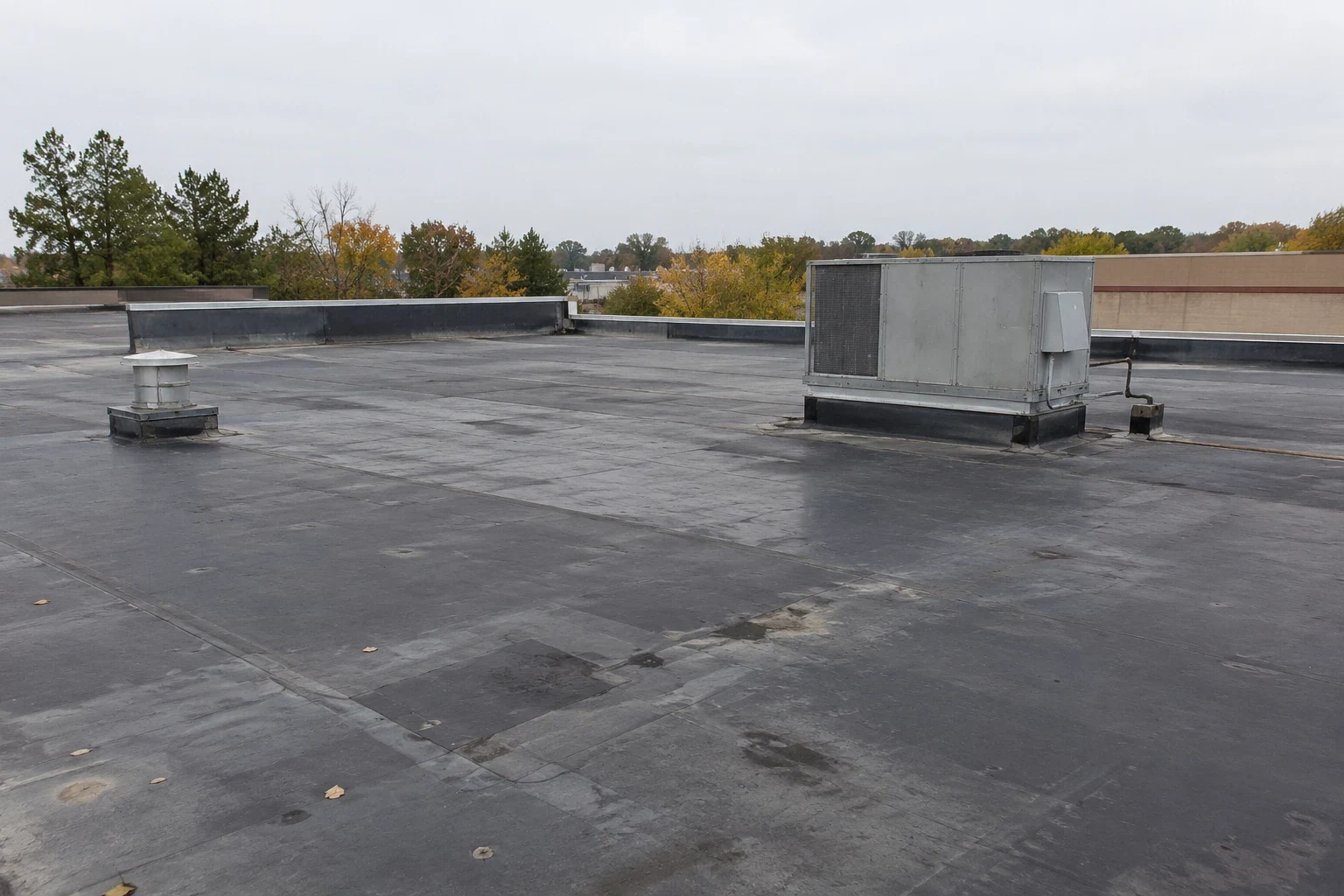
The first sign is often a sound, not a stain: a compressor rack cycling harder than usual, or a dull drip on the lid of a produce case before the store opens. A grocery roof carries a great deal of machinery, and a leak around any of it can reach food, electrical gear and customers within minutes. In South Bend, IN the usual setting is a week of lake-effect snow packed against condensers, followed by a thaw that sends meltwater looking for the edge of a curb. We treat the first call as a sequence: protect the food and the power, stop the water, trace it to its opening, and give the manager a photo log that the store's own food safety staff and its insurer can both use.
Food and power come first
We ask what is under the water: open cases, a dry-goods aisle, the cooler wall, an electrical room or the bakery. Water over refrigeration controls or panels is handled before anything else, and we tell the manager how to shield those spots until a crew arrives. On the roof we clear the drains, find the opening and set a temporary dry-in. What happens to wet product follows the store's own food safety procedures, not our judgment, but we photograph the ceiling, the roof opening and the timeline so that decision rests on facts. The permanent repair is planned only after the area has dried and the manager has what the insurer needs.
Racks, condensers and exhaust
A supermarket roof usually carries refrigeration condensers, heat reclaim units, rooftop air handlers and exhaust from the deli, bakery or kitchen. Each rides on a curb or a frame, with refrigerant lines, conduit and drains passing through the membrane beside it. We check every penetration and every support footing, because vibration from running equipment works sealant loose and wears at the membrane under the pads. Grease from kitchen exhaust is a second concern, since fats soften some membranes and leave a slick surface for technicians. Where grease is heavy, a PVC roof or KEE membrane, both formulated to resist fats, may be worth discussing. Refrigeration technicians walk the same routes every month, so we look for worn paths and add walk pads where the membrane is being scuffed. Pads reduce abrasion along repeated service paths and keep traffic away from seams.
Drifts, ice and airflow
Condensers need air, and snow does not cooperate. A drift against the coils slows heat rejection, and a crew with shovels can cut a membrane in minutes. We clear snow around equipment by hand with plastic tools, working away from seams, and keep drains open so meltwater leaves instead of refreezing in a ring. In November 2022 the airport collected 22.7 inches of lake-effect snow and Mishawaka 20.7, and with the freeze season running from about October 18 to May 1, ice at the drains is a recurring condition. Roughly 148 days a year bring measurable precipitation, so a grocery roof sheds water through many cycles, and a drain that was clear in September can be blocked by December.
Staying open day and night
Many grocery stores trade early, late or around the clock, so roof work is planned for the hours that trouble the fewest customers. Staging stays clear of the receiving dock and the fire lane, and delivery trucks get a protected route past the work area. Fresh-air intakes over the produce and bakery departments are covered while adhesives, primers or coatings are in use, because odors travel through a building quickly. Steps that produce heat or fumes are scheduled for low-traffic hours, and the manager receives a written notice of dates, hours and roof areas in use. Reroofing an occupied building that holds perishable product and customers who notice every smell runs on exactly that kind of notice.
Storm weeks
Storms are the hardest weeks for a grocery store, because a power flicker and a leak can arrive together. The highest gust at South Bend, 92 mph, and the October 2016 straight-line wind along West Indiana Avenue are why we check edge metal and unit tie-downs after a blow. June 1, 2019 brought 1 inch hail to South Bend and 0.7 inch to Mishawaka, and a storm on June 23 that year damaged buildings along the Mishawaka bypass near SR 331. After a storm, a roof walk can document dents and cracks and identify openings for temporary protection as conditions allow. A crew for emergency roof repair can go out at any hour of any day, and the photo log gives the insurer a record that ties the roof opening to the loss, the same record that roof insurance claim assistance depends on.
Planning across stores and formats
Stores around Mishawaka and Granger, reached through Toll Road exit 83 and SR 331, take the same weather as every other building in the county. Budget follows roof area, the number of refrigeration and air handling units that must be lifted and reset, tear-off versus recover, and how many nights of work the store allows. A big-box store shares many of those drivers, while a cold storage building adds insulation and vapor questions of its own. Owners with several stores get the most from a yearly inspection, since a record of each roof shows which store needs money first, and shoppers in Granger or Mishawaka notice a dry, open store long before they notice a new roof.
Commercial Roofing Questions
Can product stay in the cases while the roof is repaired above?
That is the store's food safety call, but several practical steps help. We keep tear-off and open roof sections away from areas directly over cases, cover ceiling openings below when needed, and finish work above refrigeration in short, planned shifts. The manager should keep the refrigeration contractor on call during any penetration or equipment work.
Our refrigeration vendor says a condenser pad is leaking. Who fixes that?
Bring both trades together. The vendor knows the lines and supports, the roofer knows the membrane and flashing, and a leak at a pad is often both, a support footing that moved and a flashing that opened. Have the roofer repair it with the vendor present, and photograph the work before the equipment is reset.
How do we keep roofing odors out of the produce department?
Cover the fresh-air intakes serving that section, ask for low-odor adhesives and coatings when the system allows, and schedule the work for the hours when the department is least busy. We check air movement with the facility team before the first day and stop to adjust if staff report an odor.
Is a grease-resistant membrane worth the added cost for a store with a deli or bakery?
Usually when the exhaust fans sit near the main walking routes or the drains. Fats gather on the membrane near the exhaust, and single-ply systems differ in how they handle them. We compare the choices on the actual roof, and may pair a more resistant membrane near the exhaust with a standard one elsewhere.
What belongs in a yearly roof report for a supermarket?
Expect a roof sketch, dated photographs of every penetration and equipment curb, the condition of drains and walk pads, moisture findings if a scan was done, and a ranked list of repairs. Ask that the report list refrigeration lines and drains passing through the roof, since those are the details that fail first.
Related Roof Work
- PVC Roofing
- Occupied Building Reroofing
- Emergency Commercial Roof Repair
- Roof Insurance Claim Assistance
- Mishawaka
- Big-Box Retail Roofing
- Cold Storage Roofing
- Granger
Talk to Our Team
Tell us where the water is landing, what the roof is made of and when the building is easiest to reach.
Phone: 555-555-5555
Email: [email protected]