The email subject line says roof report needed by Friday, and the property manager who typed it already knows the three questions the reader on the other end will ask: where is the damage, how bad is it, and what does it cost to stop. A lender, an insurer, a board treasurer or a tenant's attorney will each read the same document, and none of them will climb a ladder to check it. In South Bend, IN the report has to survive that kind of reading, which means the findings are specific, the photographs show the exact spot, and nothing in it depends on the author being in the room.
We write the report after the walk, in the order the roof was walked. Drains first, then the field, then the walls and edges, then the equipment. Each finding gets a photograph, a location, a plain description and a recommended action with a timing. The manager receives something that can be forwarded without a phone call to explain it, and the next crew to stand on the roof starts from our record instead of from nothing.
The walk comes before the writing
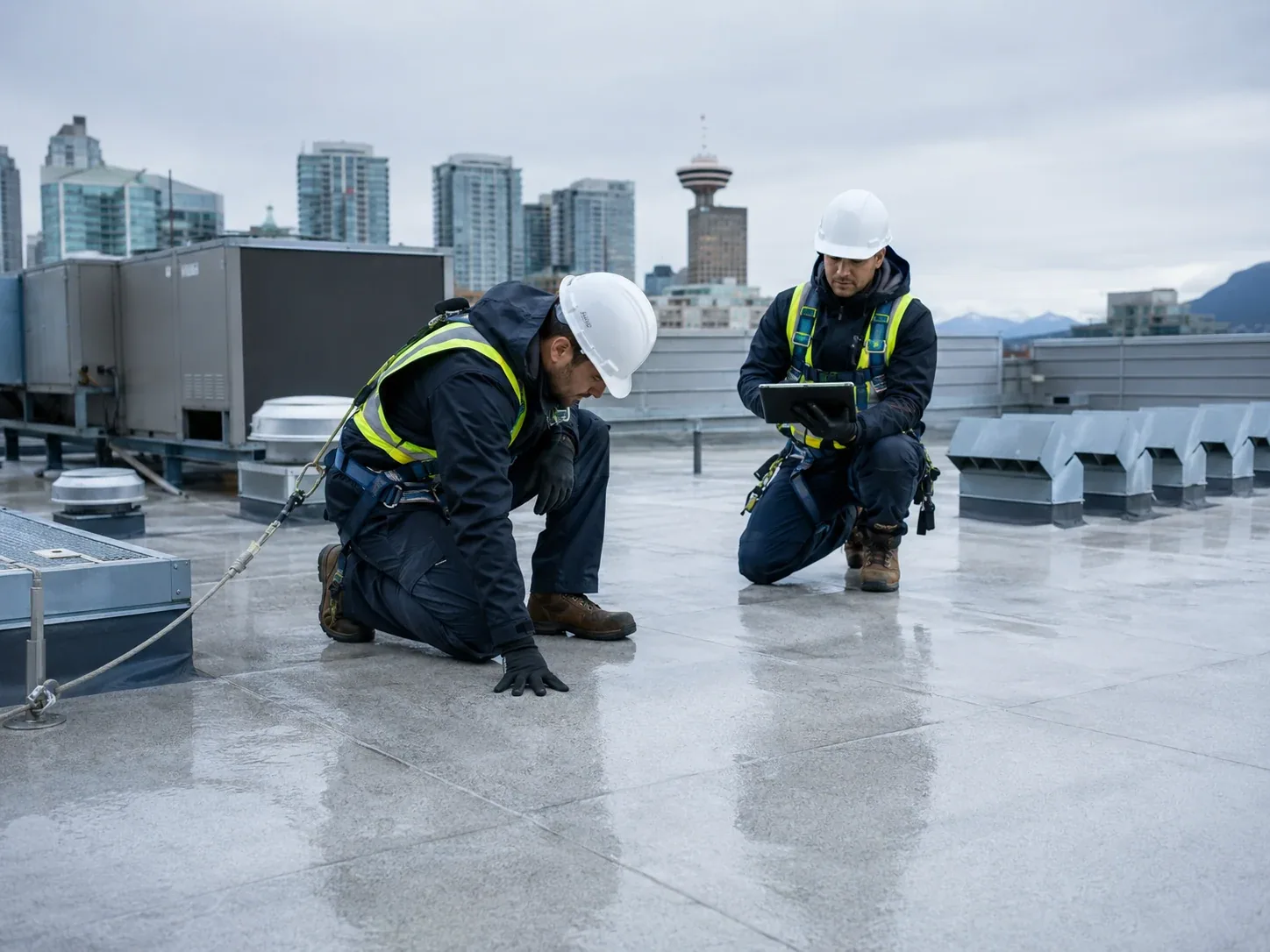
A report is only as good as the hours spent on the roof, so the walk follows the same route every time. We start at the drains and scuppers and confirm that water actually leaves the area, then cross the membrane checking seams, fastener rows, blisters, ridges, punctures and old patches. We move to every wall flashing and termination, the sealant at pipes and conduit, and the perimeter metal. Last come the rooftop units and their curbs, where foot traffic and sheet metal do the most damage. Where we see a problem we cannot name from the surface, we say so and recommend an infrared moisture survey or a core cut, instead of guessing at what lies beneath the membrane.
A photograph with a place on the roof
A snapshot of a seam means little to a reader who cannot tell which seam it is. Every photograph in our reports carries a marker on the roof plan, so a facility manager can look at an image of a lifted edge and put a finger on the corner of the building where it sits. We shoot wide first to show context, then close to show the defect, and often a third frame with a tape or a hand for scale. On large or hard-to-reach roofs a drone inspection adds an overview that makes the ground-level images easier to place. When the same spot is photographed again next season, the two images sit side by side, and the difference between them is the finding.
How a finding is worded
Each finding gets one of four labels: act now, repair this season, watch, or unknown. Act now means water is entering or about to enter the building. Repair this season means the condition will worsen through a freeze-thaw cycle and is cheaper to fix before it does. Watch means the condition is present, stable and photographed for comparison. Unknown is reserved for what could not be seen or reached, and we say what would resolve it. We do not blur those labels into a general impression of fair or poor. A reader scanning for the urgent items finds them in the first page, and a reader who wants the reasoning finds that behind each label in one or two sentences, with the photograph beside it.
What a failed roof teaches a county office
One April day in 2016, wind and heavy rain were followed by the failure of part of the roof on the county's services building in Mishawaka, and water soaked the top floor. Whatever the cause, any owner after an event like that is asked what the roof looked like before, and for many buildings the right answer is that nobody can say. A dated report with photographs is the reply to that question. It does not prevent a failure, but it shows what was known and when, and it gives the owner something to cite beyond recollection. That matters most for government building roofing, where a public body answers to taxpayers.
Reports written after weather
Some reports are ordered the week after a storm, and they follow a different rhythm. Stones as big as 1.25 inches came down near Crumstown during the June 1, 2019 storms, and the October 2016 wind event left straight-line damage along West Indiana Avenue and a microburst track between Northside Boulevard and Longfellow Road. Those events leave marks that fade, and a storm report records them while they are still readable: dents in metal, bruised membrane, cracked coating, displaced ballast, loose copings. The report lists what the storm did and separates it from older wear, because an adjuster will make that distinction whether the owner does or not. An adjuster building an insurance claim file leans on exactly this kind of before-and-after evidence.
Who reads it, and what they want
A lender reads the report for the cost of the problems that cannot wait. An insurer reads it for dates and cause. A board reads it to decide whether a vote is needed. A facility office running a single-story clinic like the VA's St. Joseph County Health Care Center in the Mishawaka reads it for whether a repair can be done without disturbing patient areas. We keep one document and make it work for all of them by putting the ranked action list on the first page and the evidence behind it. For a portfolio, the same format repeats in every building, which is what lets an owner put six reports side by side inside a roof asset management file.
Commercial Roofing Questions
How long after the walk does the written report arrive?
Timing depends on access, the number of roof areas, and whether cores or moisture testing are needed. Tell us the closing or lender deadline when you call so we can discuss the inspection scope and reporting sequence before the visit. If we find an active condition, we explain it to the property contact while on site.
Will the report recommend a replacement just to sell us a job?
It recommends what the evidence supports and shows the evidence. If a roof is a repair candidate, the report says so and prices the repair. If cores show wet insulation across the field, the report says that and lays out the replacement options, with the photographs and readings behind the conclusion. Any reader, including a second contractor, can check the reasoning without us in the room.
What if the roof is covered in snow when you arrive?
Then the first report is partial, and it says so. Snow hides seams, drains and flashings, and moisture scans do not read through it. Roughly six months of the year have freezing nights here, so we plan a fall walk before the first freeze for exactly this reason. In midwinter we document what can be seen from the edges and from inside, flag the unknowns, and finish the walk once the thaw lets us.
Can a report cover just the section that leaked?
Yes, and for a one-time leak that is often enough. A scoped report on the leaking section still checks the drains and details near it, since water rarely stays where it enters. If the rest of the roof is a question mark, we say that in a line so the reader understands the report has a boundary and knows where it stops.
Do you give a remaining-life estimate in the report?
We give a window and the conditions that would change it, not a single year. A date promises more than any roofer can know. The window feeds directly into capital planning, where the owner can set a budget year with the range in view.
Related Roof Work
- Infrared Roof Moisture Surveys
- Drone Roof Inspection
- Mishawaka
- Government Building Roofing
- Roof Insurance Claim Assistance
- Mishawaka
- Roof Asset Management
- Roof Capital Planning
Talk to Our Team
Tell us where the water is landing, what the roof is made of and when the building is easiest to reach.
Phone: 555-555-5555
Email: [email protected]