Every portfolio spreadsheet has one column that nobody quite trusts, and it is the column labeled condition. A property manager in South Bend, IN opens it the morning after a week of freeze and thaw, sees the word fair beside a building that has leaked twice since October, and cannot say whether that entry is two years old or six. Roof asset management is the work of making that column true. It starts with a walk of every roof, a photograph of every drain, seam and flashing run, and a grade for each roof with the reason written beside it. After that, each visit updates the same record, so the owner can watch a roof hold steady or slip and can see which building needs money before the next one does.
We build the record the way we run a storm call, in order. The first visit sets the baseline. The seasonal visits that follow show what winter did. Storm entries fill the gaps between. By the end of a year the manager holds a file that answers the questions an owner, a lender or an insurance adjuster will ask.
The first walk sets the baseline
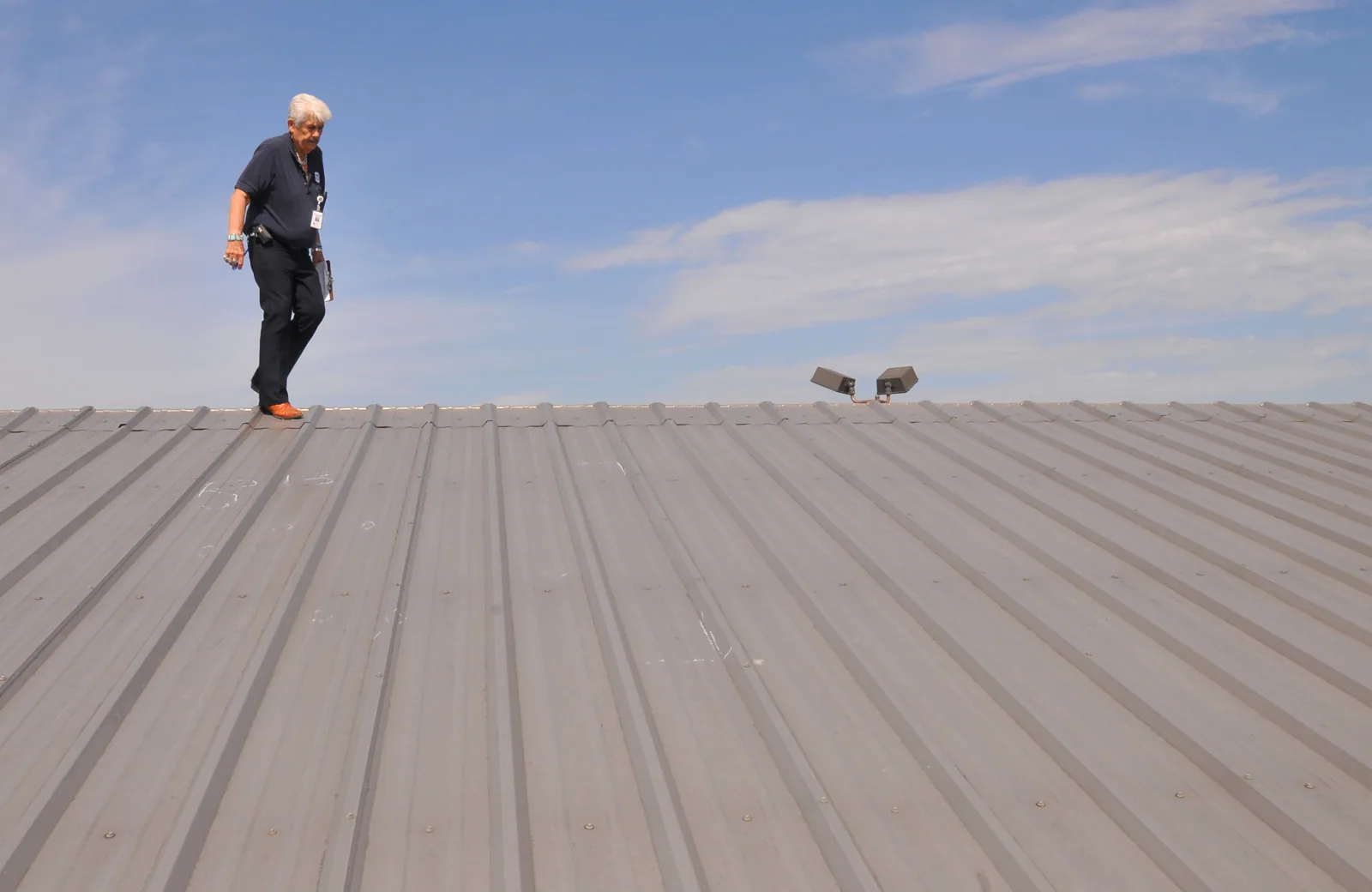
Nothing in a roof record works without one honest first walk. A crew goes over every roof on the list, on foot where the surface allows it and by drone where it does not, and logs the membrane type, the visible age, the count of drains and scuppers, the edge metal, each rooftop unit and each penetration. Every one of those items is photographed and tied to a position on a roof plan, because a picture with no location cannot be compared with next spring's picture. Where earlier repairs show as patches, we mark them. This visit is slower than any later one, and every later entry leans on it, so we do not shorten it on a roof that looks fine from the hatch.
Grades the owner can read
Each roof leaves the walk with a grade and a short reason for the grade. A sound roof gets its place on the schedule and nothing more. A roof with open laps or failing flashing gets a repair list and a date. A roof with wet insulation, a soft deck or widespread blistering moves to another shelf, the one where a replacement is being priced. What matters most is that the reason sits in ordinary words next to the grade: ponded water at the north drain, three open laps at the curb, cracked sealant along the parapet. When a different person opens the file two years from now, the reason is still there, and the grade can be argued with on the facts.
What the calendar does to the record
Measurable precipitation falls here on roughly 148 days each year, and freezing nights stretch from about October 18 to about May 1, so a flat roof here drains water on about two days in every five and goes through freeze and thaw for roughly half the year. That is why the record cannot be a single survey. We add a fall entry after the drains are cleared and before the first hard freeze, and a spring entry once the thaw has shown which seams and flashings let go over the winter. A heavy event earns its own entry between those two. After the lake-effect storm of November 2022, when the airport measured 22.7 inches and Mishawaka measured 20.7, an owner with a live record could pull the last photographs of each roof and compare drift lines, drains and parapet flashing against them.
Different owners lose different things
A drip over a trauma bay and a drip over a hotel room are the same defect with very different consequences, and this market has both: Memorial Hospital of South Bend carries a Level II trauma designation, and the hotel at South Bend opened in 2023 as the second-tallest building in the city. A hospital wing needs hospital roofing planned around infection control. The record holds a line for every building about what a leak would interrupt: surgery, a hotel floor, a lease, a production line. Tire Rack, headquartered in South Bend, ran ten warehouses across nine states as of 2017, and for logistics operators with that kind of spread the record has to sort by location as well as by building. Sorting by region and season lets a manager group nearby roof visits and avoid unnecessary repeat mobilizations.
From grade to decision
A record only pays when it changes what the owner does. When a roof drops a grade, we lay out the options from cheapest to most expensive: a repair now, a coating if the membrane and insulation are dry, a recover where the code allows another layer, or a replacement. The file holds the moisture readings from any infrared moisture survey, the past repairs and the age. Those entries feed straight into capital planning, where each replacement gets a budget year, and into the claim file when a storm brings the insurer's questions. An owner who can hand an adjuster the last four visits has a much shorter conversation than one who cannot.
What arrives after each visit
After each visit, the manager receives the updated file: photographs by location, the grade for each roof with its reason, a short list of what was fixed on the spot and a list of what is waiting. Anything that cannot wait is the first line, not the last, and we phone it in before the email goes out, because a drain iced over and backing water into a seam should not sit in an inbox overnight. The file stays with the owner. If the owner later changes roofing contractors, the record goes along, and the next crew starts from the same baseline we did. Buildings on a standing preventive roof maintenance schedule get these entries on the same visit. Before the next ownership review, a roof condition report gives each asset a dated record of the findings behind its priority.
Commercial Roofing Questions
How many roofs do we need before a record is worth keeping?
One is enough, as long as that roof matters to a lease or a loan. A single building with a mix of membranes, a parapet and three rooftop units already holds more detail than a person can remember.
Can you build on the reports our engineer already produced?
We start with them and then check them against the roof. An engineer's report is useful for scope and for dates, and we copy its findings into the file with their date beside them. What we add is a fresh walk, photographs tied to a spot on the plan, and a grade with a reason. If the earlier report and the roof disagree, the file says so plainly instead of quietly choosing one.
What happens to the record after a hailstorm?
It gets a storm entry after the condition is assessed. On June 1, 2019, South Bend took one-inch hail while Mishawaka got stones of seven tenths of an inch, and stones that size leave marks that fade or get painted over if nobody photographs them quickly. We walk the roofs in the affected area, log dents, bruises and cracked coatings against the earlier photographs, and hand the manager a dated set the insurer can compare with the baseline.
Does a tenant's lease change how a roof gets graded?
The grade describes the roof and the lease describes who pays, so we keep them separate. In a multi-tenant building the file records which suites sit under each roof area, because a leak over a vacant suite and a leak over an operating pharmacy are the same defect with very different urgency.
Which roof gets money first when two of them grade poor?
Look at the reasons, not the grades. A roof graded poor for wet insulation under a dry field is losing energy and will fail in stages. A roof graded poor for open seams at an equipment curb is letting water into a space today. We rank them by what is being damaged right now, then by how fast the condition is moving between visits, and the photographs from earlier entries settle that second question.
Related Roof Work
- Roof Insurance Claim Assistance
- Mishawaka
- South Bend
- Hospital Roofing
- Logistics and 3PL Operators
- Infrared Roof Moisture Surveys
- Roof Capital Planning
- Preventive Roof Maintenance
- Written Roof Condition Reports
Talk to Our Team
Tell us where the water is landing, what the roof is made of and when the building is easiest to reach.
Phone: 555-555-5555
Email: [email protected]