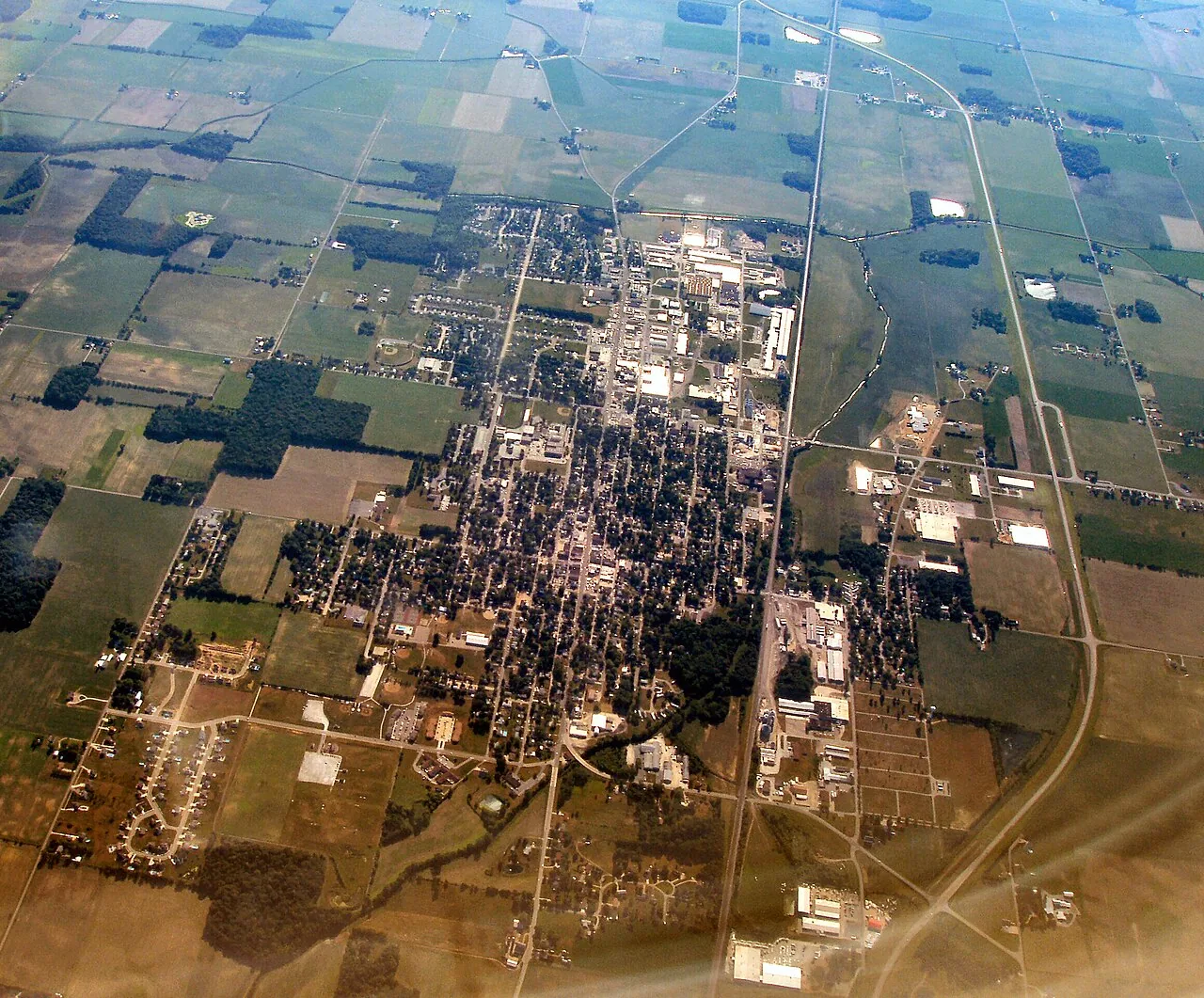
A maintenance lead walks a Bremen plant after the first hard freeze and finds ice hanging from the underside of a vent stack, with a damp ring on the insulation around it. That is the moment the roof stops being something nobody thinks about. The inspection begins with the stack, what exhausts through it and how long the stain has been visible, then checks the flashing, curb and membrane around it. Bremen is a town of 4,696 in Marshall County, 15 miles south of Mishawaka on State Road 331, with a U.S. 6 bypass along its north side. Its industry runs to fiberglass, custom cabinets, RV and van painting and roller bearings, so the plants in those trades commonly vent exhaust and process air through the roof. We repair, coat, recover and replace those roofs, and we walk the owner through each decision in order.
Ice at the stack, water at the ceiling
When a plant calls with a drip, the first visit is about the path the water took. On an industrial roof it often travels along a conduit, a duct or the top of a wall before it shows. We trace it from inside, then from above, and determine whether temporary protection is appropriate for the entry point and current roof conditions. Process areas, electrical panels and finished goods should be protected. Photographs and a written summary can document the wet area, observed damage and next steps. The permanent work is scheduled afterward, around production hours and the weather. An overnight freeze after a repair is one reason we plan the follow-up visit for after the next thaw.
Paint, resin and dust on the membrane
Painting, fiberglass work and cabinet production put more on a roof than weather does. Exhaust can carry solvents, resin vapors, oils and fine dust, and those settle on the membrane near the discharge point. Some membranes tolerate that exposure far better than others, which is why chemical resistance is a real question on these buildings. PVC roofing and KEE roofing are designed to resist many oils and chemicals, while other single-ply systems can soften or shrink when exposed. On a first walk we look for discolored or swollen membrane around fans, and for dust build-up that holds water against seams. If the exposure is heavy, we recommend a system and a detail that match it instead of repeating what failed.
Where the equipment meets the roof
Make-up air units, exhaust fans, dust collectors and process piping all penetrate the roof, and every penetration is a flashing that has to survive thermal movement. Equipment vibrates, and curbs that were sealed once with caulk open up within a few seasons. We inspect each curb for rust, loose fasteners, cracked sealant and ponding at the base, and we check that the equipment is supported so its weight is not resting on the membrane. Where a curb has failed, the repair is to rebuild the flashing into the membrane, not to add another layer of mastic. On a plant roof the curb is one of the first places water finds, which makes rooftop equipment curb and support work the core of many repairs.
Older buildings and listed properties in town
The Bremen Water Tower and the Dietrich-Bowen House are on the National Register of Historic Places. When a project affects a property with historic designation, the owner should check any applicable local review, funding or lender requirements before changing visible roof details. On older commercial buildings in general, we look for wood decking that has stayed damp, parapets with failed mortar or coping, and roof edges where a past repair changed the slope. An infrared moisture survey shows wet insulation without opening the roof, which helps an owner who needs to protect the building and also protect its character.
Where a visible roof change may be subject to review, gather the current roof plan, proposed product data, photographs and flashing details before work is priced. A property manager can then confirm which approvals or funding conditions apply and include them in the project sequence. The roof scope itself should identify the area to be changed, how drainage is maintained and how existing historic features are protected.
Planning against the South Bend record
A typical South Bend year brings about 64.5 inches of snow, and temperatures there have ranged from minus 22 to 104 degrees. These seasonal conditions make drainage, flashings and attachment details important parts of roof maintenance. For commercial roofs near Bremen, those regional conditions make drainage, flashings and attachment details important parts of seasonal maintenance.
Repeated freeze-thaw cycles work on seams and flashings, while snow can drift against a taller wall or rooftop unit. Inspect those details after winter weather and clear drainage paths when it is safe to do so. Owners with a building near Mishawaka, about 15 miles north on State Road 331, or in Plymouth can coordinate separate inspections based on each roof's access and condition.
On a building with coatings, resin dust or exhaust near the roof, identify where residue collects and how it affects the membrane surface. Choose a cleaning method that removes contamination without driving water beneath laps or damaging the finish; test a small area when compatibility is uncertain and record the chosen method.
Commercial Roofing Questions
Our paint line exhausts through the roof. Does that change which membrane we should choose?
It can. Solvent and oil exposure near a discharge point breaks down some single-ply membranes, and the damage shows up as softening, shrinkage or open seams. Membranes made to resist chemicals, such as PVC and KEE, are the usual choice near exhaust. We note where the exhaust discharges, how far it carries, and what the current membrane looks like beside it, and the recommendation follows from that.
Is it worth surveying a roof for wet insulation before we repair it?
On a plant roof with a history of leaks, it is. Water can run a long way under a dry-looking membrane, and a repair over wet insulation will fail. A moisture survey marks the wet areas on a plan, so the repair, the recover or the replacement is scoped to what is actually wet. The survey usually costs less than a failed repair, and it gives the owner a record to work from.
We own a building with historic designation. Who has to approve a new roof?
Requirements depend on the property and any applicable local review, funding or lender conditions. Confirm those with the appropriate authority before setting the roof scope. If a review is needed, the roofing contractor can provide product information, photographs and details for the proposed work.
When should we inspect a roof after a storm?
Inspect when conditions are safe and before another weather event if possible. Wind can lift edges or move coping that is difficult to see from the ground. A qualified technician can document the perimeter, field, drains and visible interior effects. If damage is found, the owner can consider temporary protection and a repair scope.
What does a first-time owner receive after a roof inspection?
A written report with photographs tied to a roof plan, the condition of each area, and the repair, recover or replacement options in the order we would take them. It reads without a roofing background. An owner can forward it to a lender, a board or an insurer as it is, and the owner can use it to discuss repair priorities with the appropriate stakeholders.
Related Roof Work
Talk to Our Team
Tell us where the water is landing, what the roof is made of and when the building is easiest to reach.
Phone: 555-555-5555
Email: [email protected]