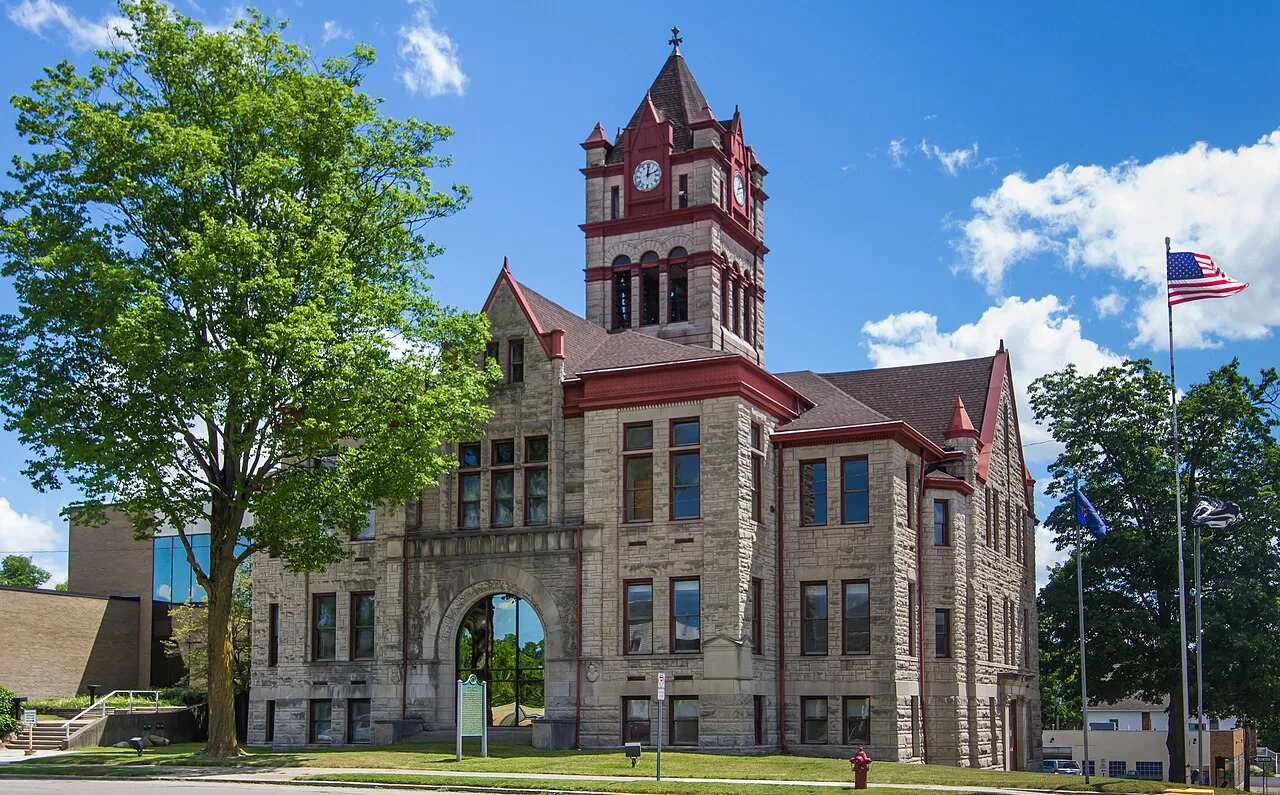
The message from the office is short: water on the floor again, second morning running, and nobody can say whether it came from the roof or from the pipes. Cassopolis, MI is the seat of Cass County, a village of 1,712 residents inside the South Bend-Mishawaka metro area, and the county government is the steady institutional presence in town. We make the roof safe first, with the drains cleared and a temporary dry-in over the wet area, then we trace the water, photograph it and write up what the office needs for its next meeting. The same sequence applies to private owners in Cassopolis and to buildings in Edwardsburg, also in Cass County.
A public owner's roof has a paper trail
A county building is not owned the way a warehouse is. Money for a roof comes through a budget year and often a vote, so the first useful thing we hand over is a written condition report with photographs, a ranked list of problems and a range of options, not a single number. A board member who has never been on the roof can read it and understand why one section is urgent and another can wait until spring.
When a leak cannot wait, the make-safe work is documented on its own, so emergency spending and planned spending stay separate on the books. Keeping the two apart is standard practice on government building roofing, and a roof condition report is what supports each line of spending.
Two townships and roofs of several ages
Cassopolis covers 2.24 square miles across LaGrange and Penn townships, which matters more for paperwork than for roofing. Once a scope is drawn, the first call is to the office that issues permits for that parcel, because the answer can change who reviews the drawings and who inspects the work. We make that call before we price anything.
Cass County developed on farming and some industry, which says little about what lies under any one roof, so we assume nothing about the surface. A hands-on inspection with core samples and a moisture scan shows how many layers there are, how much insulation sits below them and how wet it is, and the repair, recover or replacement path follows from that.
A collapse in Mishawaka and what it asks of owners
On April 1, 2016, a storm of high wind and rain ended with part of the roof coming down at the St. Joseph County Services Building in Mishawaka, and the top floor took extensive water damage. What it shows any owner is that a roof is a structure carrying a load, and water that cannot leave it adds weight.
So on a first walk we check the ponding areas, the deck underneath for rust or sag, the insulation for saturation and the overflow openings for being clear and set at the right height. A public building with a history of patched leaks deserves that deck-level look before the next storm season, not after it.
Gusts, microbursts and the edge of the roof
South Bend measured its highest gust, 92 mph, in August 1996. Two EF0 tornadoes crossed St. Joseph County on October 12, 2016, around South Bend. Straight-line wind did its damage along West Indiana Avenue, and a microburst swath ran from Northside Boulevard to Longfellow Road. South Bend's wind history includes these events, and the roof lesson is practical: inspect the edges first, where uplift can work under a loose termination.
We walk the perimeter first, pressing on copings, checking edge metal for lift and looking for membrane pulled loose at a termination. The October 24, 2001 F3 tornado that crossed northwest South Bend toward Niles is the reference point for the worst case, and our tornado damage roof repair work starts with making the building safe and the deck dry.
Downpours test the drains first
A 24-hour fall of 4.88 inches on August 2 and 3, 1995 is the South Bend record, and precipitation reaches the ground there on about 148 days in an average year. A roof that sheds through internal drains, scuppers or both has to move that water out, and the failure is usually small: a leaf-packed strainer, a scupper blocked by a scrap of membrane, an overflow set too high.
We clear, flush and photograph each drain and scupper, then watch the water move on the follow-up visit after the first real rain. Where ponding is still standing long after the roof should have dried, we talk about tapered insulation or added drains rather than another patch.
Timing the work around the thaw
At South Bend the first freeze of fall usually lands near October 18 and the last of spring near May 1, which puts a roof through about six months of freeze and thaw. Planned work belongs in the months between, when adhesives cure, welds make and crews are not clearing snow before they can start. Winter work is possible, and an emergency never waits, but cold adds time and cost to nearly every step, from heating materials to protecting open areas.
Owners who book a survey in late fall can walk into spring with a repair list already priced. A visit after the thaw checks every area the winter worked on: drains, laps, flashings and the places where drifts sat against rooftop units.
Commercial Roofing Questions
The board votes at a monthly meeting. How soon can a roof scope be ready for it?
Start with a walk and a short written report. We can turn the findings into a ranked list with options, photographs and rough scope boundaries that a board can read in one sitting, and the urgent items can be handled as separate make-safe work while the larger project goes through the approval cycle. Public bodies often need more than one quote, so the report is written so another contractor could price from it.
Water appeared at the ceiling, but the roof looks fine from the parking lot. Where do you begin?
On the inside, then the roof. We look at where the stain sits relative to exterior walls, rooftop units and drains, check for plumbing or condensation sources, and then go up to trace the path. Many leaks enter a long way from where they show, so the photo log records both the ceiling and the likely entry point.
Can a roof that was patched after storm damage still be recovered instead of replaced?
Sometimes, if the insulation beneath the patches is dry. An infrared moisture scan followed by core samples tells us. If the patches sit over wet insulation, a recover would trap that moisture and the replacement conversation begins; if the insulation is dry, a recover or a coating can often carry the roof several more years.
Our building straddles a township line. Who do we ask about a permit?
We call the issuing office for the parcel before the scope is final and put the answer in writing for the owner. Permit requirements for a re-roof can bring insulation and fastening into the scope, so it is better to learn them before pricing than after tear-off.
What does a follow-up visit actually involve?
A second walk, usually after the first rain or thaw following the work. We check the drains, look at the new laps and flashings, compare the roof against the photo log, and see whether any water is standing. The owner receives a short written update, and anything we find is corrected as part of the same job.
Related Roof Work
- Edwardsburg, MI
- Government Building Roofing
- Written Roof Condition Reports
- Commercial Roof Inspection
- Mishawaka
- Tornado Damage Roof Repair
- Roof Drains, Scuppers and Ponding Correction
Talk to Our Team
Tell us where the water is landing, what the roof is made of and when the building is easiest to reach.
Phone: 555-555-5555
Email: [email protected]