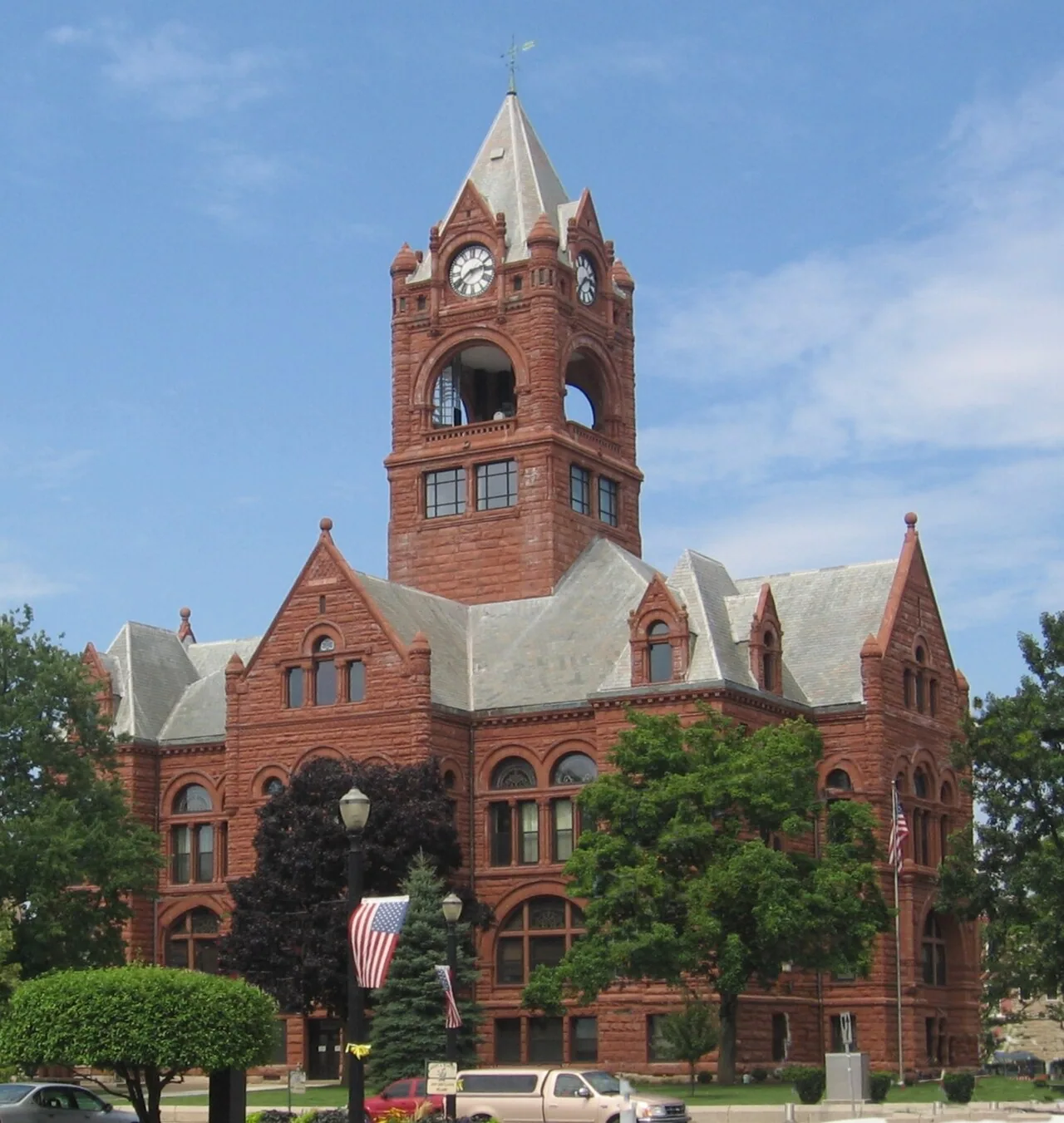
Ice rims the drain at the back corner of a public building in La Porte, IN, and the first anyone knows of it is a brown ring spreading across a ceiling tile in the records room. The clerk who finds it calls the facilities office, the facilities office calls us, and the conversation runs in a set order. Where is the water showing, can anyone stand on the roof safely, and who has to be told before a crew goes up? The inspection checks drainage, traces the wet area from inside and above, and determines whether temporary protection is appropriate while permanent repairs are planned. That sequence holds whether the building is a courthouse annex, a school office, a shop or a warehouse.
Public buildings and the budget calendar
La Porte is the LaPorte County seat, and a county seat carries public buildings: offices, records, and the rooms where boards meet. The roofs over those rooms are paid for out of a budget that moves on a calendar, which shapes how we work. A leak cannot wait for the next fiscal year, so the first response is a temporary dry-in that stops the damage and buys time. The permanent scope is then written up so a commissioner or a board member can read it without climbing a ladder: the photographs, the moisture findings, a ranked list of what is failing, and the ranges for repair, recover or replacement.
The St. Joseph County Services Building in Mishawaka is the cautionary example in this region: a partial roof collapse there on April 1, 2016 followed high winds and rain and caused extensive water damage to the top floor. It shows what a public owner stands to lose when a roof gives way in a storm, and why public agencies are better served by a documented condition on file before the weather arrives. For a county or city owner, a government building roof starts with that file.
The armory on State Road 2
La Porte has a National Guard armory, about 30 miles west of South Bend. A building used for assembly, training and equipment storage has a roof whose first job is keeping that equipment dry, and the schedule on a guard facility is set by the unit, not by us. Roofing on a military property is usually planned with the facility manager well ahead of time, with access arranged, workers badged and escorted, and material deliveries scheduled with the gate. Roof specifications for military work commonly follow the Unified Facilities Criteria, and our crews write the scope to that standard when it is called for.
Armory roofs across the state call for the same planning, and the work on National Guard armory roofing turns on access as much as on membrane. Veterans from La Porte are also among those served by the VA clinic at Mishawaka in Mishawaka, which opened in 2017, and the same careful approach applies to roofs over clinical space.
A manufacturing past and what it means for a roof
The Advance-Rumely Company, maker of the Oil-Pull tractor, dominated La Porte's economy historically. If an owner has an older industrial building from that period, the first question is not what roof it was built with but what is on it now. Years of repairs and additions can leave a roof made of several systems that meet at awkward seams, and the drainage may have been altered by later additions. We walk it, core a few spots if the situation calls for it, and map every transition between old and new work.
An older industrial roof may carry rooftop units that were added one at a time. A moisture survey finds out which of those junctions are wet. Each curb is a place where flashing can fail, and each unit sheds condensate that feeds ponding nearby. A thorough walk records where units sit and how their drains were routed, because those details decide which repairs hold and which fail the next freeze.
What moves the cost and the calendar
On a La Porte roof the price and the schedule are driven by a short list of things, and we name them on the first walk. The extent of wet insulation comes first, since saturated board has to come out and be replaced while dry board can stay. Deck condition follows, because a corroded or rotted deck must be fixed before any membrane goes down. After that come the number of curbs and penetrations to rebuild, how far materials must be carried from the truck, and whether the building can be partly closed off during the work. Season matters too: adhesives and sealants have temperature limits, and a roof opened in January needs a different plan from one opened in June.
For a public owner there is one more driver, which is procurement. A scope that has already been written, photographed and ranked can be bid or approved faster than one that begins with a site visit, so we hand over the report in a form that can go straight into a packet. A written scope helps an owner compare planned work with temporary protection and sequence procurement around the building's needs.
Snow and the thaw as South Bend records them
Snowfall in South Bend averages about 64.5 inches annually. In November 2022, the airport recorded 22.7 inches during a lake-effect event. For a La Porte roof, inspect actual drift zones, drains, parapets and equipment after snow and thaw conditions; those details determine where water can collect.
After the thaw, look for soft spots in the membrane, open laps at walls and moisture visible from below. The snow and ice roof damage assessment can document affected details before repair or replacement options are compared. Keep the findings and any temporary work in the property record.
Commercial Roofing Questions
Our board meets once a month. How do we get a roof repair approved without losing the building to the next storm?
Split the decision in two. The temporary dry-in goes on right away because it stops damage and costs little next to what water does inside. The permanent repair goes to the board with a photo report, a ranked list of problems and a plain statement of what can wait, so members vote on evidence instead of a rumor.
The building is old, nobody has plans, and the roof has been patched many times. Where do you start?
With a walk and a drawing. We map every layer and every patch, find the drains and trace where they run, and note which areas are soft underfoot. Cores and an infrared survey come next if the surface leaves questions, and the result is a plan that shows what the roof really is.
Meltwater came through the top-floor offices after a snow drift. Is that a flashing problem or a drain problem?
Either one, and sometimes both. If the stain sits near a wall or a rooftop unit, flashing is the first suspect, since drifted snow loads it and meltwater finds any gap. If it sits in the middle of the field, we check the drain and the slope toward it. We trace the water from the ceiling up before cutting anything.
What do you need from us before a quote on an armory roof?
The facility contact, the access rules, the building's drawings if they exist, and any known history of leaks. We bring the walk, the photo log and the scope in the format an agency expects, and we plan for escort, badging and delivery windows from the start.
Related Roof Work
- Mishawaka
- Cities, Counties and Public Agencies
- Government Building Roofing
- National Guard Armory and Readiness Center Roofing
- Mishawaka
- Infrared Roof Moisture Surveys
- Snow and Ice Roof Damage Repair
Talk to Our Team
Tell us where the water is landing, what the roof is made of and when the building is easiest to reach.
Phone: 555-555-5555
Email: [email protected]