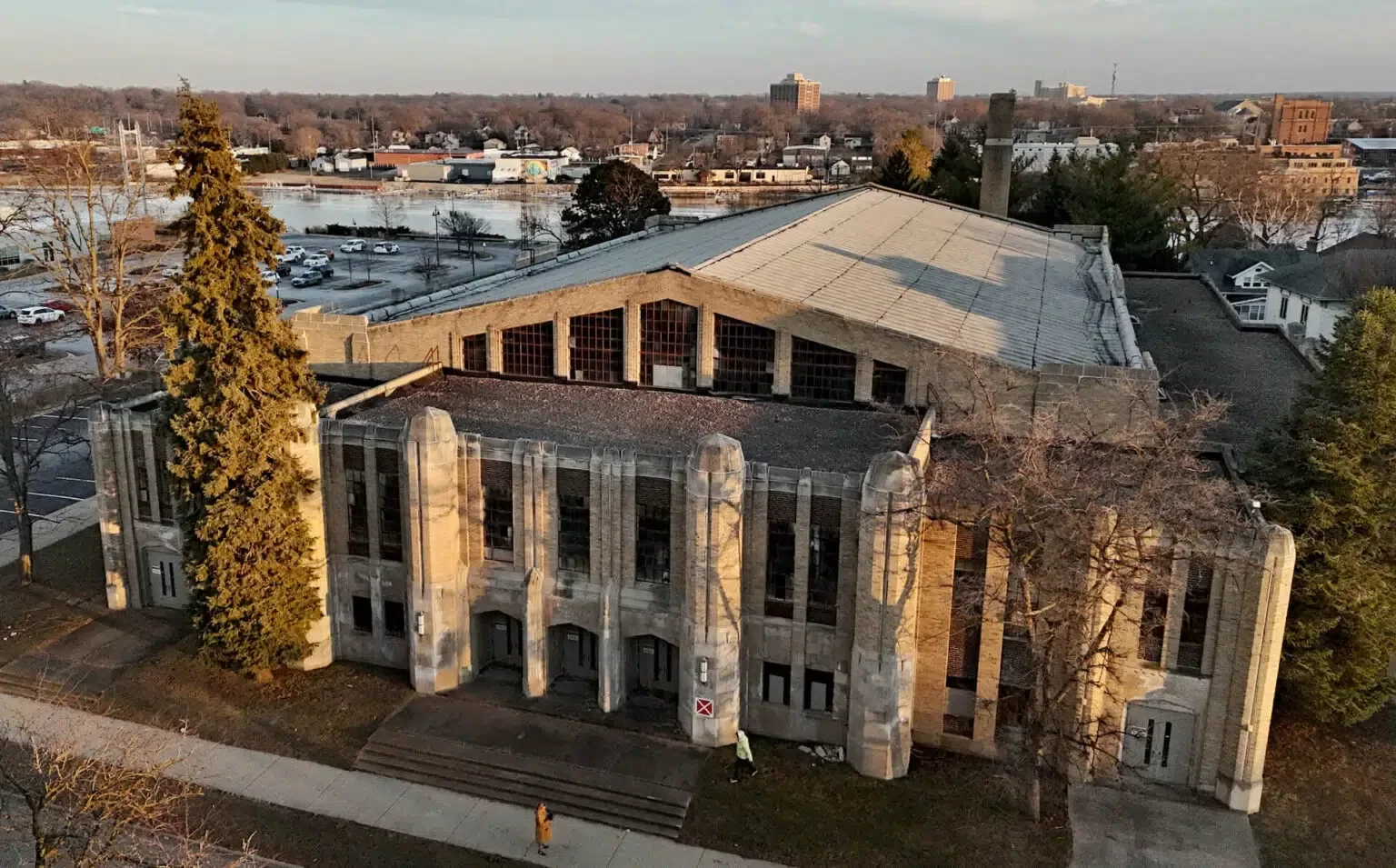
A unit administrator opens the armory on a Saturday morning before the drill schedule begins and finds a dark ring of water spreading across the assembly floor, with a drip still falling from the ceiling grid above it. The questions arrive in a predictable order: what is stored under the wet spot, who has to approve a contractor, and whether the unit can still use the hall tonight. For a National Guard armory near South Bend, IN, we answer the first one on the phone, ask someone to move gear away from the water, and send a crew to make safe while the paperwork question goes up the chain.
Floor, classrooms and equipment storage
Indiana runs 64 armories, and the state describes them as assembly and training space, classrooms and storage for equipment. That mix tells a roofer where to look. Water over a classroom damages ceilings and projectors, water over an assembly floor can warp a finished surface, and water over the equipment storage wing reaches gear that a unit has to keep dry and accounted for. When we trace a leak from inside we photograph each room, mark which ceiling tiles are stained and note the equipment that sits nearby. Then we go up and find the opening, starting at the nearest drain and working outward along the seams.
The Kemble Avenue armory
The South Bend armory is inside the city limits, so it takes the same weather the rest of South Bend does. The October 12, 2016 storms produced two EF0 tornadoes in and near the city, with straight-line wind damage reported along West Indiana Avenue and a microburst swath that ran from Northside Boulevard to Longfellow Road. Wind like that is what pulls edge metal loose or shifts a rooftop unit on its curb. We look at how the coping is fastened, how the flashing sits against the walls, and whether rooftop equipment is still fastened as installed.
What a public building teaches
On April 1, 2016, high winds and rain caused a section of roof to fail at the St. Joseph County Services Building in Mishawaka, and water flooded the top floor. That event shows how quickly a public building moves from a quiet roof to a closed floor when wind and water arrive together. The lesson for a readiness center is to find weak points before a storm does: ponding that loads a deck, drains that stay clogged, and edges that have started to peel. A maintenance visit before winter and after the thaw can catch clogged drains, ponding and edges that have begun to lift.
Regional response planning
Our regional service area includes South Bend, Elkhart, La Porte and Warsaw. Travel conditions and site access shape dispatch planning, so the first call should identify the municipality, access requirements and what is at risk below the leak. Distance and road conditions affect dispatch planning, so the first call should identify the municipality, access requirements and what is at risk below the leak. The response plan considers temporary protection, safe roof access and materials appropriate to the assembly. Findings are photographed, and permanent repairs follow after conditions permit a full inspection.
Wind and one-inch hail
South Bend's record gust of 92 mph, logged on August 22, 1996, is a fair design reminder for any armory roof, because most failures begin at the perimeter where metal edges and flashing have to hold against uplift. The June 1, 2019 storms added hail up to 1 inch in South Bend, which can bruise a membrane without leaving a hole, so a smooth sheet may look unharmed from the lot while the layers under it have crushed. After a storm we walk the roof, test the soft spots and write down where we saw dents, scuffs and loose laps. That record supports a wind damage repair and any insurance or state-agency claim that follows.
What the unit receives
A unit commander rotates, a full-time staff member changes jobs, and the roof history disappears unless someone wrote it down. We leave a written condition report with photographs, a plan of the roof marking each repair and each area to watch, and a short list of recommended work in the order it should be done. The agency responsible for the building can use the same file when it budgets public agency projects. The record should also identify drains, rooftop equipment, penetrations and the roof edges checked during the work. A facilities contact can compare these points with later observations and direct attention to a specific roof zone instead of relying on a ceiling stain alone. If a later inspection finds movement or new moisture, those reference points help the facilities contact compare conditions and direct attention to the affected roof zone. A follow-up visit after the thaw checks what held, and the report is updated. A VA medical center roof calls for the same kind of record, since a facilities office outlasts any one staff rotation. Where the installation also has aircraft facilities, the aircraft hangar roof needs its own span, access and uplift review.
Commercial Roofing Questions
Our unit only has the building on drill weekends. How do we get a roof walked without losing a training day?
Pick a weekday morning and ask the full-time staff member to open the hall, which usually means a crew of two on the roof while the floor stays empty. We start with the drains and edges, then check the details around rooftop equipment. If that visit finds something that needs a longer stay, we schedule the repair for a weekday as well, so the next drill weekend has a dry hall.
Wind pulled the coping off one corner last night. Can the unit use the hall this weekend?
Often it can, once the corner is secured and the opening above the wall is covered. The crew removes loose metal, checks the membrane underneath for lifted laps and installs a temporary cover that will hold until the permanent edge is ready. We then tell the unit which rooms to avoid and which are safe. If the wall below is wet, we ask for a quick look inside before anyone enters.
What access details help coordinate an emergency roof response?
Share the municipality, gate or escort requirements, what is at risk below the roof and whether roof access is restricted. Emergency roofing response is available around the clock, including holidays; site conditions and access determine the safe inspection and protection steps.
Equipment sits right under the deck of the storage wing. How is it protected during a reroof?
Before tear-off, the unit identifies equipment that must move or be covered. We phase work so exposed areas can be closed as conditions require, keep debris and dust controlled, and coordinate roof access with the facility contact. A designated unit representative can review the work area and closeout record.
Is one-inch hail enough to damage a readiness center roof?
It can be, depending on the membrane, its age and the insulation beneath. Hail of that size fell in South Bend on June 1, 2019, and damage does not always show as a puncture. We look for dimples, cracked granules on older surfaces and soft spots under the sheet, and we cut a small core if the evidence points to crushed insulation. The findings go into a report that the owner can send to an adjuster.
Related Roof Work
Talk to Our Team
Tell us where the water is landing, what the roof is made of and when the building is easiest to reach.
Phone: 555-555-5555
Email: [email protected]