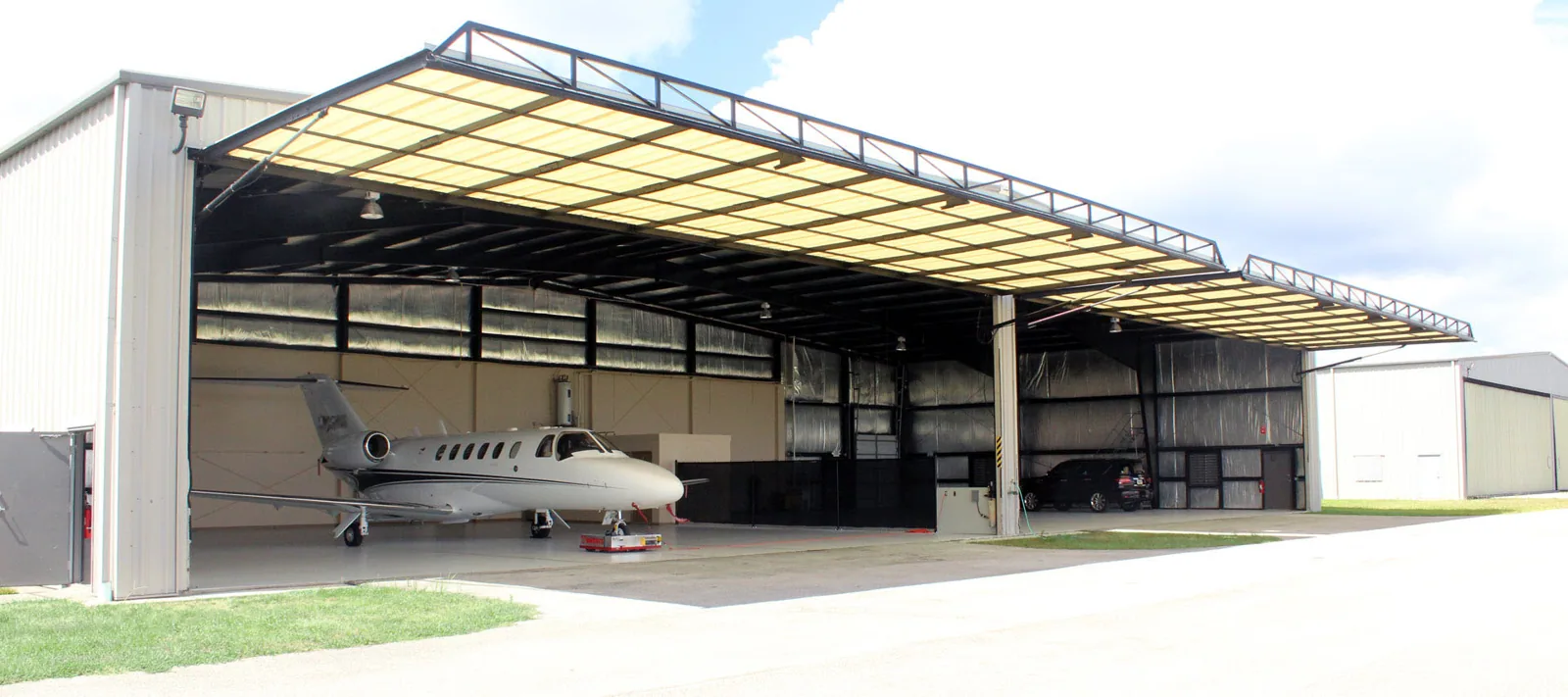
A line technician tows an aircraft into the bay on the first mild afternoon after a January storm, and meltwater falls from a truss joint onto the wing he just parked. He stops the tug, the hangar manager takes a photograph, and the question becomes how fast water can be kept off the aircraft, the floor and the electrical gear. A hangar roof in South Bend, IN is a very large piece of enclosed volume with expensive things under it, so our first call is about what sits below the opening and how quickly it can be moved or covered. The roof itself comes second, and then the order of work follows.
Clearing the bay before climbing
The first questions are about the aircraft, not the roof. Which bay, what is parked in it, whether fuel or ground power is nearby, and whether the manager can tow the aircraft to a dry bay or cover it. A crew member goes inside to photograph the leak and read moisture along the purlins and the underside of the deck, then asks the staff to stay clear of any wet electrical equipment. On the roof, access is arranged through the airport or hangar operator, since an airfield is a controlled place. The temporary dry-in goes over the opening once it is found, and the manager receives a photo log for the insurer and for the aircraft owner.
Long spans, big doors and wind
Hangars are open volumes with a clear span and a huge door opening, and that combination shapes how wind treats the roof. When a gust enters through a door that is open or has failed, the pressure inside the building pushes up on the roof from below while the wind pulls across the top. The highest wind gust recorded at South Bend is 92 mph on August 22, 1996, and the October 24, 2001 outbreak sent an F3 tornado across northwest South Bend. After wind damage we check panel attachment, ridge and eave closures, and edge metal, since the edge is where uplift begins. Open airfield pavement, such as the three runways at South Bend International Airport, gives wind little to slow it before it reaches a hangar.
Fuel, foam and hot work
Work above an aircraft needs rules that a typical commercial roof does not. Open flame and torch-applied materials are ruled out near fuel vapor, so repairs are done with mechanical fasteners, cold adhesives and sealants, and heat-welded seams only where the operator approves them. Many hangars also carry foam or sprinkler piping hung from the roof structure, and a drill bit that goes through the wrong spot can cause a very expensive discharge. We map the piping from the interior before a single fastener is driven, and we ask the operator for the fire watch they want. If a spark risk is present, the work waits. Every tool, bucket and scrap of membrane is tethered, so nothing falls into the bay.
Badges, escorts and loose debris
The ramp has its own rules. Crew members who work on an airfield need the credentials and escort the airport requires, vehicles follow marked routes, and cranes and lifts are coordinated with airport operations in advance. FedEx Express operates cargo flights from South Bend International Airport, so the ramp has cargo traffic to plan around as well. Foreign object debris is a real hazard: a dropped screw or a strip of membrane blown across the apron can damage an engine. We sweep the roof and the ground after each shift with magnets, keep fasteners in closed containers, and secure any loose sheet before wind arrives. The operator controls the process, and we write each step into the daily plan.
Telling the operators who share the building
Hangars often hold more than one tenant: a charter operator, a maintenance shop, a flight school or a private owner. Each has aircraft to protect and a schedule to keep. We prepare a short notice for each tenant naming the bays affected, the work hours and the doors that will be closed. If an aircraft owner needs the photos and moisture readings for an insurer, the manager can pass them along without waiting for a formal request. Where a hangar shares a lot with a warehouse or a flex building, we notify those tenants as well, because vehicle traffic may shift for a few days.
Metal, membrane or coating after the thaw
Many hangar roofs are metal over long steel framing, with a low-slope membrane over the attached office and shop wing. A tired metal roof with failing fasteners and laps can often take a metal retrofit or a new standing seam system with hidden clips. A drone roof inspection shows the full panel field without a crew walking the entire span. Permanent work waits for the thaw, when adhesives and sealants cure properly. The same planning applies at South Bend International Airport and its business park, at the Goshen Municipal Airport near Goshen, and at smaller fields such as Dowagiac Municipal Airport, each with its own operator and access routine.
Commercial Roofing Questions
Do we have to move the aircraft out of the bay for a roof repair?
For a small repair on the far side of the building, usually not, if the aircraft is covered and the area below is barricaded. A leak directly overhead or any work that opens a panel calls for moving it, and the manager knows the tow limits and the other bays available. We ask the same questions every time, which aircraft, what fuel is nearby, how fast it can be moved, and plan the roof work around those answers.
How does a damaged hangar door affect the roof during a windstorm?
An open or failed door lets wind inside, and the building then has pressure pushing up on the roof from below as well as suction from above. That combination can lift panels, strip edge metal and loosen fasteners that were fine in lighter wind. If a door is damaged, we check the roof edges and panel attachment after the storm, and we recommend repairing the door before the next high-wind forecast.
Who arranges badging and escort for the crew?
The airport or hangar operator sets the process, and we follow it. Send us the access steps, the names we need to submit and the vehicle routes, and we provide a crew list ahead of time. We never improvise on a controlled ramp. If the process takes several days, a temporary dry-in is still possible through the operator's approved access, so the aircraft are protected while the paperwork finishes.
Can a hangar roof be coated, or does it need to be replaced?
A coating can extend a metal roof whose panels are sound and whose rust is on the surface. Test areas show whether the coating will bond and whether the fasteners hold. If the panels are perforated, the insulation is wet, or the framing is corroded, a coating only hides the problem. A moisture survey and a close look at the underside tell us which path is honest.
What keeps loose fasteners and debris off the ramp?
Every fastener lives in a closed container until it is driven, and every scrap of membrane or metal is collected at the end of each shift. Magnet sweeps cover the roof edge and the ground below, and we stop work when the wind picks up. Operators can check the sweep log, and any piece found on the apron is reported immediately to the person who controls the ramp.
Related Roof Work
- Wind Damage Roof Repair
- Edge Metal, Coping and Gutter Repair
- Warehouse Roofing
- Flex and Light Industrial Roofing
- Metal Roof Retrofit and Restoration
- Standing Seam Metal Roofing
- Drone Roof Inspection
- South Bend Airport Industrial Park
- Goshen
Talk to Our Team
Tell us where the water is landing, what the roof is made of and when the building is easiest to reach.
Phone: 555-555-5555
Email: [email protected]