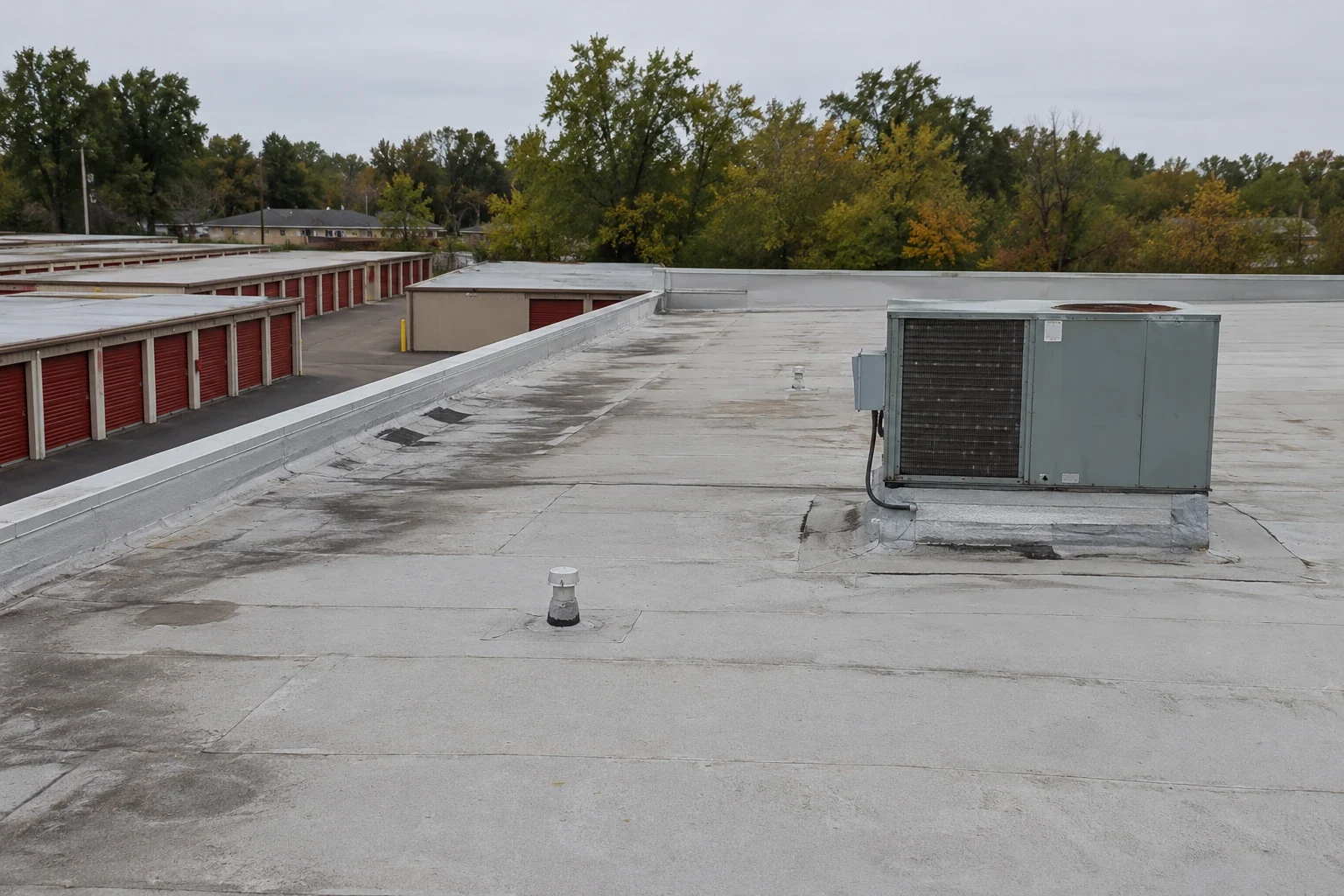
A tenant phones the office from the end of a drive-up row to say the boxes at the back of the unit are damp, and the manager walks the row an hour later, after a thaw, looking up at a ceiling of corrugated metal for a bead of light. Nothing is visible. That is how storage roof problems usually arrive in South Bend, IN: one unit, one complaint, and a long low roof that gives no hint of where the water entered. Our first call starts with that unit number and the door it sits behind, then works outward along the row until the entry point is found and a temporary dry-in is on.
Walking the row after the call
The manager tells us which doors, which units and what the tenant says is inside. A crew member checks the wet unit from the interior, photographs the ceiling and the stained wall, and notes whether the water ran along a purlin or dripped straight down. On the roof we follow the same line backward, looking at the ridge, the eave, the sidewall transition and every screw head along the way. If we find the opening, a compatible sealant, butyl tape or patch panel may stop the water, depending on the roof and conditions. The photo log goes to the manager, who can show the tenant that someone is already on it.
Fasteners and laps on a long metal run
Most storage buildings carry a long, low-pitched run of metal panel over each row, and the weak spot is the screw. Exposed fasteners sit in a rubber washer that cracks under sun, and the metal around it moves with the weather. South Bend has recorded -22 F and 104 F, a swing that makes panels expand and contract many times over the life of a roof, and that motion works screws loose. Backed-out fasteners leave a hole under the washer, and the lap seam above it opens. We replace failed fasteners with oversized ones, reseal laps, and look at the ridge cap and the endlap sealant. A roof that has been through this once usually needs the same attention again, so the visit ends with a list of what was done and what to watch.
Snow on the drive lane and wind between rows
Smooth metal sheds snow all at once. A cold week of lake-effect snow, followed by a warm afternoon, can send a sheet of ice from the roof into the lane where a tenant is backing up a truck. South Bend averages about 64.5 inches of snow a year, and in November 2022 one lake-effect event dropped 22.7 inches on the airport and 20.7 inches in Mishawaka. Snow guards above the doors and drive aisles keep slides under control, and snow removal around parapets and between buildings keeps meltwater off the panel laps. Rows set parallel to each other also funnel wind along the aisle. The 92 mph gust of August 1996 is a reminder to check ridge caps and end flashings after any snow and ice event.
When the drip is not a leak
Uninsulated metal over a cold unit sweats on a still morning, and the drops look exactly like a roof leak. A manager can chase that complaint for a season. The test is to see whether the drip follows weather or follows humidity: condensation shows up on a cold morning after a warm, damp night and dries by noon, while a leak follows rain and meltwater. A moisture survey of the unit and a look at the underside of the panel settles it, and the answer may be ventilation or an insulated liner instead of new roofing. Climate-controlled conversions, with their parapets, internal drains and membranes, are closer to a warehouse roof than a metal row, and we inspect them that way.
Tenant notice without a claim
Storage tenants feel the roof when their belongings get wet, so the notice should be quick and specific. We give the manager a short message naming the row, the work dates and the units that will be inaccessible for a few hours. Fire lanes stay open, and the gate keeps running its normal hours. If goods were damaged before we arrived, the photo log and the moisture readings document when and where water entered, which helps the tenant and the facility's insurer. We do not argue who pays. The lease and the policy answer that, and the paperwork we leave is built to support either side's adjuster with plain dates and photographs.
One row at a time, one season at a time
Owners rarely replace every building at once, so we plan the permanent work as a sequence. A sound panel with failing seams may be a candidate for silicone coating. A rusting corrugated roof with tired purlins may call for a metal retrofit or a new standing seam system with concealed clips and no exposed screws. The report ranks rows by risk, putting active water entry or a soft deck first; the remaining work follows a schedule the manager can fund. For owners with facilities along Toll Road exit 83 toward Granger, a multi-site roof program keeps every location on the same schedule. A maintenance visit each spring catches loose screws before they leak, and a flex building on the same site gets its own plan.
Commercial Roofing Questions
Why do the screws on my storage roof keep backing out?
Metal expands and shrinks with the season, and the screw holds a panel that is moving around it. Over time the rubber washer cracks and the hole under the head elongates, so the fastener loses grip. A standard repair uses a slightly larger screw with a fresh washer and a bead of sealant at the lap. If the whole roof is doing this, tightening each screw is only a delay, and a coating or retrofit becomes the sounder investment.
Water drips from the ceiling on cold mornings but there is no hole. Is it a leak?
Often it is condensation, particularly in an uninsulated unit with a metal ceiling and warm, humid air from the day before. Watch whether the drip follows rain or follows temperature and humidity. We can confirm by checking the underside of the panel and the moisture in the surrounding insulation or purlin. If it is condensation, ventilation or a liner solves it, and no roofing is needed.
Do I need to empty the units under a roof repair?
Usually not. Panel and fastener repairs are done from the outside, and we cover the unit's door and the lane to keep debris away from belongings. A full replacement is different, and some owners ask tenants to pull valuables from the top shelf or cover them with plastic. We tell you in advance what a particular scope involves, so the notice to tenants is accurate.
Can a rusting metal roof be coated instead of replaced?
Sometimes, if the panels still hold fasteners and the rust is surface rather than through the metal. We clean the roof, treat the rust, reseal the laps and fasteners, and apply the coating. A test area shows whether the coating will bond. If the panels are perforated or the purlins have corroded, coating only hides the problem, and we say so before any work starts.
Who pays when a tenant's belongings are damaged by a roof leak?
Your lease and your insurance policy answer that, and a property attorney or insurance agent can interpret them. What we contribute is the record: when the leak began, where water entered, the repair that stopped it and the photographs. Tenants and adjusters both ask for that, and owners who keep it ready usually settle the question faster.
Related Roof Work
- Mishawaka
- Snow and Ice Roof Damage Repair
- Warehouse Roofing
- Metal Roof Retrofit and Restoration
- Standing Seam Metal Roofing
- Granger
- Multi-Site Roof Programs
- Preventive Roof Maintenance
- Flex and Light Industrial Roofing
Talk to Our Team
Tell us where the water is landing, what the roof is made of and when the building is easiest to reach.
Phone: 555-555-5555
Email: [email protected]