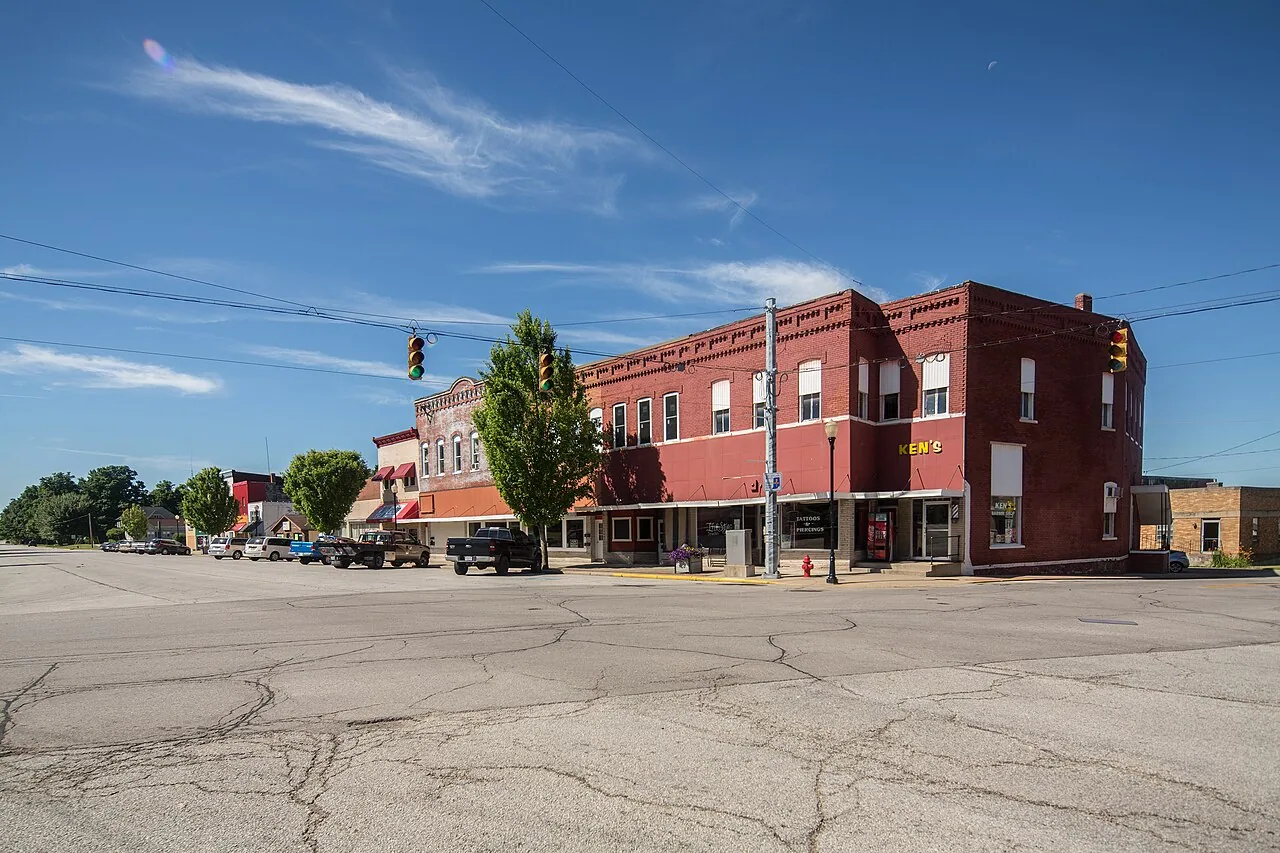
Paint lifts in a long curl just below the ceiling line on the inside of an older storefront, and it is often on the wall that meets the roof. That is where an Argos owner first suspects water, and it is where we begin too. Argos, IN is a 1.30 square mile town of 1,777 residents in Marshall County, grown up along the old Michigan Road, and its downtown carries a National Register historic district listing from 2001. Our crews take on low-slope and metal commercial roofs there, and on an older commercial building the first job is to learn what kind of roof edge and wall junction the building actually has, then make that junction safe before the next rain.
Older storefronts and the fabric worth keeping
The Argos Downtown Historic District was listed on the National Register of Historic Places in 2001, so older commercial buildings there need roof work that respects historic fabric. In practice the roof is only part of the question. Where a building has a cornice, a parapet cap or a decorative edge, those pieces are often its visible character, and the work has to keep water out without replacing them with something that looks wrong from the street.
We photograph existing conditions before anything is touched, work out which flashings can be repaired in place and which must be rebuilt to the same profile, and ask early whether any review applies to the exterior parts of the scope. That conversation happens ahead of the schedule, not in the middle of it, and a failed flashing or a worn edge metal and coping detail is rebuilt from that record.
The old Michigan Road and the new US 31
Argos grew along the old Michigan Road, and the road network around it is changing. INDOT is converting US 31 to a limited-access highway, with the SR 10 intersection in Argos flagged for safety work, and the freeway running from Plymouth into South Bend dates to 2014. For a roofing job that shows up as logistics rather than weather: where a delivery truck can turn, when a lane is restricted, how far a crane must reach and where the crew parks.
We confirm the delivery route, the staging spot and the nearest point of roof access during the first visit, because a tear-off scheduled for a week when the approach road is torn up can lose more time than the roof itself takes. The same visit tells us whether a lift is needed or whether materials can go up by hand.
What lies under the surface of an older roof
Roofs on older commercial buildings tend to carry a history: a built-up roof from one era, a recover from another, a patch from last winter. We do not assume what is there. A core cut shows how many layers sit on the deck, whether they are dry and how much weight the structure already carries. If two roofs are already stacked, a further recover may not be allowed, and removal of the old layers becomes part of the cost.
If the insulation is dry and the membrane is sound, a coating or a recover may be enough. We carry the results into a short written report with a photograph of each core, so the owner has evidence in hand when comparing options or talking to an insurer.
The code in force and the code on the way
Indiana's commercial code in force statewide is the 2014 edition, drawn from the 2012 International Building Code, and local building departments enforce it. Energy requirements follow a 2010 code that points to ASHRAE 90.1-2007. The state commission has a draft rule that would put the 2024 International Building Code into effect as the 2026 Indiana code, but the draft leaves the effective date empty.
For an owner planning a replacement, the practical point is timing. A project permitted before a new edition takes effect may be reviewed under the old one, and a roof being designed now is worth checking against both. We confirm which edition the local reviewer is using before the scope is set, so the insulation and fastening in the quote match what the inspector will look for.
Cold, heat and hail as South Bend records them
Cold weather, meltwater and hail all put roof details to a practical test. After a freeze, we inspect drain bowls, wall flashings and laps where water can collect before moving into the building. A June 1, 2019 storm brought 1.25-inch hail near Crumstown and 1-inch hail in South Bend. After a hail report, a close walk checks for bruised membrane, crushed insulation and damaged edge details that may not show from the ground. The findings guide hail damage repair and ordinary maintenance.
What moves the number, and when to schedule
On a downtown storefront the drivers are specific: custom-formed edge metal, hand work at tight parapet corners, the number of layers to remove, and how much of the roof has to stay open to the weather at a time. Occupied buildings add notice to tenants, deliveries to protect and hours to keep, which we plan with the manager before the crew arrives. The milder months are often the practical window for larger work that depends on dry surfaces and curing conditions, while preventive maintenance in spring and fall helps catch small issues before they widen. The same spring and fall rhythm suits owners in Bourbon, also in Marshall County.
Commercial Roofing Questions
Our building is in the historic district. Can the roof still be replaced?
The roof itself can be replaced; what we handle with care is anything visible from the street, such as a cornice, a cap or a decorative edge. We document those pieces first, repair them where they can be saved, rebuild them to the original profile where they cannot, and ask early whether any review applies so the schedule is not caught out.
A stain appears at the front wall every time it thaws. What is the likely cause?
Look first at the wall junction. Meltwater runs down the roof and meets the base flashing, and a split in that flashing or a gap at the top of the wall lets it in only when the water is moving, which is why the stain follows the thaw. We trace it from inside, then open the flashing to see how far the water has traveled.
How do we find out whether another recover is allowed on our roof?
Cores come first. A cut through the roof shows how many layers are already on the deck and whether the insulation is wet, and the local building office confirms what it will permit. If the answer is no, the quote includes tear-off, and we describe the added cost in the report so it does not surprise anyone.
Will road work on US 31 affect a re-roof schedule?
Only through access. A closed turn lane or a restricted intersection can change where trucks and cranes work, so we check the delivery route on the first visit and adjust the dates if the corridor near SR 10 is under construction. The roof itself is not affected.
Is a patch worth doing on a roof that is near the end of its life?
A patch buys a season when the membrane around it is still sound, and an infrared survey shows whether that is true. If the surrounding insulation is wet, the patch only moves the leak, and the money is better spent planning a recover or replacement while the schedule is still yours to set.
Related Roof Work
- Flashing Failure Repair
- Edge Metal, Coping and Gutter Repair
- Plymouth
- Roof Recover and Overlay
- Hail Damage Roof Repair
- Preventive Roof Maintenance
- Bourbon
Talk to Our Team
Tell us where the water is landing, what the roof is made of and when the building is easiest to reach.
Phone: 555-555-5555
Email: [email protected]