A line lead at a coach or bus assembly plant in Nappanee, IN notices a slow drip near a production station and asks whether the floor needs to stop. We begin with the affected area, what is running below it, and whether people or equipment need to move. The roof inspection traces the opening, records the surrounding membrane and identifies what temporary protection is practical. A permanent scope can then be sequenced around production needs. Nappanee's RV and bus manufacturing activity makes roof access, exhaust points and equipment clearances important parts of that first walk.
Coach and bus plants in town
Nappanee is a regional center for RV manufacturing, and the manufacturers named in town include Fairmont Homes, Franklin Coach, Gulf Stream Coach and an Alexander Dennis bus assembly plant that has operated since 2014. Elkhart, about 15 miles east of South Bend, calls itself the RV Capital of the World, and Thor Industries, the largest RV maker, runs major plants in Elkhart County and Middlebury. Assembly work is a major part of the roofing picture for this corner of northern Indiana.
The roof over an assembly floor works hard in specific ways. Exhaust fans, makeup air units and skylights pierce the membrane in many places, so penetrations and curbs get the first look on a walk. Large doors, wherever a plant has them, put the roof edge and the wall junction under wind pressure. A plant that runs paint, adhesives or finishing in one corner may also have chemical vapor and heat venting through the roof, and the membrane chosen for that corner has to tolerate it. We ask about those details before recommending a system.
Craft shops and visitor weekends
Nappanee also has customer-facing commercial spaces, where roof work must protect merchandise, staff routes and the entrance. When a roof leaks over a retail floor on a Saturday, the question is how to keep the doors open. We set a temporary dry-in, cover merchandise, mark the wet area and tell the manager exactly what to say to staff. Permanent work is scheduled for a weekday, with the loudest operations and any strong-smelling adhesive work timed away from opening hours.
The same photo log serves a shop owner and a landlord. It shows where the water came in and what was done, and it gives a tenant something specific to show the building owner. If you manage a restaurant roofing project or a strip of retail units, the order of work stays the same: stop the water, protect the space, and document the cause. Cooking vents on a restaurant roof add grease and heat, and those curbs get extra attention.
US 6 and getting material to the roof
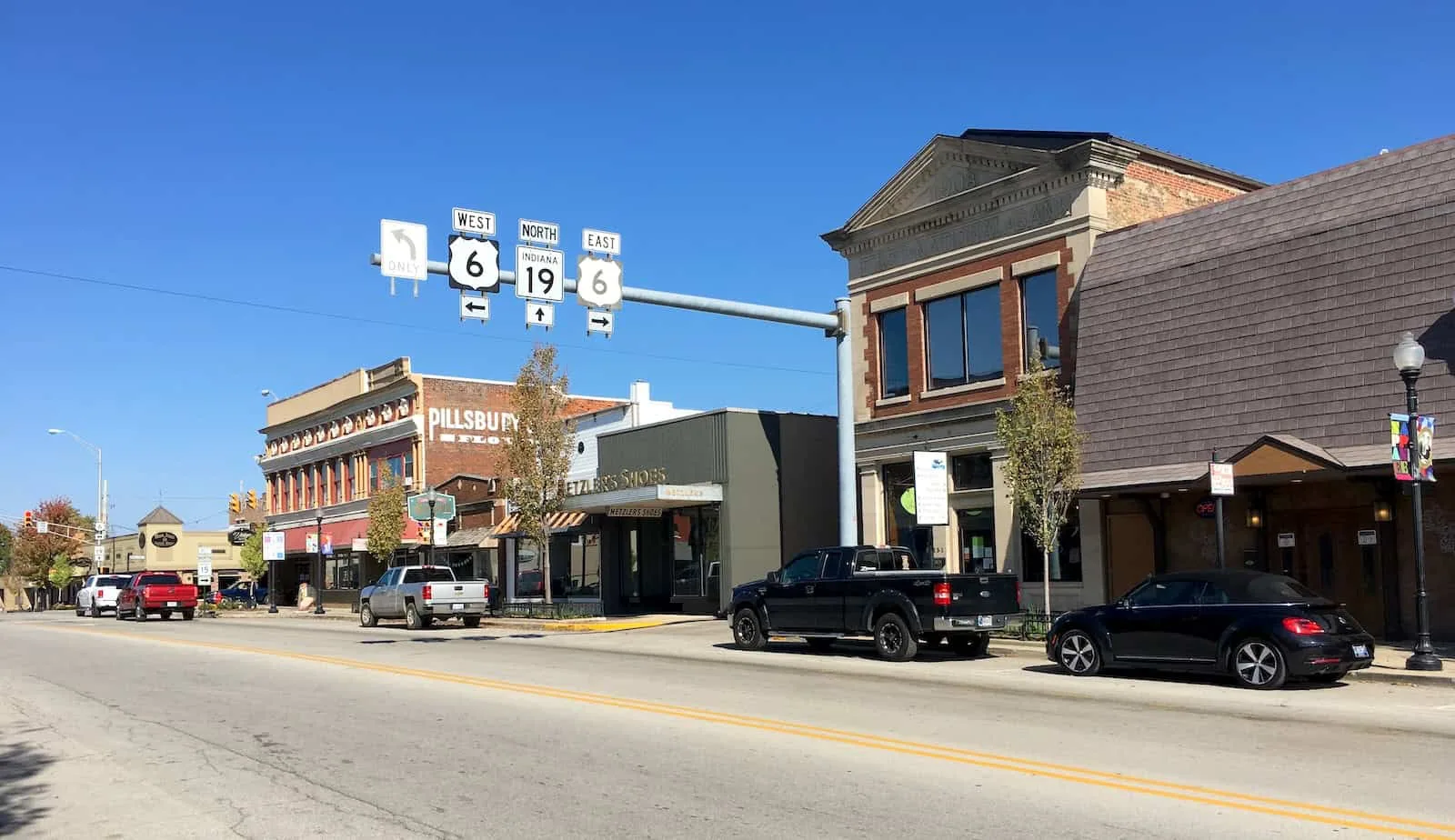
US 6 reaches Nappanee 8 miles east of Bremen, and a roofing delivery arrives by truck over roads like it. Membrane rolls, insulation boards and edge metal need a staging area off the plant's own shipping lane, and on a tight site the delivery timing is arranged with the receiving office. A plant that ships daily cannot have a flatbed blocking a dock, so we schedule deliveries for the quiet part of the day and keep unloading short. On the roof, loads are spread to avoid concentrated weight on a deck that may have taken water damage.
If an owner has sites in Bremen and Nappanee, we can walk them in the same visit with a commercial roof inspection at each. The report format is the same, so the owner can compare roofs against one another and rank which ones deserve the next dollar.
Hail, wind and the county record
The wider northern Indiana market has seen damaging hail and wind. On June 1, 2019, hail up to 1.25 inches fell near Crumstown and 1 inch fell in South Bend. South Bend also recorded a 92 mph gust in 1996. After severe weather, a roof walk starts at edge metal, penetrations and exposed seams, then checks the membrane field for bruising or lifted areas. After severe weather, a roof walk starts at edge metal, penetrations and exposed seams, then checks the membrane field for bruising or lifted areas.
After hail, we look for bruised or punctured membrane, crushed insulation under soft spots, and damaged metal at the edges and vents. A hail damage roof repair scope is documented with dated photos, because the insurer will want to see what the roof looked like before and after. Wind damage is checked in the same visit, starting at the perimeter, where an edge lifts first and the rest of the membrane follows.
Choosing between a repair and a new system
After the walk, an owner usually faces three options: repair the failed spots, install a coating or recover over a sound base, or tear off and replace. The facts that decide it are measurable: how much insulation is wet, what shape the deck is in, how many layers are already up, and whether the building can tolerate the noise and disruption of a tear-off. A single-ply TPO system suits a wide flat roof with many penetrations, while a metal roof retrofit is worth weighing on a building with a steep enough slope and persistent leaks at seams.
Before a production roof is priced, we separate the area that needs immediate protection from the roof that can remain in service. Core samples or moisture readings show whether insulation is dry, while seam and flashing checks find openings that can be repaired without disturbing sound sections. The resulting scope gives the owner a repair option and a replacement path with the reasons for each. We also identify staging needs near receiving lanes, overhead doors and pedestrian routes, so material handling does not disrupt an active assembly shift.
Commercial Roofing Questions
Our plant runs two shifts. How do you work over a floor that never goes quiet?
We work in sections and keep the area below protected and clear. Each day ends with the open section dried in, so the next shift walks in under a sealed roof. Loud or dusty tasks are timed away from sensitive stations, and a supervisor gets a short note each morning on what the crew is doing and where.
Hail was reported in the county after a storm. How would we know whether our membrane took a hit?
Look for what the surface cannot tell you. Bruises and punctures show up on a close walk, but crushed insulation underneath only shows with a moisture scan or a core. We do the walk first, then scan if the surface shows impact marks, and we record everything with photographs so a claim has a clear before and after.
The roof edge by our big bay door keeps leaking. What is failing there?
Most often it is the edge metal or the flashing where the membrane turns up, loosened by repeated wind pressure and thermal movement. We pull back the damaged section, check the substrate for rot, and rebuild the edge with fasteners and sealant suited to the load. Fixing only the surface leaves the same weakness in place.
We manage a shop that is busiest on weekends. When should the roof be worked on?
Weekday mornings, when foot traffic is lightest. A temporary dry-in is placed whenever a leak appears, even on a Saturday, but permanent work goes to a quiet day so the crew has room and customers keep clear access. The manager receives a written plan beforehand, with a drop zone marked.
Related Roof Work
Talk to Our Team
Tell us where the water is landing, what the roof is made of and when the building is easiest to reach.
Phone: 555-555-5555
Email: [email protected]