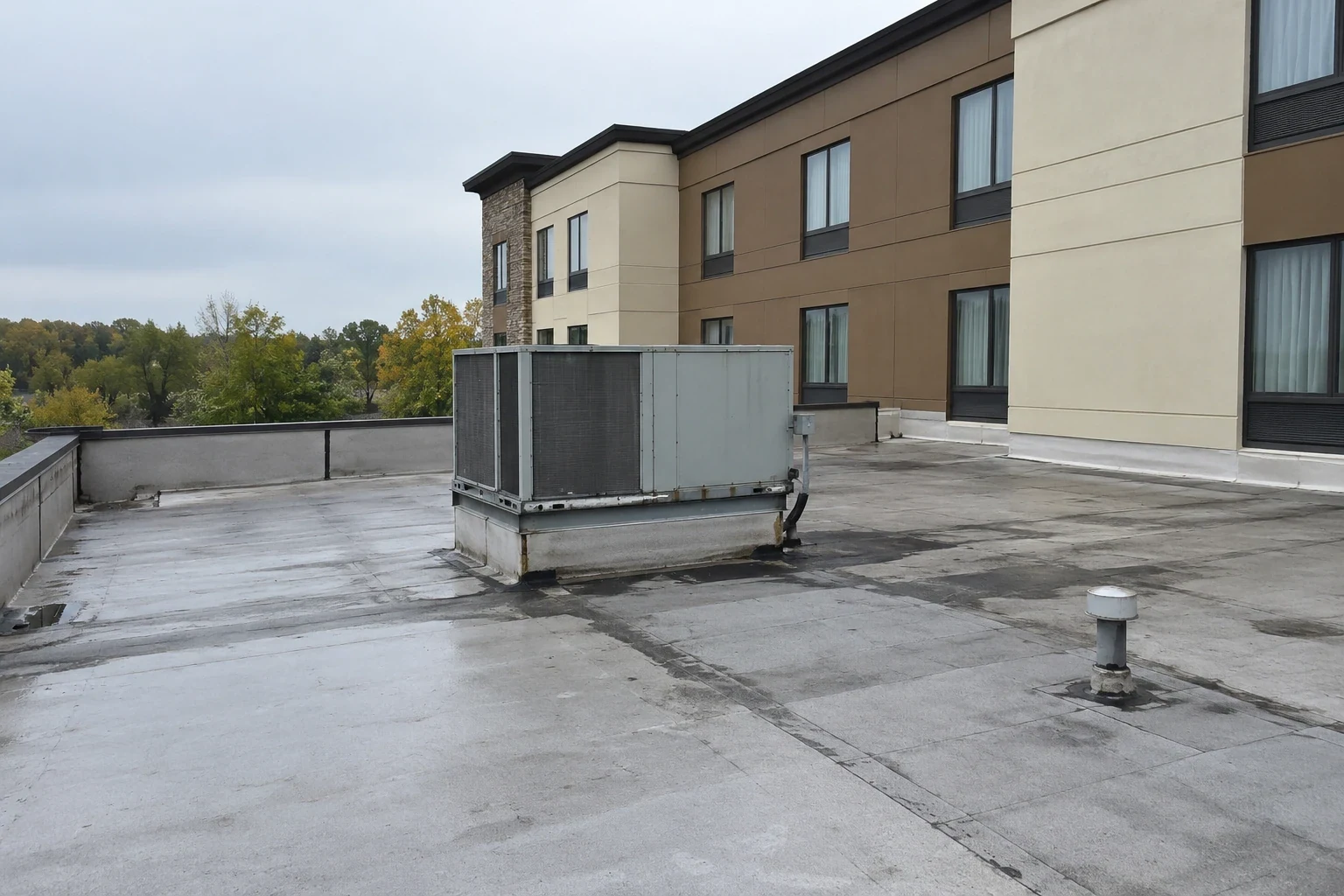
The night auditor takes the call at ten past two: a guest on the top floor has water coming through the ceiling above the bed, and the lobby is quiet enough that the desk can hear the drip over the phone. The room goes out of inventory at once, but the real questions come next. Is the water only in that room or running along the corridor ceiling? Are the rooms below affected, and what will the morning shift tell the next guest? In South Bend, IN, where lake-effect snow can stack on a roof for days before a thaw, that call can arrive at the wrong hour on the wrong night. A roofer for a hotel has to think about three people at once, the guest, the manager and the owner, and the sequence we follow keeps all three informed.
The night desk call
A person answers at any hour, and the first questions are the ones a night manager can answer from the floor: which room, how fast, and whether water has reached the corridor or the rooms below. We ask for the room and any room under it to come out of inventory, and for towels and plastic only where the floor is dry. A crew goes to the roof, clears the drains, traces the water from the ceiling to its opening and plans a temporary dry-in as access and weather allow. The manager receives a list of affected rooms, a photo log of the roof opening and a proposed permanent-repair schedule, so the revenue team can plan room inventory. Interior drying belongs to whichever restoration firm the property uses, and we coordinate timing with them.
Tower, podium and porte-cochere
A hotel rarely has one roof. The tower, the lower wings over the lobby, restaurant and meeting space, the porte-cochere and the mechanical level each carry their own membrane, flashing and drainage, and the junctions between levels are where water finds a way in. Height raises wind exposure: the hotel at South Bend opened in March 2023 and stands second in height among the city's buildings, and the 22-story hotel at Michigan City's Blue Chip Casino is described as the biggest building in northwest Indiana. Copings and perimeter attachment matter more on a high roof, so we start with edge metal and copings. We then walk the field, photograph every penetration, and study the transitions where a tall wall drops onto a low roof, because snow and ice slide and collect there.
Rooms under the roof
Top-floor rooms sit directly under the work, so noise, dust and vibration matter. We agree on the rooms to be blocked before the crew mobilizes, schedule loud steps for mid-morning through mid-afternoon, and run the work wing by wing so the whole building is never affected at once. The front desk, housekeeping and the revenue manager receive a written notice with the dates, the roof areas in use and the rooms most affected. Occupancy has its own calendar, and in a market with a 77,622-seat stadium at Notre Dame, an event weekend is no time for a tear-off. We keep heavy steps for slower weeks and limit peak dates to short repair visits, using occupied building reroofing methods throughout.
Weather on a tall roof
South Bend has logged a gust of 92 mph, and in October 2016 a microburst ran from Northside Boulevard to Longfellow Road while damaging wind hit West Indiana Avenue. On a tall roof, wind like that tests every coping and every edge detail. Hail up to 1.25 inches fell near Crumstown on June 1, 2019, and 1 inch fell in South Bend, enough to bruise a membrane and dent rooftop equipment. Winter brings ice at the drains, drift load on the podium roof below a tower, and snow sliding from a higher roof onto the entry canopy. We clear the drains and canopy edges after heavy snowfall and recommend a look at the entrance side before guests arrive in the morning.
Moisture inside the walls
Guests notice what managers miss. A damp smell in a corridor, a ceiling tile with a yellow ring, a warped baseboard or carpet that squelches near an exterior wall can all trace to a roof that has leaked slowly for weeks. Water travels down wall cavities and along pipe chases, so the stain is rarely under the opening. An infrared moisture survey after dark maps wet insulation on the roof, and a moisture meter inside shows how far the water has gone. Catching a slow leak early costs a few rooms for a short time; catching it late costs the rooms, the drywall behind them and sometimes a mold response. The owner's restoration and insurance contacts need the dated photo log either way.
Owners, operators and lenders
Hotels answer to several readers: the owner, the management company, the lender and the insurer. We write for all of them, naming each roof section, tying photographs to findings and giving every item a priority. Operators of several properties benefit from a common format across hospitality groups, so the roof budget at each hotel can be compared. A roof condition report before a renovation, sale or refinancing gives the owner facts to negotiate with. A hotel with a restaurant on site inherits the grease and exhaust questions of restaurant roofing, and an extended-stay building shares the concerns of apartment roofing.
Commercial Roofing Questions
How quickly can a leaking guest room go back on sale?
That depends on how much moisture reached the room. The roof opening is addressed first, then the room is checked with a moisture meter and the interior is dried or repaired by the property's restoration team. A small stain may require a short outage; wet drywall or carpet can take longer. We coordinate the roof scope with the manager so room decisions follow the actual condition.
Do guests have to be moved out for a full reroof?
Seldom. Rooms directly under the active section may be blocked for noise, and the work runs wing by wing so the rest of the hotel keeps selling. The crew uses protected paths away from entrances, covers intakes and ends each day with a watertight section. A revenue manager who knows the dates in advance can price around the disruption.
Why do stains appear in the corridor when the leak is in a room?
Water follows the lowest route along the deck, through a wall cavity or down a pipe chase, and stains wherever it finally finds a way out. We trace backward from the wettest spot with a moisture meter and an infrared scan, then confirm the opening with a dry-in and watch the next storm.
What makes a tall hotel roof harder to repair than a low one?
Access, wind and hoisting. A crew may need a crane or hoist to move materials, fall protection is more demanding, and gusts at height can stop work that would continue on a low roof. We plan around wind forecasts, secure materials every evening, and keep a temporary repair ready for days when a full day on the roof is not possible.
How do we rank roofs across several hotels?
Rank by what is under the roof, how much life is left and how often the property has had leaks. A roof over guest rooms, a ballroom or a kitchen outranks one over storage. Get a condition report on each property, keep photographs by section, and update the ranking each spring after the thaw.
Related Roof Work
- South Bend
- Edge Metal, Coping and Gutter Repair
- Occupied Building Reroofing
- Infrared Roof Moisture Surveys
- Hotel Owners and Hospitality Groups
- Written Roof Condition Reports
- Restaurant Roofing
- Apartment Roofing
Talk to Our Team
Tell us where the water is landing, what the roof is made of and when the building is easiest to reach.
Phone: 555-555-5555
Email: [email protected]