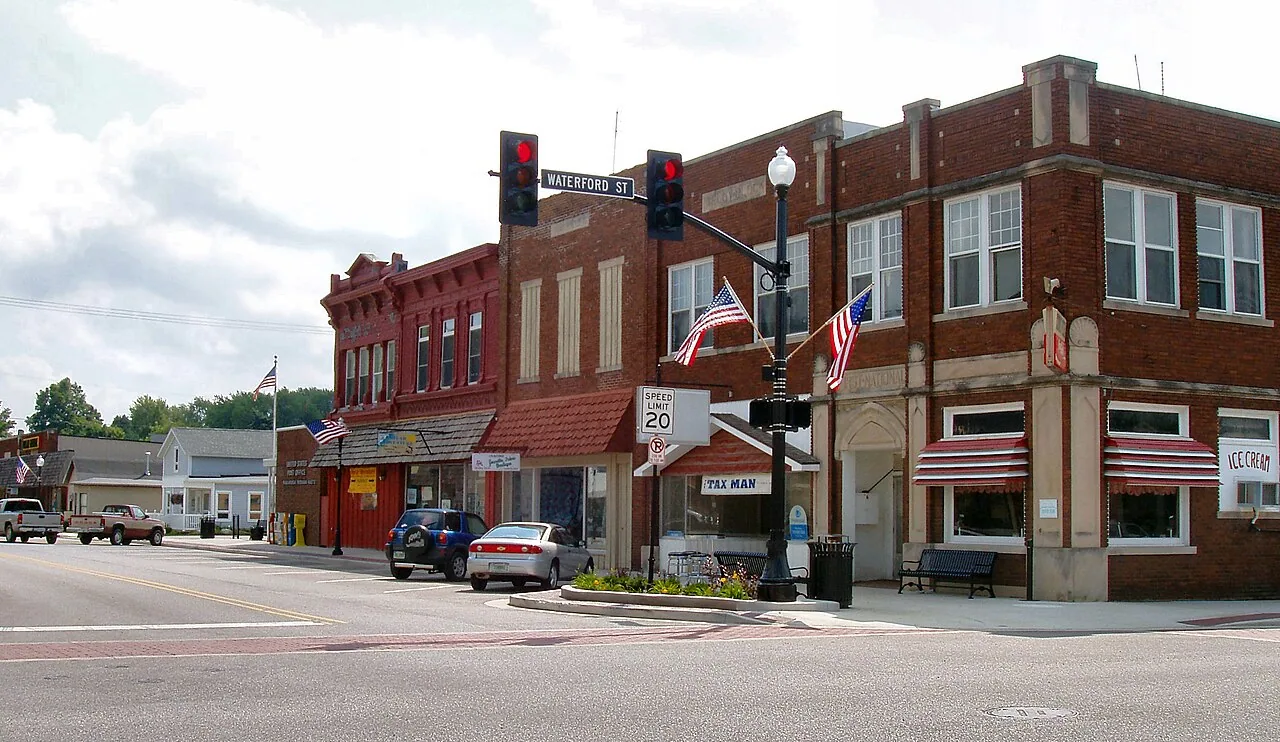
A supervisor calls from a Wakarusa plant floor a little after shift change. Water is coming through near a bay where work is under way, and nobody wants to stop the line unless the roof forces it. What decides the next hour is where the water is traveling, because on a plant roof it often enters at a curb or a seam well away from the spot where it drips. So we ask for the nearest column line, the nearest rooftop unit and what sits underneath, and a technician heads up with a camera while the call continues. Wakarusa sits on State Road 19, 12 miles south of Elkhart and 25 miles southeast of South Bend, IN. Forest River employs nearly 600 people in town, Thor Industries about 700 in a former Monaco Coach facility, and the town also has a farming economy with two grain mills.
Stopping the water without stopping the line
The first visit has one aim: keep the production floor running while the roof stops leaking. We look for the entry point from above and from below, set up a temporary dry-in over the opening, and put diverters or tarps under the leak path only where the plant manager agrees it is safe. Anything electrical, any paint or finishing area and any stored material gets covered or moved first, in that order of priority. Before leaving, we photograph the wet area, the repair and the surrounding roof, and the plant manager receives that photo log along with a short note on what happens next. The permanent work is scheduled afterward, with production hours in mind, not squeezed into the same emergency visit.
What a production roof carries
A manufacturing roof is rarely just a membrane. It carries exhaust fans, make-up air units, process vents, sprinkler risers and conduit runs, and each of those is a place where water can find a way in. On a first walk we look at the flashing around every one, at the condition of the curbs, and at any sealant that has been added as equipment changed. Walkways to the units matter too, since service techs wearing grit on their boots can wear through a membrane faster than weather does. On a manufacturing plant roof, how equipment is supported matters as much as the membrane, and where a curb has to be rebuilt we tie it into the new membrane instead of patching around it, with the curb and support details settled before the sheet goes down.
Mills, bins and metal panels
Wakarusa's farming economy includes two grain mills, and farm and feed buildings often carry metal panels. If a building has panels, the questions are about fasteners backing out, sealant at laps, ridge and eave closures, and corrosion at cut edges. Where the existing metal is sound, a metal roof retrofit can put a new standing seam or a new membrane over it without a tear-off, which keeps the building in service and avoids landfill costs. Grain and feed operations also make dust, so we pay attention to how vents and openings are detailed and how a dust-laden surface will take a coating or a bond. Where a building calls for new metal, standing seam metal roofing removes the exposed fasteners that are a common cause of panel leaks.
Winter and wind planning nearby
South Bend, 25 miles away, averages 64.5 inches of snow a year, with freezes running from about October 18 to May 1. That long seasonal cycle makes clear drains and sound scupper details important; the current forecast and roof conditions guide each repair. Those winter conditions make drain and scupper access part of the seasonal plan. South Bend's historic 92 mph gust in August 1996 shows why straight-line wind puts edge metal, copings and membrane attachment under scrutiny on a plant roof. After a wind event, we walk the perimeter first, since loose edge metal is where uplift starts, then check the field for billowing or torn membrane. A wind damage roof repair that begins at the edge and works inward catches problems before the next storm.
Phasing a replacement around production
On a plant that cannot shut down, the roof is divided into zones and replaced one at a time. Each zone is opened, dried in and closed before the next begins, so no section sits exposed overnight. Cost and timing hinge on how much of the roof is wet underneath, how many equipment lifts the schedule needs, how the crane or lift reaches the building, and whether production has a slow week we can work in. We write the phasing plan with the plant manager, including where noise or dust has to be held down, and reroofing an occupied building this way keeps each zone sealed from the interior. The same zone-by-zone method carries over to roofs in Elkhart, the RV manufacturing center to the north, and to Middlebury, where Thor Industries has major plants, so an owner with buildings in several of these towns can run one schedule with one contact.
Commercial Roofing Questions
Our plant has a leak above a finishing area. What should happen first?
The first move is to protect the work below and find the entry point, in that order. We cover or relocate anything sensitive, then go to the roof and trace the water to a curb, seam or penetration. A temporary dry-in goes over the opening the same visit. The permanent repair is scheduled afterward with the plant manager, since it usually needs dry weather and a clear zone around the equipment.
Is a metal roof retrofit worth it on a building with leaking panels?
It is worth considering when the panels and purlins are structurally sound and the leaks come from fasteners and laps. Retrofit goes over the existing metal, so the building stays in use and there is little tear-off. If rust has eaten through panels or the framing is weak, retrofit hides the problem and replacement is the safer path. A condition report tells you which case you are in.
How do you replace a plant roof without shutting production down?
We divide the roof into zones, open one zone at a time, and close it dry before moving on. Equipment shutdowns are scheduled with the plant manager, and noisy tear-off can be timed to a quieter shift. Interior protection goes up where needed, and a daily walk-through confirms every opening is sealed at day's end. Phasing adds some calendar time, but it keeps lines moving.
A storm blew through and we see loose edge metal. Can it wait for spring?
Loose edge metal should be secured right away, because the next gust can peel it back further and expose the membrane beneath. A temporary fix costs far less than the damage it prevents. We secure the metal, photograph the area for the insurer, and recommend a permanent repair after the thaw. If the membrane was lifted, we also check the insulation below for water.
Do grain mills and farm buildings need a different kind of roof maintenance?
They benefit from attention to fasteners, laps and closures on metal panels, and to dust around vents and openings. Dust holds moisture and can shorten the life of a coating or a seam. We check the panels, tighten or replace fasteners, reseal laps, and keep drainage clear so ice does not build at the eave. A twice-yearly walk usually catches problems before water gets inside.
Related Roof Work
- Manufacturing Plant Roofing
- Rooftop Equipment Curbs and Supports
- Metal Roof Retrofit and Restoration
- Standing Seam Metal Roofing
- Wind Damage Roof Repair
- Occupied Building Reroofing
- Elkhart
- Middlebury
Talk to Our Team
Tell us where the water is landing, what the roof is made of and when the building is easiest to reach.
Phone: 555-555-5555
Email: [email protected]