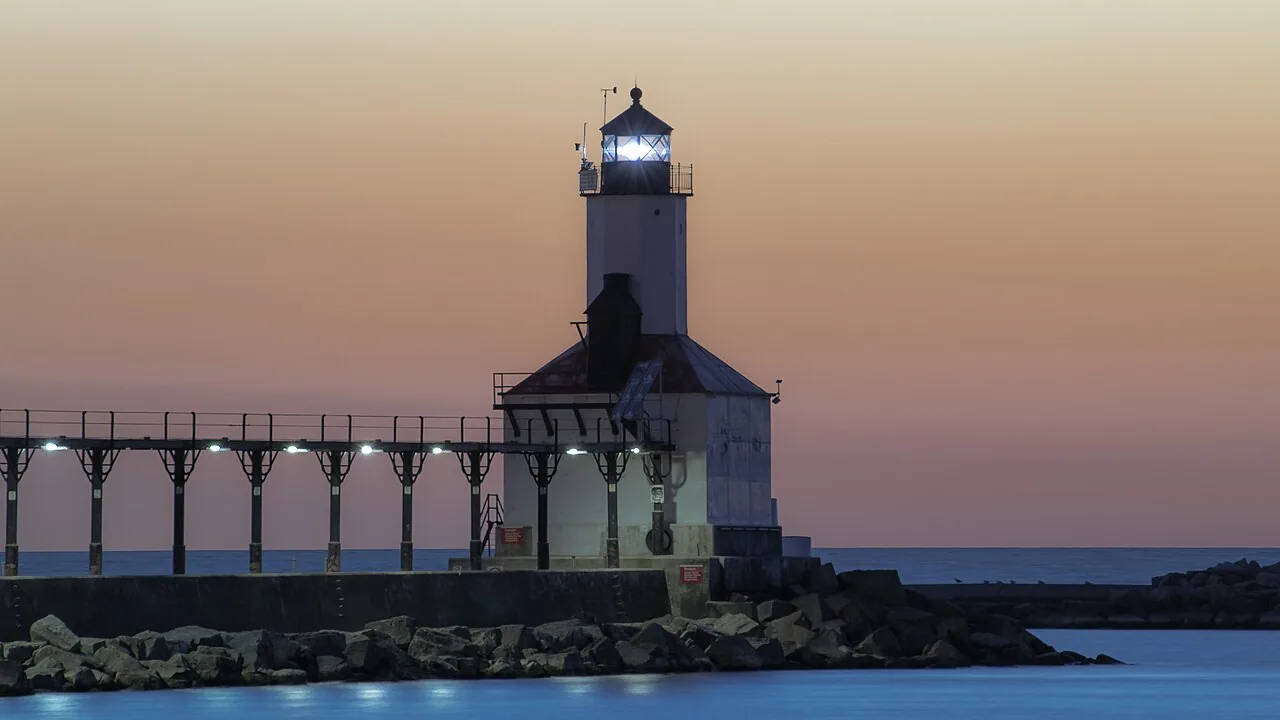
The overnight engineer at a lakeshore building in Michigan City, IN hears a steady tick in a service stairwell and goes up with a flashlight, and the ceiling tile he finds soaked is nowhere near the spot where the water is actually getting in. That is the usual shape of the first call. The person on the phone has a wet floor, a manager to wake and no idea whether the roof can be reached safely before daylight. We take the address, ask where the water is showing, and walk through what happens next: someone goes on site to find the entry point, a temporary dry-in is set so the space can be used, and the photo log starts before anything is moved. Michigan City is about 40 miles from South Bend, and the planning begins on the first call.
What height does to a hotel roof
The Blue Chip Casino's 22-story hotel, finished in 2009, is described as the biggest building in northwest Indiana. A tower like that changes how a roof repair is run, regardless of what membrane sits on top. Wind speeds climb with height, so materials have to be hoisted, tied down and staged with a close eye on the forecast. The ground below holds guests, vehicles and entrances, which means a drop zone has to be fenced and watched for the whole job. Rooftop mechanical equipment sits close to every edge, and a gust that tosses a loose sheet of insulation board is a safety event before it is a roofing problem.
We sequence tower work so the leak is stopped first and the permanent repair follows on a day with the right wind. Guest-floor noise and any odor from adhesives are planned with the engineering office, and a hotel roofing scope names which rooms sit under the work so the front desk can move bookings before the crew arrives.
Outlet storefronts and a mall after its department store left
Lighthouse Place Premium Outlets opened in 1987, and the indoor Marquette Mall closed in 2017 after JCPenney left, which leaves two very different roof questions. At an outlet center the first job is to find out what is actually up there: how many layers, what kind of flashing sits at the storefront parapets, and where earlier patches were made. A stack of old repairs, each cheap on the day, costs an owner more over the years than a planned program would.
A building that has lost its largest tenant and sits partly or wholly empty carries a different risk. No one is inside to notice a drip, so water can run for weeks before it is seen. Drains and scuppers still need to be cleared, and an insurer will want dated photographs of the roof's condition. For occupied centers the same photo log supports a plan for shopping center roofing repairs that can be phased around store hours.
The generating station and the shoreline
The Michigan City Generating Station sits on the Lake Michigan shore west of downtown. Roof access on a controlled industrial property like a power plant follows a known pattern: site safety orientation, restricted areas, hot work permits, and a schedule worked out with operations instead of imposed on them. A roof over equipment or a control room is judged by what a leak would stop, and a temporary dry-in is often the first answer so the permanent repair can wait for an outage window.
Any building on an open shoreline faces wind with little to break it, which is why edge metal, copings and the perimeter membrane attachment get the closest look on those roofs. The 92 mph gust logged at South Bend on August 22, 1996 is the figure we use as a reminder of what straight-line wind can do to a loosely attached edge. Our wind damage roof repair work starts at the perimeter for that reason.
Franciscan Health and the sensitive roof
Franciscan Health Michigan City is the main hospital in town, and a roof over patient care space is worked on differently. Hospital roofing starts from that fact. Infection control comes first: the roofing plan is shared with the infection prevention team, air intakes are located before a single bucket of adhesive is opened, and dust, odor and noise are managed at the source. Work above surgical or critical areas is scheduled with the clinical leadership, and a leak inside a ward is treated as urgent, with temporary protection planned in coordination with clinical leadership.
For a healthcare system with several buildings, the written condition report ranks roofs by what sits below them, so the capital request goes in with photographs instead of opinions.
Winter numbers from South Bend, and the rail between
The South Shore Line links Michigan City with the South Bend airport, and the figures we quote for this part of the state belong to South Bend: about 64.5 inches of snow in an average year, freezing weather from an average first freeze on October 18 to a last one on May 1, and a November 2022 lake-effect event that dropped 22.7 inches on the airport. For a Michigan City building, the roof's exposure and drainage shape the winter plan: inspect parapets and rooftop units for drift loading, keep drains clear, and check seams after thaw.
After a heavy week, the sequence is the same: clear the drains and scuppers first, then look for sagging ceiling tiles inside, then get on the roof once it is safe to walk. An emergency roof repair call follows that order whether the building is a tower or a single-story shop. An owner with roofs in Michigan City and La Porte can have both written up in one report format so they are easy to compare.
Commercial Roofing Questions
The roof of our hotel tower is far above the street. What changes when a leak is repaired at that height?
Safety planning takes up more of the schedule than the repair itself. The drop zone below is fenced and watched, materials are hoisted only when the wind allows, and loose items are tied down. The leak is made safe first, and the permanent repair waits for a calm day instead of racing the forecast.
Half of our center is vacant after a large tenant left. Who is watching the roof over the empty space?
Nobody is, unless you arrange it, and that is the risk. We recommend a scheduled walk after every major storm, clearing of the drains and scuppers, and a dated photo log that doubles as proof of condition for an insurer. A small program like that costs far less than discovering a soaked deck months later.
Our building sits close to the lake. Should we expect wind damage to be more likely?
Open exposure raises the stakes on edge metal, copings and the perimeter attachment, so those get checked first and fastened to the standard the building needs. The gust record we use comes from South Bend, 92 mph in August 1996, and it tells us what an unprotected edge can face.
An insurer is asking for documentation after a storm. What do you send them?
A dated photo log with each image tied to a spot on the roof plan, notes on what was found and what was made safe, and a written scope for permanent repair. We keep moisture findings and repair photographs together so the claim file reads as one story. The adjuster gets the same package, so nothing arrives out of order.
Related Roof Work
- Hotel Roofing
- Shopping Center Roofing
- Wind Damage Roof Repair
- Hospital Roofing
- Healthcare Systems
- South Bend Airport Industrial Park
- Roof Drains, Scuppers and Ponding Correction
- Emergency Commercial Roof Repair
- La Porte
Talk to Our Team
Tell us where the water is landing, what the roof is made of and when the building is easiest to reach.
Phone: 555-555-5555
Email: [email protected]