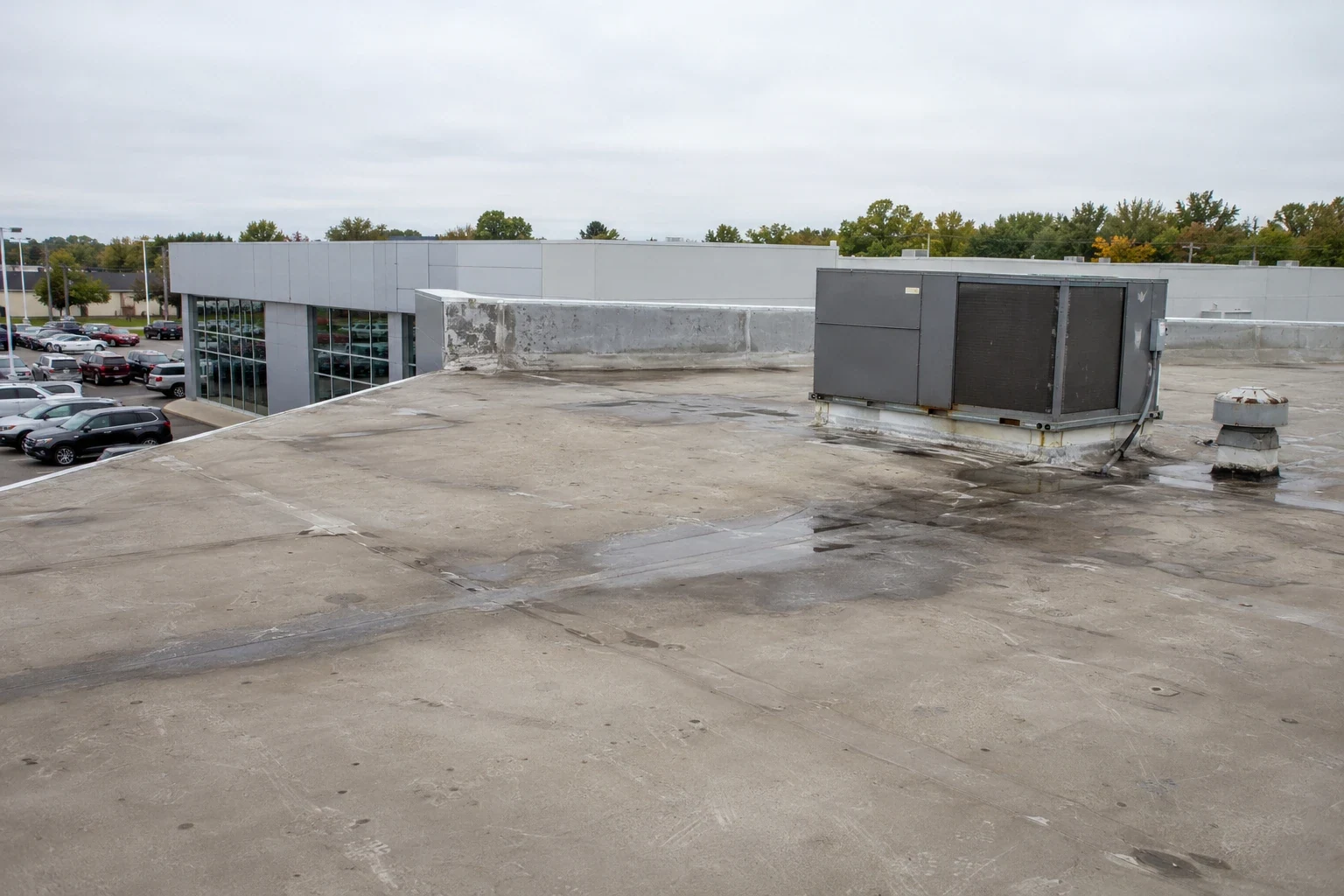
A single drop lands on the hood of a new sedan parked under the showroom lights, and the sales manager steps in front of the car before the next customer walks past. By the end of the morning the same drop has become three, and a service advisor is asking whether the parts counter ceiling is wet too. That is the usual way a dealership roof problem shows itself in South Bend, IN: in the one spot where it costs the most to ignore. Our first call sorts the building into zones, showroom, service, parts and lot, and protects the most expensive floor space first.
Moving the cars, then the water
The general manager or fixed operations director tells us where the water is and what is under it. If a vehicle sits below the drip, someone drives it to another bay while we are on the phone. A crew member goes to the interior to photograph the stain and read moisture along the ceiling and the top of the glass wall. Plastic and absorbent sheeting go down for the rest of the day. On the roof, we trace the water back through the showroom parapet, the canopy and the transition to the shop roof, then put a temporary dry-in over the opening. The photo log records the affected area, and the work zone is separated from vehicles in storage.
Glass walls, canopies and parapets
Showrooms are built for light, which means tall glass, a parapet that meets the curtainwall, and often a canopy over the delivery area. Each of those junctions is a flashing problem. Water that runs down the glass line can slip behind the sill and show up as a stain far from the glass. We examine the counterflashing where the roof meets the glass wall, the coping at the parapet, the scuppers that drain the canopy and any skylight or penetration in the shop roof. After a freeze-thaw week, with ice forming at the drains and snow sliding off the higher roof onto the lower, those details move, and a sealant bead that held in July can open by February.
What the service bays exhale
The roof above a service department takes a pounding that a retail roof does not. Exhaust fans push oil mist and solvent vapor onto the membrane, makeup air units sit on curbs that crews open for filter changes, and paint or body shop exhaust may discharge across a large area. Standard TPO can soften where grease collects. A PVC or KEE membrane is formulated to resist oils and fats, and we recommend one of them when exhaust lands on the roof. The curbs and flashings around each unit get proper attention, because a technician who leaves a panel off or a curb unsealed can create the next leak in an afternoon.
Hail on the lot and on the roof
A hailstorm that dents an inventory lot also bruises the roof, and the two claims move together. The June 1, 2019 storms produced hail up to 1.25 inches near Crumstown, one inch in South Bend and 0.7 inch in Mishawaka. Stones in that range can fracture a membrane over soft insulation without leaving anything visible from the ground. After a storm we walk the field looking for round marks, crushed board and bent vents, and photograph each find for the hail damage repair scope. The same photo set supports insurance claim assistance, so the roof claim and the vehicle claim describe the same date and storm without contradicting each other.
Working around sales hours
A dealership earns most on weekends, so a roof crew should not be above the showroom on a Saturday morning. We plan loud work for weekday mornings when traffic is lighter, keep the delivery area and the customer entrance clear, and stage equipment where it does not block the service drive or the lot. Staff receive a short notice listing the work dates, the noisy hours and the doors to use. When a section must be opened, it is closed again before dark with a temporary dry-in, so no vehicle sits under an open deck overnight. Sunday work is possible for sensitive areas with prior notice and a smaller crew.
The permanent roof and the brand's building
A dealership building may answer to the brand's facility standards as well as to the owner, so we coordinate the roof with whoever is handling the exterior and the signage. A dealer on one of the commercial routes through Mishawaka, such as U.S. 20 or State Road 933, or near the Grape Road corridor, competes for visibility, and a stained canopy shows. The permanent plan is chosen by roof condition, not by guess: a moisture survey tells us how much insulation is wet, and the answer points toward repair, recover or replacement. Owners who also manage a big box or a shopping center can fold the dealership into the same program, with permanent work scheduled after the thaw.
We mark customer parking, service-bay doors, and the crane route before tear-off begins. That drawing lets the manager move vehicles once, keep a clear path for deliveries, and tell sales staff which areas will change during the day. At closeout, the roof sketch shows the completed section and any area held for a later phase.
Commercial Roofing Questions
Hail dented the cars on the lot. Does the roof need to be looked at too?
Yes, and the sooner the better, because hail damage to a membrane often appears as a leak months later. We walk the field, probe suspect areas and photograph any fractures or crushed insulation. Having the roof assessed before the insurer's adjuster arrives keeps the vehicle claim and the building claim consistent, and a written report gives you something to compare against the adjuster's findings.
The showroom has glass on three sides. How do you keep dust and debris off the new inventory?
We stage work in sections and cover or move the vehicles nearest the area. Tear-off debris goes down a chute or a covered path into a container, never across the delivery lane. Where air intakes sit near the work, we agree on a temporary shutoff with your maintenance team. A staff member inspects the section at day's end, and a sweep of the roof perimeter finishes each shift.
Why is the membrane near the service bay exhaust soft and swollen?
Oil mist, solvent vapor and grease are likely the cause. Some single-ply membranes absorb those chemicals and soften around the discharge point. We check for sheet softness, lifted seams and discolored flashing, then compare the damage to where the exhaust lands. A PVC or KEE membrane in that zone resists the attack, and walkway pads and grease guards extend the life of whatever sheet is already there.
What does a dealership need on file for the insurer after a hail event?
Dates, photographs and a plain description of the damage are the core. Add the moisture readings, a diagram of where each impact was found, the repair scope and any temporary protection installed. If the roof also feeds a warranty claim, the manufacturer's paperwork belongs in the file. We build that set during the work so it exists the day the adjuster asks for it.
Can the work be scheduled on Sundays to protect sales days?
For sensitive sections it often can. A smaller crew, quieter methods and an early-day start let us finish a protected area before opening hours on Monday. Loud tear-off is kept on weekdays, when it disturbs the fewest customers, and we confirm any Sunday plan with you before it goes on the schedule. Tell us the sales calendar and we build around it.
Related Roof Work
- Skylight and Penetration Flashing
- PVC Roofing
- KEE Roofing
- Rooftop Equipment Curbs and Supports
- Hail Damage Roof Repair
- Roof Insurance Claim Assistance
- Grape Road in Mishawaka
- Big-Box Retail Roofing
- Shopping Center Roofing
Talk to Our Team
Tell us where the water is landing, what the roof is made of and when the building is easiest to reach.
Phone: 555-555-5555
Email: [email protected]