By half past five on a January morning, the first members have swiped in and a steady drip is already ticking onto the rubber flooring beside the treadmills. The front desk puts out cones, the manager looks up at the high ceiling and cannot see where the water starts, and a member asks whether the club is still open. A fitness facility in South Bend, IN has to answer that question quickly, because members arrive before the roof company does. Our first call starts with where the water lands, what electrical equipment is near it, and how to keep the floor safe while a crew heads to the roof.
The front desk call
The person calling is usually the manager or an opening staff member, so the questions are short. Which part of the floor, how high is the ceiling, and are treadmills, cable machines or lighting nearby. We advise moving equipment away from the drip and cordoning off wet rubber flooring, which gets slick. A crew member comes inside, photographs the ceiling and the stain, and takes moisture readings along the ceiling grid or the exposed deck. Then someone goes up to clear the drains and trace the path back. A temporary dry-in goes over the opening, and the manager gets a photo log before the evening rush, when the club is busiest.
Sweat, steam and the vapor in the ceiling
A fitness building makes its own weather. Hundreds of people breathing and sweating, showers, saunas and sometimes a pool push warm, damp air toward the ceiling every hour of the day. In a South Bend winter, with a freeze from October 18 to May 1 on average, that air meets a cold roof deck and condenses inside the insulation. The roof then looks sound from above and feels wet from below. An infrared moisture survey maps that wet insulation without cutting open the membrane, and a probe confirms it. If the vapor path is the cause, new roofing alone will not fix the drip, so we look at the ventilation and vapor retarder as part of the repair.
Rooftop units that never rest
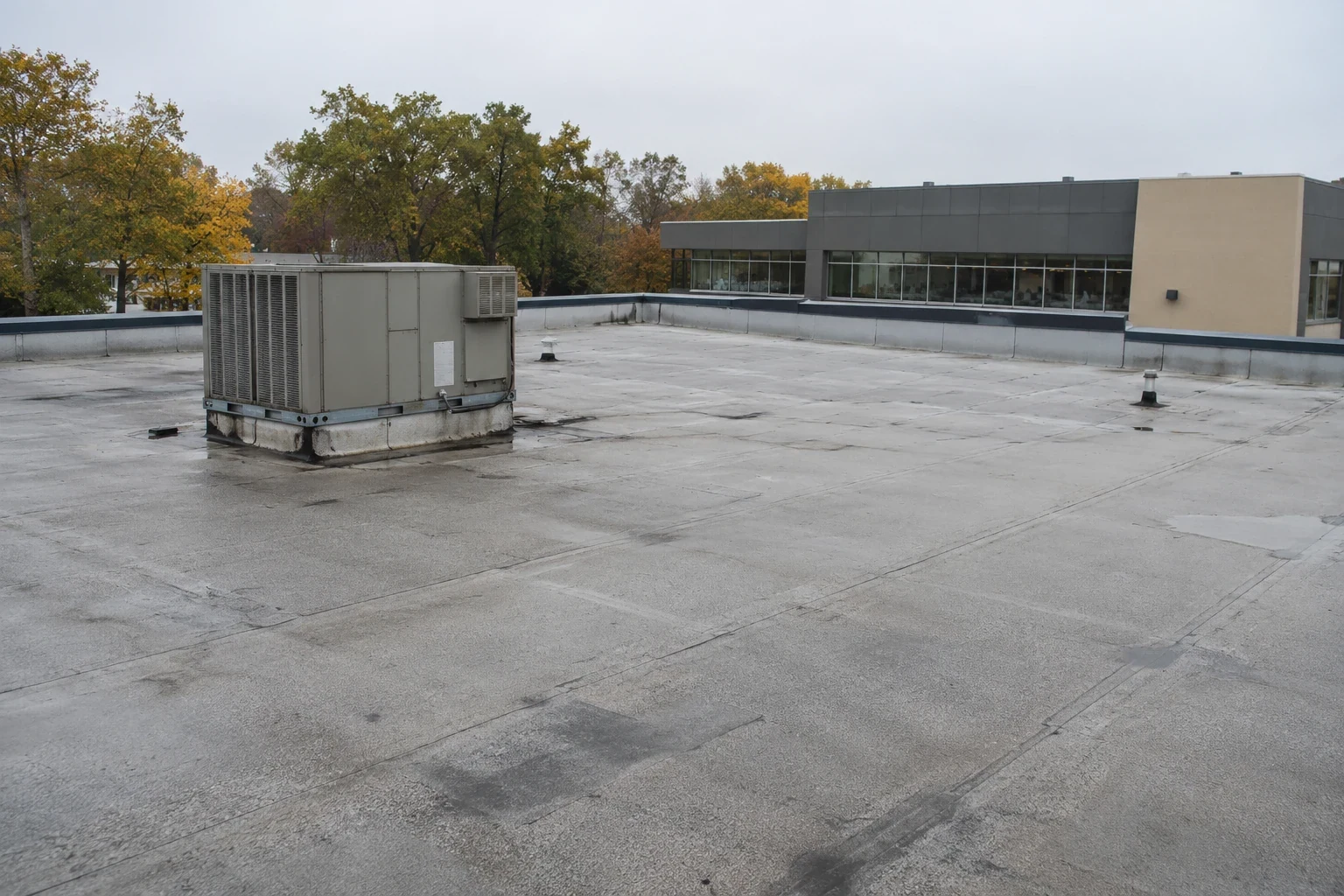
Gyms run hard on mechanical systems, and the equipment lives on the roof. Large rooftop units supply fresh air for people breathing hard, and many run through the night to hold temperature and humidity. That means more foot traffic from technicians, more vibration, more condensate lines and more places where a curb can lose its seal. Our work on rooftop equipment curbs and supports includes checking each curb flashing, the condensate discharge, the walkway pads where technicians step, and the refrigerant and electrical lines that cross the membrane. A technician who forgets to reseal a panel can create a leak in an afternoon, so we photograph each unit and keep the record.
Tall volumes beside low roofs
A gym floor, a racquetball court or a basketball court needs height, so fitness buildings often have one tall roof volume next to lower roofs for locker rooms, studios and the front desk. Those steps in the roofline collect snow drifts against the higher wall. The yearly average in South Bend is 64.5 inches of snow, and Mishawaka took 20.7 inches in the lake-effect storm of November 2022, and the airport took 22.7. A drift packed against a tall wall melts from the bottom, finds the counterflashing and runs behind the wall. We check the flashing at every roof step, the drains on the lower roof and the scuppers that carry water away from the club entrance, where ice is a hazard to members.
Telling members without losing them
A club lives on routine, so a roof project should disturb as little of it as possible. We schedule loud work for mid-morning and early afternoon, when the floor is quieter, and keep staging away from the entrance and the lot. A short notice for the front desk lists the work dates, the noisy hours and the areas to avoid, and a sign at the door tells members what is happening. If the building shares a plaza with a shopping center, neighboring tenants get the same notice. The front desk can post the affected entrance and room schedule while the manager keeps classes in unaffected areas. A recreation center that belongs to a school or a college follows the same notice habits, and its roof is handled like any other school roof or college campus building.
Fix the vapor path, then the membrane
The permanent plan begins with where the water comes from. A defect in the membrane calls for repair, while wet insulation from interior vapor may call for new insulation and cover board with a vapor retarder below it. Where a roof is nearing the end of its life and insulation is wet across a wide area, replacement is usually more durable than repeated patching. The work is phased so that one part of the club can stay open, and it is scheduled after the thaw so adhesives and sealants cure well. Whether a club is near Granger or the Grape Road corridor, roof steps and crowded rooftop equipment deserve a post-thaw check before repairs are prioritized.
Commercial Roofing Questions
The ceiling over the locker rooms keeps dripping, but the roof looks fine. Is it a leak?
Possibly not. Warm, humid air from showers rises, meets a cold deck and condenses, and the drops look just like a roof leak. We compare the timing of the drips with rain and meltwater, and we survey the roof with infrared and probe for wet insulation. If the moisture is interior, the fix is better ventilation or a vapor retarder rather than a new membrane.
Our members train from five in the morning. Can the roof work happen without closing the club?
In most cases the club can stay open. We work in sections, keep equipment away from entrances and set the loud work for the hours when the floor is quietest. If a section is directly over a studio or a court, that room can close for the day and reopen with a notice. Tell us the quiet hours and the schedule follows them.
How loud is rooftop work over a yoga or spin studio?
Tear-off and fastening are the loudest steps, and they carry through a metal deck. We schedule those for times when the studio is empty or between classes, and use quieter methods near sensitive rooms. Roof inspections, moisture surveys and sealant repairs are quiet enough to run during most classes. We ask for the class schedule so the daily plan reflects it.
What should the manager do when water hits a treadmill or a weight rack?
Stop the equipment, unplug it if it is safe to do so, and move members away from the wet floor. Put out cones and cover rubber flooring that has become slick. Photograph the water, the ceiling and the equipment, and call us with the location. We will walk through what to shut off and what to leave until we are on site.
Do rooftop units need their own curb inspection?
A fitness-building inspection should include every curb, especially where units run through the night and vibration works on the flashing. We check the flashing, the sealant, the condensate discharge, the lines that cross the membrane and the walkway pad beneath each access panel. Any curb that shows cracked sealant or ponding at its base gets repaired before winter, and the photo log shows what was done.
Related Roof Work
Talk to Our Team
Tell us where the water is landing, what the roof is made of and when the building is easiest to reach.
Phone: 555-555-5555
Email: [email protected]